Schools
Monroe Volunteer Firefighters Teach Fire Safety to Fawn Hollow Students
Firefighters are making presentations throughout the town during Fire Safety Month and Fire Prevention Week.


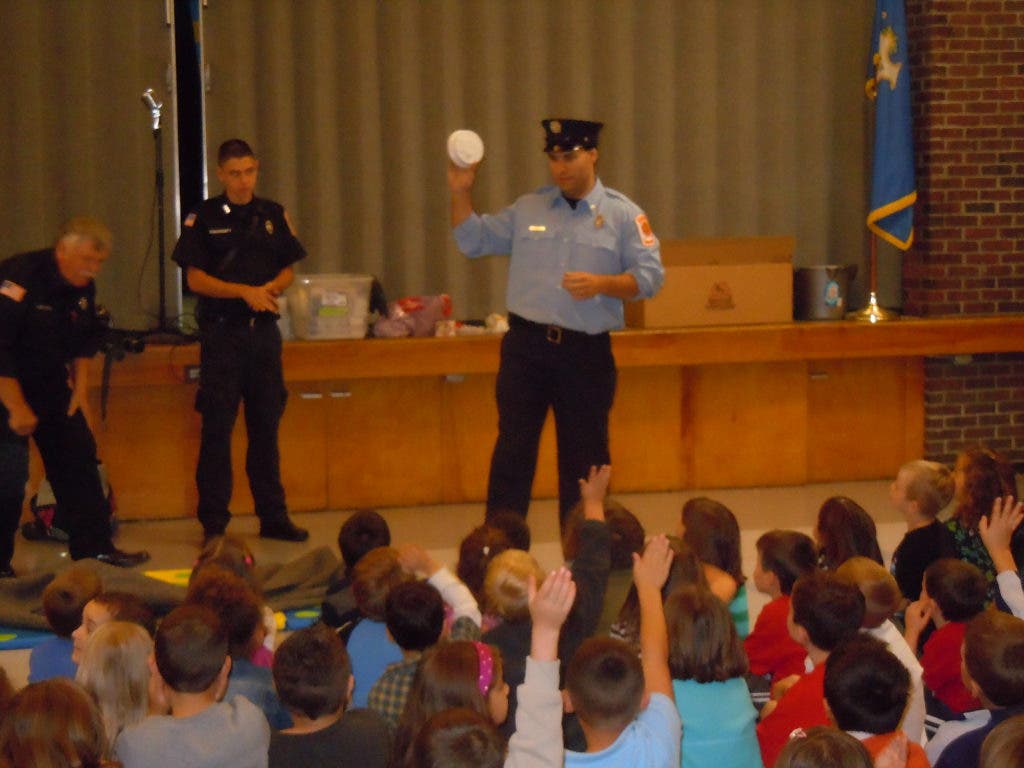


Monroe Volunteer Firefighter Kevin Catalano asked a large audience of first grade students and kindergarteners gathered in the Fawn Hollow Elementary School auditorium Monday morning if they know what happens during the month of October.
"Halloween!" a few children shouted. But then Catalano told them October is Fire Safety Month and that this week is also Fire Prevention Week.
"You guys think about pumpkins, candy and rolling in the leaves and we think of smoke detectors and other stuff," Catalano said.
Find out what's happening in Monroefor free with the latest updates from Patch.
He teamed up with fellow firefighters Jon Krchnavy and Jim Eastwood, who is also a retired firefighter for the town of Fairfield, to teach children fire safety tips for two sessions at Fawn Hollow. They also planned to make presentations at Monroe Elementary School and at three daycare centers in town.
Stepney Volunteer firefighters also did a program at Stepney Elementary School on Monday.
Find out what's happening in Monroefor free with the latest updates from Patch.
At Fawn Hollow, children watched a presentation on fire safety and practiced how to stop, drop and roll on a mat before Eastwood awarded them with stickers. Students also received plastic kids' fire helmets and coloring books before climbing aboard a fire engine outside.
Firefighter Jim Wakes Up to Smoke
Eastwood wrapped himself up in a blanket and laid on a mat and Catalano pressed the button of a smoke detector to make it beep. Eastwood pretended to wake up. "What should I do?" he asked. "Should I get up?"
Eastwood told his young audience that one should stay low when there is smoke. He crawled to the double doors on the side of the auditorium as if it was his bedroom door. "Should I open the door?" he asked.
Eastwood then showed them how they should first feel the door to see if there is heat. If it is hot, he should keep it closed. If not, then it is safe to open it.
Catalano held up a toy fire engine. "It needs to have batteries in it or it doesn't work," he said. Then he picked up a smoke detector, "This needs batteries in it or it doesn't work [either]."
"What does it do?" Eastwood asked of the smoke detector, before answering, "It keeps you ..."
"Safe!" the children called out, finishing his sentence.
Krchnavy told them how to call 9-1-1 to get help in an emergency.
"You use it when you're hurt or if your mom or dad need help," Krchnavy said. "These are very important numbers 9, 1, 1."
But Catalano stressed that people should only call 9-1-1 when they really need help from an ambulance, police or firefighters.
"There's smoke and you can't find your mom and dad. Do you call 9-1-1?" Catalano asked.
"Yes!" his audience answered.
"You can't find your favorite toy. Do you call 9-1-1?"
"No!"
Eastwood picked up two candles. "Is this a toy?"
"No!"
"And if it falls on the floor, what do you do? Call 9-1-1!" Eastwood said.
Catalano held up a lighter. "Is this something you play with?"
"No!"
"Let the adults touch that," Catalano said. "The closest you should come to flames in your house is when you blow out the candles on your birthday cake."
Being Prepared
Catalano told the children they should keep a flashlight next to their bed in case there is an emergency.
"It's pretty unusual to have a fire," he said. "We just want you to be ready in case it happens."
When a fire spreads in a home, Catalano said many children's first instincts are to hide in their closet or under their bed.
"Don't hide under your bed," Eastwood said.
"People need to be able to find you," Catalano added.
The firefighters told the children they should talk to their families to make sure there is a common place outside for them to meet if there is a fire. Catalano said there are cases when one family member leaves the house through the front door and another escapes out the back — and both think the other is still inside.
"Never run into the house for a pet or a toy," Eastwood warned. "That's our job."
Krchnavy put on fire gear, which included fire proof boots, pants, a coat and a hood, a helmet and an air tank. Eastwood said it is this protection that allows firefighters to go into a burning house.
"This is called an air pack," Eastwood said of the tank. "It will help him breathe when there is smoke. A bell rings when he runs out of air and is in trouble, so we can find him."
"You hear that?" Catalano said of the sound of Krchnavy breathing inside his oxygen mask. "It sounds like Darth Vader doesn't it?"
Of course, not all fires occur inside a building.
Eastwood said, "You're outside at a barbeque and your pants catch on fire. What do you do?"
"Stop, drop and roll!" the children called out.
Eastwood then used the mat to show them how to cover your face and roll, before they took a turn.
Eastwood held up yellow caution tape that said: "Fire line do not cross." "What does this mean?" he asked, before telling them the answer, "No. No. Don't go!"
He had his audience repeat the phrase.
After the early morning session, both Eastwood and Catalano said this training has been effective.
"We've had some god awful fires," Eastwood said.
"And the injuries have been close to non existent," Catalano added.
Get more local news delivered straight to your inbox. Sign up for free Patch newsletters and alerts.