Business & Tech
I'll Take My Drugs as Lollipops and Gummies, Hold the Applesauce
Compounding pharmacies produce specialized strengths, doses and combinations of drugs, as well as making it into forms that are easier to ingest.




A smoker stuck on a 20-hour flight can suck on a nicotine lollipop to get through the trip. Medication can be taken as a gummy bear to make it more palatable. A senior citizen's medications can be combined to make it easier to keep track of daily doses.
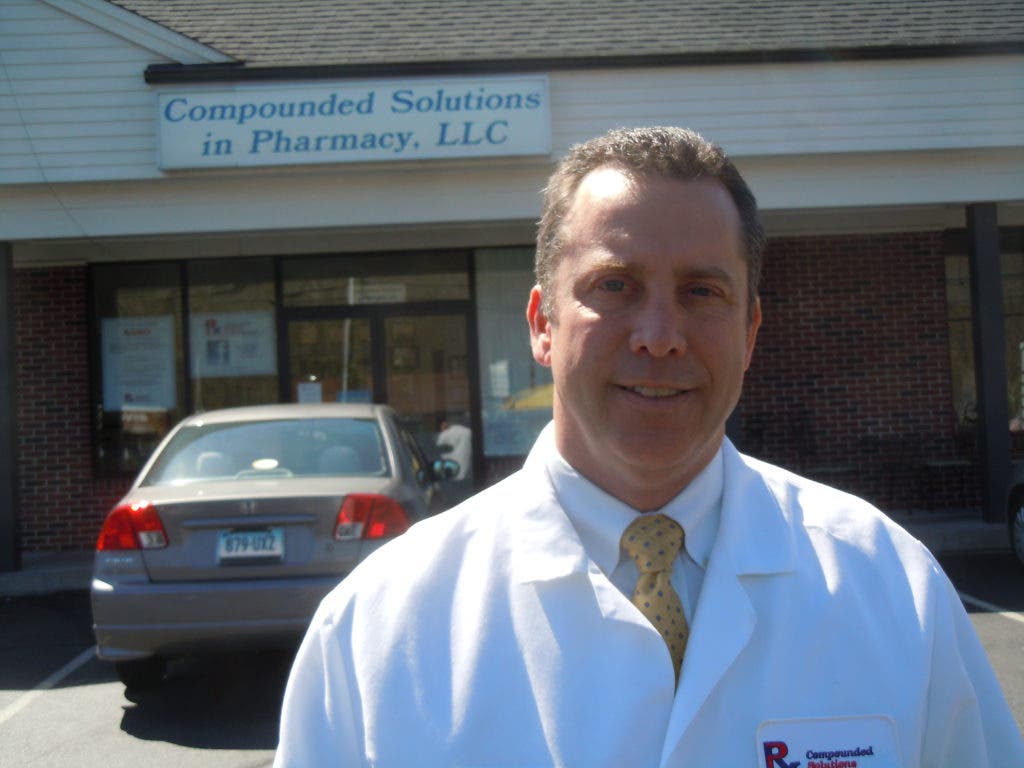
"These are the kinds of problems we solve here," said Michael Roberge, R.PH, of Fairfield, who owns Compounded Solutions in Pharmacy, LLC.
The office is across from Monroe Car Wash on Main Street in Monroe.
Find out what's happening in Monroefor free with the latest updates from Patch.
On Friday afternoon, Roberge wore a blue mask, a hairnet and rubber gloves while producing Versed, an anesthesia used for one-day surgeries. The sterile room he worked in filters and circulates the air 100 times per hour.
"This is where we make eye drops, nasal spray and injectable products," he said.
Find out what's happening in Monroefor free with the latest updates from Patch.
The air is sucked into vents near the floor, cleaned in the ceiling ducts and blown down into the room again. The same thing occurs on a smaller scale inside the sterile hood where Roberge mixes compounds.
Only his hands and arms enter the hood beneath a clear plastic window guard. Roberge, seated on a stool, taps his foot on a pedal on the floor everytime he needs to fills a small vial with liquid.
Just behind the pharmacy's front counter, Janis Covey filled capsules with a white powder placebo for a research study.
Roberge started Compounded Solutions 13 years ago. Prior to that, he worked as a pharmacist at Brooks Drug Store in Monroe for four years, before it was acquired by Rite-Aid.
"I've been in Monroe for almost 18 years," said Roberge.
He grew up in Massachusetts and earned a bachelor's degree in pharmacy from the University of Rhode Island.
Filling a Need
The purpose of compounding is to provide different strength doses of a drug for clients and to produce unique combinations of drugs.
Companies that mass produce a drug only do so in a certain number of strengths and doses, but one size doesn't fit all, according to Roberge.
"It costs a lot of money to manufacture products. They have to make a lot of them to support a manufacturing line," he explained. "If there were 100 different strengths, there would have to be 100 different production lines. That's not cost effective for them."
When solutions made by compounding pharmacies become popular, such as a nicotine lollipop or a vitamin gummy, Roberge said manufacturers will often mass produce it.
All pharmacists are trained to do compounding, according to Roberge. However, most pharmacies dedicate a significant amount of space to retail, and compounding requires more counter space and room for specialized equipment, he said.
It was while working at Brooks that Roberge noticed a tremendous need for compounding.
"I had a number of people coming to me with compounds and I did the best I could with the space and equipment I had," he recalled. "I decided to start my own business."
In the United States, Roberge estimates that there are between 300 and 400 pharmacies whose primary business is compounding.
"We could definitely stand to have more," he said. "It's just one of the things that hasn't caught on with public awareness."
Roberge attributes the small number of compounding pharmacies to the amount of effort, research and hours that must be dedicated to get such a specialized business off the ground.
"You have to be entrepreneurial, a little daring and put in all the hours," he said. "I started with nothing here — zero."
Compounded Solutions now has over 5,000 doctors in its system and approximately 25,000 patients throughout the country, according to Roberge. It has 10 part-time employees. The pharmacy's business comes through referrals.
The pharmacy is affilliated with several national compounding organizations.
A Tsunami Hits Japan
Compounding pharmacies have the raw materials to produce drugs that are taken off the market — such as Midrin for migraines — and to step up when there are shortages.
When the tsunami caused a disaster at the Fukushima nuclear plant in Japan many people worried about exposure to radiation and a drug shortage of potassium iodide ensued. The drug protects the human thyroid gland from radioactive iodine emitted in reactor accidents.
Though the finished product was selling out fast, Roberge and other compounding pharmacists were able to obtain the bulk powder required to produce potassium iodide.
"We were able to send it to patients in California," he recalled.
No More Applesauce
A compounding pharmacist can produce a drug mixture or spray without an ingredient a patient is allergic too, as well as produce the drug in forms that are easier to ingest.
A woman had come to Compounding Solutions for help when her mother, who was in her 80's, suffered from the latter problem.
"Her daughter thought she was at the end of her life cycle because she couldn't take her pills," Roberge said. "She had to crush her pills and mix it with applesauce and couldn't take all of them, because she'd get full with all the applesauce. We made it into a liquid, so it was more convenient with less volume. She's been doing great."
For information, visit Compounding Solutions' website or call the pharmacy at 877-RX NEEDS.
Get more local news delivered straight to your inbox. Sign up for free Patch newsletters and alerts.