Schools
Specialist Unravels Process of Applying to College
Expert Tony Luther will repeat last night's informative College Planning Workshop on Saturday, Sept. 17, at 2 p.m. at the Edith Wheeler Memorial Library.
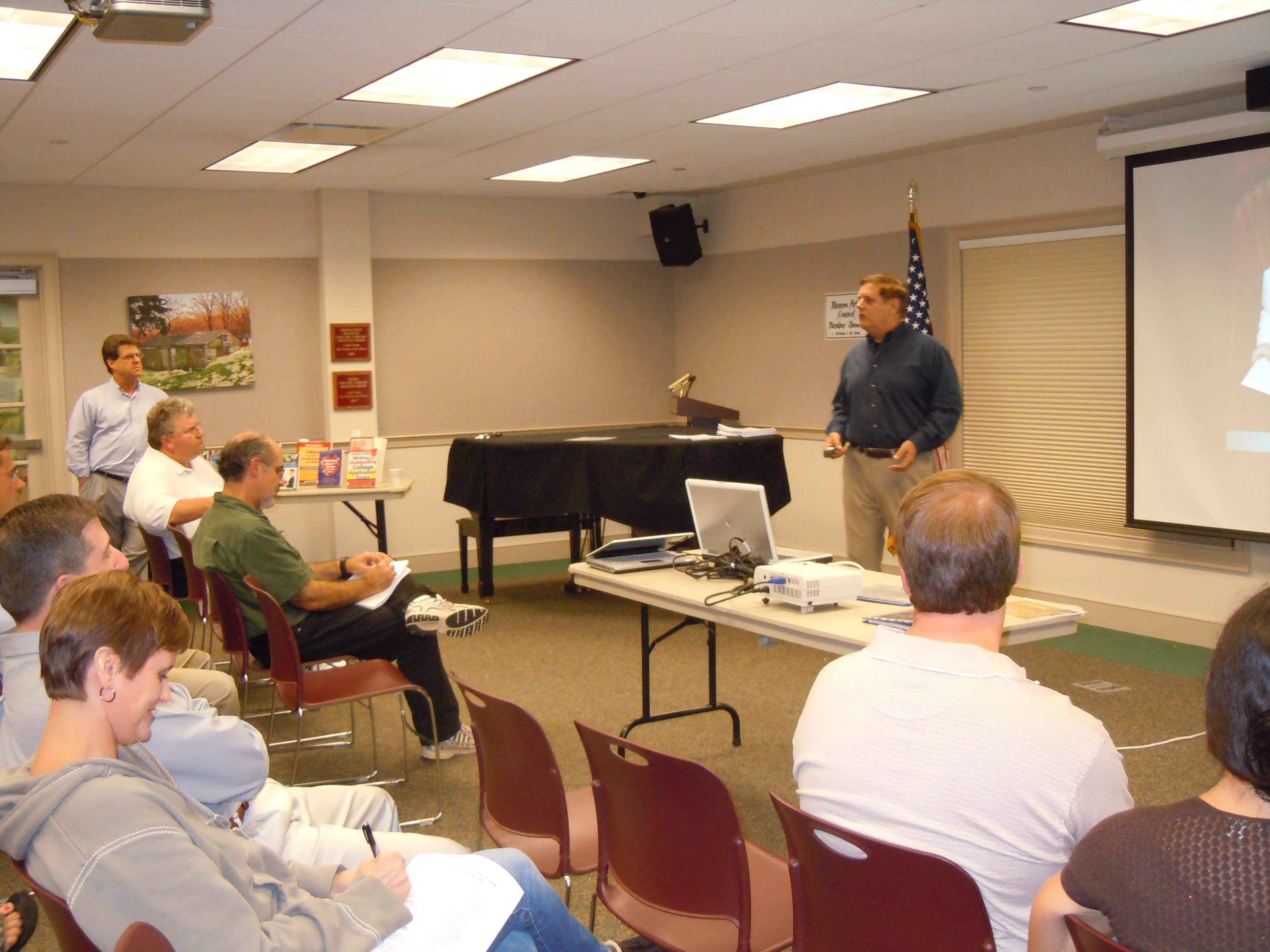
Universities and colleges are businesses that select incoming students based on where they live, whether they have parents and grandparents who are alumni, their ability to pay full tuition costs — which is about $50,000 in the Northeast — and, yes, their grade point average, SAT and ACT test scores and high school extracurricular activities. This is a sample of some of the insights provided by expert Tony Luther at last night's College Planning Workshop, which was sponsored by the Edith Wheeler Memorial Library.
"They're a big business and they're there to make money," said Luther, a college planning specialist who spoke for more than two hours last night at the library. "They do a lot of marketing to children."
Luther encouraged the audience of 30-plus adults and a few teens to visit colleges they're interested in applying to. Most importantly, he emphasized the need to start the college planning process early. Ideally, young people should have their college essay completed and have received the highest scores on their SAT or ACT by the end of their junior year of high school.
Find out what's happening in Monroefor free with the latest updates from Patch.
During the summer between junior and senior year, Luther suggests that families visit colleges and audit classes. The more you do to show that you are interested in a school, the stronger the odds of getting admitted, Luther said.
"Go for an interview, even if it's not required," Luther said. "They want to see if you fit into their school and if you really want to go there."
Find out what's happening in Monroefor free with the latest updates from Patch.
It's critical for students to choose the right college to attend. Transfer students lose valuable scholarships and the time and tuition invested in the first school they attend.
Luther strongly urged parents and teens to do a thorough search early on in their high school years so that they have time to explore a variety of possibilities. Highly competitive and "popular" colleges are less likely to offer "free" money, which is the kind of financial aid package families are looking to obtain, he added.
While scholarships from local organizations are generous, colleges will deduct this amount (usually the award is a one-time only $1,000 scholarship) from their scholarship monies. "The money that you're looking for is the money that comes directly from the colleges because this is typically for all four years," Luther said.
Luther pointed out that teens often base their college choices on where their boyfriend/girlfriend is going to school, proximity to the beach, sports teams and reputation as a "party" school. "Instead, students should pick their school based on what their intended major is and what the school offers," Luther said.
Many times families overlook local schools — such as the University of Bridgeport and Sacred Heart University — simply because they are located "too close to home." However, he offered the example of a client who was looking for a college where she could participate in gymnastics and major in holistic medicine. It turned out that the University of Bridgeport, with high-ranking gymnastics and world-renowned holistic health departments (including stellar chiropractor and dental hygiene programs), was her best choice.
He also pointed out that Sacred Heart University has one of the best programs for people wanting to study occupational therapy.
However, Luther also encouraged families to open their college search to schools outside of the Northeast because these schools are looking to create geographical diversity in their incoming freshman class. Luther said students from the Northeast are more likely to not only be accepted, but also to receive good financial packages from schools in the south and Midwest. Luther added, "Midwestern schools will buy your Connecticut accent."
Monroe parent Bridget Nossek said the College Planning Workshop "opened her eyes" to several different aspects of the process that she hadn't thought of before. "It was definitely informative and gave us a lot to think about," Nossek said.
Laurie Champagne, a mother of two high school students — a sophomore and a junior — said she was going to share what she learned with her children. "I heard that it's really important to choose a school based on where you're going to get the best education," Champagne said.
She recently changed careers and is presently attending school to become a nurse. Having recently navigated the application process for financial aid, Champagne said, "It wasn't too difficult."
Luther, who has worked in the accounting and financial planning fields, emphasized the need to apply for all federal and college financial aid, even if you think you might not qualify. Meeting every deadline is critical, too.
"If you miss a deadline, you could miss out on a lot of money," Luther added.
For those who could not make last night's program, Luther will be repeating the College Planning Workshop on Saturday, Sept. 17, at 2 p.m. Registration is suggested. Refreshments are offered.
Lorna Rhyins, Edith Wheeler Memorial Library's Adult/Teen Services Librarian, has created a comprehensive display of college search books and resources that are available on the public.
For more information, go to ewml.org.