Neighbor News
WDS Museum Opens Season With Two New Exhibitions Focused on Women
Webb Deane Stevens Museum Opens Dual Exhibitions Honoring Women of the American Revolution—and the Girls Who Stitched Its Memory


The Webb Deane Stevens Museum Announces Two New Exhibitions for Public Opening on May 1
Webb Deane Stevens Museum Opens Dual Exhibitions Honoring Women of the American Revolution—and the Girls Who Stitched Its Memory
Webb Deane Stevens Museum, Wethersfield, CT
Find out what's happening in Naugatuckfor free with the latest updates from Patch.
WETHERSFIELD, CT, April 2, 2026
On May 1, 2026, the Webb Deane Stevens Museum opens its doors to two new exhibitions that, together, mark a first in the museum's history: the entire exhibition space is dedicated to women.
Find out what's happening in Naugatuckfor free with the latest updates from Patch.
In a place best known for the 1781 meeting between George Washington and the Comte de Rochambeau that set the stage for the Yorktown campaign—and for the lives of Silas Deane, America's first diplomat, and Wallace Nutting, progenitor of the Colonial Revival movement—that is no small thing.
The exhibitions are Remember the Ladies: Women of the Revolution, curated by TR Revella-Hamilton, Director of Preservation & Collections, and American Girlhood: Needlework, Memory, and the Making of a Nation, guest-curated by Emily Whitted, a scholar specializing in early American material culture and textiles.
The first is an exhibition of portraiture ranging from WDS’s own Elizabeth Saltonstall Deane to a rendering of Margaret Beekman Livingston by Gilbert Stuart. The second showcases needlework made by schoolgirls during the early years of American nationhood and elevated to collectible status in the early-twentieth century. The two exhibitions speak a common language about women whose activities and influence during the early years of American nationhood may come as a surprise to visitors who thought they knew the story of our country’s founding.
EXHIBITIONS ON VIEW
NEW | Remember the Ladies: Women of the Revolution
Abigail Adams' famous charge to her husband—“remember the ladies”—was equal parts plea and warning. In the decades surrounding the American Revolution, women of means occupied a peculiar position: they were educated enough to understand the politics of the age, well-connected enough to influence them, but often acted outside of the formal structures of government and business. The Webb Deane Stevens Museum has mounted an exhibition of their portraits as a window into the fascinating roles they played, some of which were hugely consequential for the Patriot cause.
Remember the Ladies offers a rare look at women who were there, who mattered, and who are worth celebrating today. This is a more complicated picture of the Revolution than many of us were taught—and one that includes Patriots and Loyalists alike. The common thread is not which side they supported, but the ways in which each of these ladies used the position she occupied to effect remarkable change.
Works that have hung in private halls, family collections, and museum galleries are gathered in the same room. During their own lifetimes, some of these women knew each other's worlds and moved through overlapping social circles. They also experienced some of the same threats to their ways of life as a result of the Revolution, and some of the same losses of property and loved ones. Brought together, their individual stories illuminate one another in ways no single portrait can accomplish alone. The result is something greater than the sum of its parts: a universe of women who were indispensable to the creation of the United States of America.
Betty Washington Lewis, George Washington's sister, was a formidable patriot in her own right. She is represented by a c.1757 portrait believed to be a reduced copy by John Wollaston of the larger portrait still on view at Kenmore, and on loan from the George Washington Foundation, Fredericksburg, Virginia. Margaret Beekman Livingston, matriarch of one of New York's most powerful political families and a tireless supporter of the Continental cause, appears in a celebrated 1794 portrait by Gilbert Stuart, on loan from Bard College's Montgomery Place Collection. An 18th-century engraving of Queen Charlotte after William Beechey, on loan from a private collection, brings the loyalist world into the room—a queen who became, in her own words, "political despite myself," absorbed by a war that would determine the fate of the empire she steadied from behind the throne.
Grace Sexias Nathan, a prominent figure in Philadelphia's Sephardic Jewish community and a woman of keen intellect and wide correspondence, is represented by a portrait by Henry Inman, on loan from the American Jewish Historical Society, New York. And Elizabeth Bancker Webb—painted by John Durand, on loan from the Shelburne Museum, Shelburne, Vermont—carries a quietly resonant connection to the museum itself: she was the wife of Colonel Samuel Blachley Webb, who was born and resided in the Webb House well into the Revolution. These women knew each other's worlds. This exhibition puts them back in the same room.
The exhibition also features Elizabeth Saltonstall Deane, whose 1762 portrait by Joseph Blackburn is part of the WDS permanent collection. Granddaughter of Connecticut Governor Gurdon Saltonstall and great-granddaughter of Governor John Winthrop, she organized the women of Wethersfield to produce supplies for General Israel Putnam's army while her husband negotiated the French alliance in Paris—helping cement Connecticut's role as the "Provision State." She died in 1777 at thirty-four, never knowing the outcome of the war she had quietly helped sustain.
Remember the Ladies is a moment to reflect on the important impact women have played in the founding of the nation. We have gathered a small but diverse collection of portraiture that is intended to literally put faces to names that are often glazed over in history. All of the women in the room were connected by the American Revolution, including the women who commemorated the Revolution in later periods. Their stories are powerful and extraordinary but at their core exceedingly human. TR Revella-Hamilton, Director of Preservation & Collections, Webb Deane Stevens Museum
NEW | American Girlhood: Needlework, Memory, and the Making of a Nation
The needlework stitched by young hands in the new nation took various forms: alphabets, genealogical records, memorials to the departed, and pictures ranging from the simple to the spectacular. Each is a declaration of skill and identity, often revealing glimpses of the stitcher’s surroundings, cultural touchpoints, and sometimes even her political sentiments. The exhibition is guest-curated by Emily Whitted, a scholar of early American material culture and textiles, with collaboration from the preeminent dealers Carol and Stephen Huber.
American Girlhood brings together an exceptional assembly of needlework from the late eighteenth through mid-nineteenth centuries, drawn from museum collections and private hands across the country. It is an exhibition about what girls were taught and what they managed to say, within and beyond those lessons. Some of the works on view have rarely or never before been exhibited publicly.
Samplers confirmed to be by Black and Indigenous girls are among the show’s rarer pieces, not because these girls never engaged in needlework but because unidentified makers of samplers are often presumed to be white. Many girls of color were educated, and needlework was practiced across lines of race and class in ways that defy any tidy narrative. While less prevalent, samplers made by them do survive, and they are remarkable when we can attribute them to the girls who stitched them.
There are multiple ways—and many mediums—to connect to the founding of the United States, but needlework has proven a consistently enduring form. As both educational and artistic expressions, they were powerful forms of self-fashioning for early American girls and women at their making and live on to shape our collective memory of who is remembered from our Revolutionary past. This exhibition will offer visitors unique access to look closely at multiple threads of early American girlhood and consider the roles early American needlework plays in our national consciousness in 2026.—Emily Whitted, Guest Curator
Also woven throughout the exhibition is a second, quieter story: the generations of collectors, preservationists, educators, and institution-builders who had the foresight to recognize these objects as history worth keeping. Their stewardship is itself a form of authorship. Without the collectors, including many members of the National Society of the Colonial Dames of America, who pulled these works from attics and auction rooms and family trunks, there would be no story to tell about American needlework. They are part of the exhibition's subject as much as the girls who held the needles.
Highlights from the Checklist
Among the exhibition's most significant works from private collections:
Marcy Hay’s Sampler (Charlestown, MA, c. 1777) stitched just outside Boston in the aftermath of its violent occupation by British forces during the American Revolution.
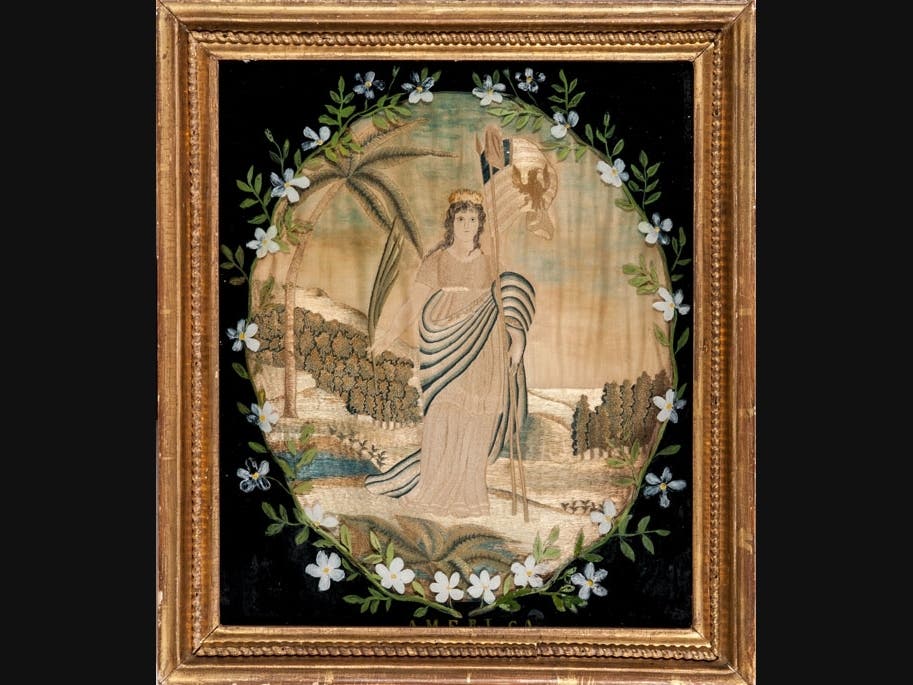
A silk embroidery by Hannah P. Badger (Atkinson, New Hampshire, 1811) depicting America as the Goddess of Liberty with a liberty cap and American flag waving in the breeze.
An early silk embroidery stitched by Phebe Carlton (Andover, MA c. 1790) depicting her family’s home, which was passed down in her family for generations after her death at age 27.
From public collections, significant works include:
Celia Talcott’s Sampler (Wethersfield, CT, c. 1818), a spectacular local piece of needlework reflective of the rich educational opportunities available to girls in the Connecticut River Valley and the design influences that instructors could inspire, from the Webb Deane Stevens Museum’s own collection.
A sampler stitched by Christeen Baker (Choctaw Mission School, Mayhew, Mississippi, 1830), on loan from the Pittsford Historical Society. Christeen was a Choctaw girl who stitched samplers as part of her educational experience at a mission school in Mississippi which had economic entanglements with New England.
A richly detailed sampler made by Lydia Church (New Haven, CT, 1791), on loan from the Connecticut Museum of Culture and History. Lydia attended Mrs. Mansfield’s School in New Haven and rendered this sampler full of personality when she was thirteen years old.
Jerusha Pitkin / Pitkin Family Coat of Arms (CT, Hartford, c. 1750–1755) represents one of the earliest works in the exhibition, and one of the most unusual in format. An unfinished heraldic coat of arms worked in silk is a rare in-process work, demonstrating layers of multi-generational collaboration on a single-family heirloom across two centuries.
The geographic breadth of the checklist also ensures this is not a New England story in isolation. Works from Westtown School in Pennsylvania, as well as the Museum of Early Southern Decorative Arts, give texture to often overlapping geographies of early American girlhood. A sampler by Mary Willis Daingerfield of Spotsylvania County, Virginia (1795–1800), from MESDA’s collection is an exciting crossover piece between these two exhibitions, with familial ties to portraits on display in Remember the Ladies.
A Moment for the Needlework
These exhibitions open during a season of renewed national attention to early American needlework. 2026 brings sister exhibitions at institutions including the American Folk Art Museum (Locating Girlhood: Place and Identity in Early American “Schoolgirl” Art, opening October 2026), the Shelburne Museum in Vermont (On Point: Needlework from the Garthwaite Family Collection, May–October 2026), and the de Young Museum in San Francisco (Embroidered Histories, through May 2026). The Metropolitan Museum of Art's ongoing A Century of Massachusetts Samplers continues through June 2026.
That so many institutions are turning their attention to this art form at once is not coincidence. It is a reckoning. For too long, the sampler has been dismissed as domestic, feminine, minor—precisely the qualities that once marked it as beneath scholarly attention, and that now make it essential. American Girlhood is proud to be part of this moment, and proud of the company it keeps.
From the Executive Director
These exhibitions fulfill the vision of our new Holcombe Education Center, bringing important objects from around the country into dialogue with our own collections. The hope is for visitors to leave with new ways of seeing familiar pieces of the American cultural landscape. It gives us particular pleasure to focus on women’s experiences during the 250th because the Webb Deane Stevens Museum owes its existence to the ladies of the National Society of The Colonial Dames of America, who led the way in preservation and collecting during the early twentieth century. Our galleries this year invite people to imagine the experiences of many different women, at many stages of life, who shaped the American nation over multiple generations.—Brenton Grom, Executive Director, Webb Deane Stevens Museum
PUBLIC PROGRAMMING
Remember the Ladies and American Girlhood are accompanied by a wide array of on-site and virtual programs designed to enhance and deepen the exhibition’s emerging themes, and our experience of America 250 years after the signing of the Declaration of Independence.
LECTURE | 250 America's Tapestry: Fiber Arts & The Revolution
Thursday, Apr 9, 7:00 PM
Discover how a sweeping community embroidery project is stitching together lesser-known stories from the American Revolution in time for the nation's 250th anniversary.
Tickets: $15 | $12.50 Virtual | $10 Members
*This lecture will be offered in person and via Zoom.
LECTURE | 250 The Art of Collecting
Thursday, May 14, 7:00 PM
Textile historian Ned Lazaro explores the fascinating and very human impulse behind collecting early American schoolgirl samplers—and what these rescued objects reveal about who we are. Lazaro is the Associate Curator of Costume & Textile at the Wadsworth Atheneum.
Tickets: $15 | $12.50 Virtual | $10 Members
*This lecture will be offered in person and via Zoom.
Special Event | 250 Wethersfield 250 Jubilee: Revolutionary War Encampment & Traditional Trades Fair
Saturday, May 23, 2026, 10:00 AM-4:00 PM
Musket fire, master craftsmen, open-hearth cooking, and Colonial games collide in this free, all-day celebration of America's 250th anniversary on the museum grounds.
FREE
LECTURE | 250 Civic Stitches: Early American Needlework and National Identity
Thursday, Sep 10, 6:00 PM
Guest curator Emily Whitted reveals how schoolgirl needlework was far more than a domestic skill—it was the space where young women in the early republic stitched their civic identities into silk and linen.
Tickets: $15 | $12.50 Virtual | $10 Members
*This lecture will be offered in person and via Zoom.
LECTURE | 250 Women of the Revolution with Zara Anishanslin
Thursday, Oct 1, 7:00 PM
Historian Zara Anishanslin introduces the women who rallied communities, supplied armies, and exposed the deepest contradictions of the new nation—stories of courage that have waited far too long to be told.
Tickets: $15 | $12.50 Virtual | $10 Members
*This lecture will be offered in person and via Zoom.
Visit wdsmuseum.org/events for a full list of programs and events.
About the Curators
TR Revella-Hamilton is the Director of Preservation & Collections at the Webb Deane Stevens Museum.
Emily Whitted is a scholar specializing in early American material culture and textiles. She serves as guest curator for American Girlhood and brings deep expertise in the history of girlhood, education, and needlework traditions across regional and community lines.
Support
American Girlhood: Needlework, Memory, and the Making of a Nation is supported in part by a planning grant from Connecticut Humanities. Additional support provided by private individuals. Programming associated with both exhibitions is supported, in part, by the Sue B. Hart Foundation.
HISTORIC HOUSE TOURS: Four Houses, One American Story
Our campus at the center of Connecticut’s oldest and largest historic district interprets three National Historic Landmark and National Register houses and their outbuildings, acquired between 1919 and the 1950s by The National Society of The Colonial Dames of America in The State of Connecticut, and one National Historic Landmark owned by Connecticut Landmarks. Together these houses represent a series of significant milestones in the military, political, social, and economic history that saw America’s transformation from a series of colonies into a concerted nation.
The 1752 Joseph Webb, Sr., House hosted the pivotal 1781 Wethersfield Conference where Washington and Rochambeau planned the Yorktown campaign that would help win American independence.
The circa-1770 Silas Deane House was home to America's first foreign diplomat, whose efforts secured crucial French support during the Revolutionary War. Deane's subsequent downfall through false accusations provides insight into early American political discourse.
The 1789 Isaac Stevens House illustrates the "radicalism of the American Revolution," showing how a leatherworker could rise to become a bank proprietor, embodying the new social mobility of the early republic.
The 1711 Buttolph-Williams House, shown to the public on behalf of Connecticut Landmarks, whose restoration with leading architects and decorators in the 1950s inspired the setting of the Newbery-winning novel The Witch of Blackbird Pond.
Together, these interconnected places tell a multidimensional story of the uncertain decades that gave birth to American nationhood.
GUIDED TOURS
May–December
Wednesday–Sunday: 11:00 AM | 1:00 PM | 3:00 PM
About the Webb Deane Stevens Museum
Located in the heart of Connecticut’s largest historic district, the Webb Deane Stevens Museum consists of three furnished historic houses, the new state-of-the-art Holcombe Education Center, and period outbuildings on an 8-acre campus which includes the Amy Cogswell Colonial Revival Garden and the historic Webb Barn. The Museum's campus serves as a place for community gatherings, recreation, and cultural enrichment. For more information, visit wdsmuseum.org.
MUSEUM HOURS
May–December
Wednesday–Saturday: 10:00 AM–4:00 PM
And by appointment