Schools
WestConn Photography Exhibit Depicting Stories of Immigration
WestConn photography exhibit depicting stories of immigration to open Sept. 12


Press release
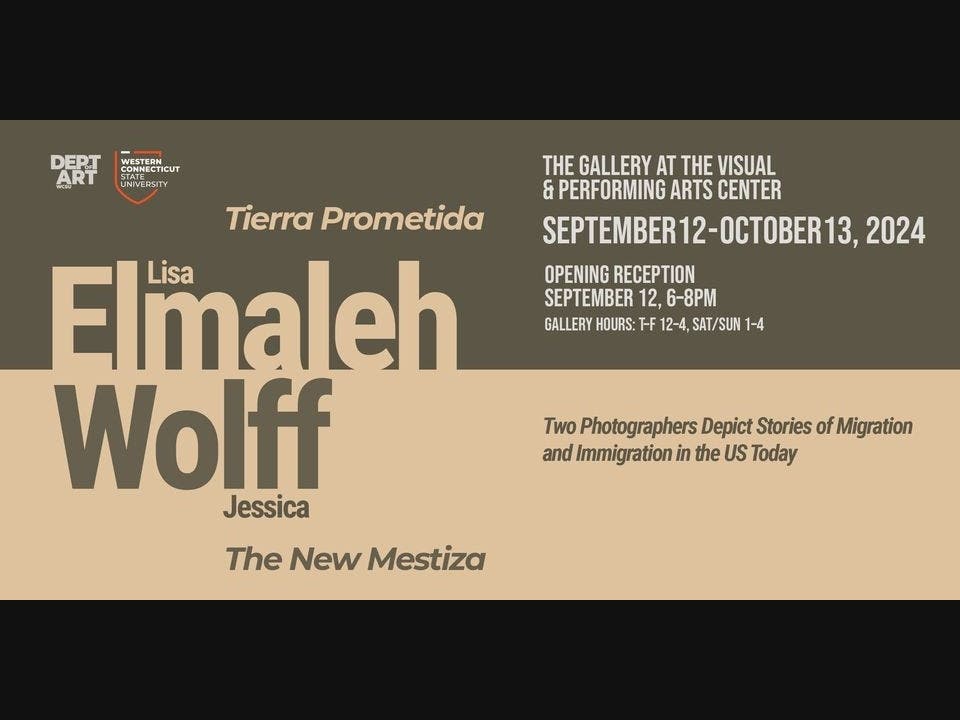
DANBURY, CONN. — The first exhibit of the 2024-25 season at Western Connecticut State University’s The Gallery at the Visual and Performing Arts Center, 43 Lake Ave. Extension in Danbury, will feature two photographers whose work depicts stories of immigration. “Lisa Elmaleh: Tierra Prometida and Jessica Wolff: The New Mestiza” will be presented from Thursday, Sept.12, through Sunday, Oct. 13.
An opening reception at which visitors will have an opportunity to meet Jessica Wolff will be at 6 p.m. on Thursday, Sept. 12, at the Gallery. The exhibition will be on view during normal gallery hours: from noon to 4 p.m. Tuesday through Thursday, and from 1 to 4 p.m. on Saturday and Sunday. Admission to the reception and exhibition are free and open to the public; donations to support the programs of the Department of Art will be accepted. The exhibit is cosponsored by the Department of Art and the Office of Diversity, Equity, and Inclusion. Reservations to attend the opening reception can be made online at www.wcsuvpac.eventbrite.com.
Find out what's happening in Naugatuckfor free with the latest updates from Patch.
Utilizing a large format 8x10 camera, Lisa Elmaleh’s black and white photographs depict the complex aspects of migration encountered along the border between the U.S. and Mexico. Elmaleh is the recipient of a 2024 Guggenheim Fellowship. Selections from her most recent series, “Tierra Prometida,” which in English translates to “promised land,” will be on view.
Mexican-American artist Jessica Wolff explores themes of family, community and culture in her hometown of Tucson, Arizona. Working primarily in color, she often combines nontraditional techniques and mixed media in her photography practice. Wolff will exhibit selections from multiple series: “Viva el Pueblo,” “The New Mestiza” and “¡Viva Tucson!” The works of each artist contribute a valuable personal dimension and humanitarian perspective to contemporary discourse about migration and immigration.
Find out what's happening in Naugatuckfor free with the latest updates from Patch.
Lisa Elmaleh is an analog photographer, artist and humanitarian. Elmaleh resides in Paw Paw, West Virginia, in a primitive cabin. Her most recent body of work, “Promised Land/Tierra Prometida,” focuses on the crisis at the border of the United States and Mexico; and since 2020, she has been immersed in the migrant justice community there. Selections from this series will be on view at WCSU. Elmaleh’s images have been exhibited nationally and recognized by the Creator Labs Photo Fund (2023), the Arnold Newman Prize (2022), the Puffin Foundation (2022), the Aaron Siskind Foundation (2011), and the Tierney Foundation (2007), among others. Her work has been featured by such publications as Harper’s Magazine, Smithsonian magazine, the New York Times, and National Geographic, and by CNN and NPR. Elmaleh’s photographs are in the permanent collections of the Norton Museum in West Palm Beach, Florida, the Ogden Museum in New Orleans, Louisiana, and the Wittliff Collections in San Marcos, Texas, among others. Her first monograph, “Everglades” (Zatara Press, 2016), documents the impact of climate change on the South Florida landscape.
Jessica Wolff, a native of Tucson, Arizona, is a Mexican-American artist who received her B.A. in Photography from the University of Arizona in 2023. Wolff’s photography and mixed-media work explores family, community and culture, especially regarding the ways in which they can become complicated when mixed. Wolff’s photographs delve into the experience of being Mexican-American and navigating the dynamics of two cultures that often clash or contradict each other. Embracing the term “mestizos” (of mixed race), Wolff acknowledges her and her subjects’ Indigenous and Spanish ancestry. Using symbols and icons from both Mexican and American history, she creates a fusion that represents a new culture, new myths, new icons, and new images, where there is no longer a strict division between Mexican and American identities, but rather the emergence of a new mestiza culture. Wolff resides in her hometown of Tucson, where she continues her art practice and works as an elementary school art teacher.
For more information, contact the Department of Art at robeaul@wcsu.edu or WCSU Communications and Marketing at pr@wcsu.edu.