Neighbor News
Two Houses: House of History, House of Mystery
A story of two antique houses in New Canaan. By Ed Chrostowski
By Ed Chrostowski
Because they span such a broad spectrum of architectural styles and eras, ranging from colonial post and beam to futuristic glass and steel, houses in New Canaan always have attracted widespread attention.
Now a different facet of this fascination develops in the speculation about the state of two contrasting homes, both now unoccupied, one steeped in local history and the other cloaked in mystery.
Find out what's happening in New Canaanfor free with the latest updates from Patch.
There is still another remarkable difference between the two. Generations of various families that had been influential in the development of New Canaan have lived in the shingled roadside colonial at the northeast corner of Ferris Hill and Conoe Hill roads for almost 300 years. The other, a French country style mansion built about 70 years ago on a 52-acre estate on Dan’s Highway, has never been occupied.
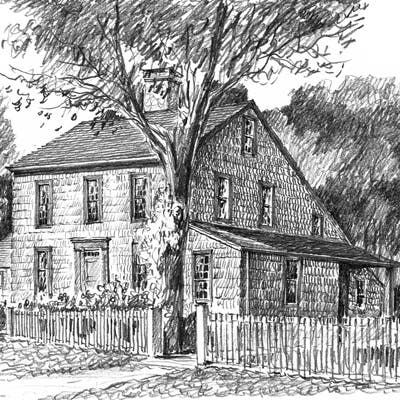
For all of the majesty of a heritage dating back to the founding of Canaan Parish in 1731m the wooden structure at the Ferris Hill corner is unpretentious, though certainly not without charm. Historical records indicate the house was built there by Abner Hoyt (variously spelled Hait or Hayt in colonial days) during the 1730-40 decade, though there is also some indication that the original may have been replaced in about 1800. Its present owner, Diana Tillson, acquired it in 1957 and lived in it for half a century before moving away and leaving it vacant for the first time.
Find out what's happening in New Canaanfor free with the latest updates from Patch.
The Hoyts were among the earliest residents of Norwalk and in about 1730 they began to fan out to other settlements in the area. The “proprietors” of Norwalk had granted Zerubbabel Hoyt and his three sons, Joseph, Daniel, and Caleb, more than 100 acres, supplemented by additional acquisitions a few years later so that it stretched through much of the east side of what is now New Canaan. So many Hoyt sons and nephews built their residences there that the area became known as “Hoyt Ridge.”
One of those sons, Deacon Daniel Hoyt, was given the upper portion of that spread and when he later divided it among his sons, Abner Hoyt acquired the six acres on which the Ferris Hill house was built.
The names of families that were to occupy it through the years after that are still familiar in New Canaan. Hannah Carter and her husband, Jonathan Burwell, bought the house in 1749 and lived there several years. She was the daughter of Capt. Ebenezer Carter, sole member of his family to have survived an Indian massacre earlier in the century in Deerfield, MA.
By 1772 the house had reverted to Hoyt ownership and occupancy. It was one of the stops on the historic “Visitation Journey,” made on horseback that year by the Congregational pastor, the Rev. Dr. William Drummond, to take a kind of census of Canaan Parish. He recorded that Ezra Hoyt, another of Deacon Daniel’s sons, was living there then with his wife, Phoebe Benedict. Ezra and Phoebe are listed in history as being among the founders of Canaan Parish, which in 1801 officially became the Town of New Canaan.
Writing about the house in “Landmarks of New Canaan,” a book published by the New Canaan Historical Society in 1951, Edwin Hoyt Bouton reported that his own ancestors had lived there for 100 years. As a boy, Mr. Bouton grew up on the “Town Farm” on Laurel Road, where his father was superintendent. Known as “Bowler,” Mr. Bouton later was superintendent of mails in New Canaan and chairman of the Town Housing Authority during the 1950s. His own great-grandmother, wife of a Revolutionary War soldier, had lived in the Ferris Hill house many years and died there.
In about 1872, Gilbert Birdsall, who had developed the Third Avenue railway in New York City, bought the Ferris Hill house and a hulking three-storey wooden structure downtown, which became known as “The Birdsall House.” Her operated it as a hotel, tavern and livery stable for many years. It was demolished about 55 years ago and its site is now the Morse Court parking lot, bounded by Main Street, Cherry Street and South Avenue. The short street there was named for Mr. Birdsall’s granddaughter, Mrs. Robert B. Morse, who was born in the Ferris Hill house and lived there all of her life.
When Annabelle Birdsall and Fanklin Stevens, Mrs. Morse’s parents, were married and moved into the house, the “Bridal Maples,” one tree on either side of the front walk, were planted there in the romantic tradition of that era.
Through the years, the house has been “adjusted” to accommodate modern requirements, but it remains a private residence and is essentially the same, its history is too rich and too deep to ever be diminished or altered.
Whether the same can be said for the other house, “the house of mystery,” remains to be seen. In marked contrast to the simple and utilitarian charm of a bygone era reflected in the Ferris Hill house, the massive mansion on Dan’s Highway suggests the grandeur of more recent vintage in town.
Yet, for all of its spatial splendor and its idyllic setting, the Dan’s Highway mansion is perhaps most intriguing for its inscrutability. An entrepreneur with a plan for a grandiose real estate development, two former United States senators, one of whom made millions of dollars from his Arizona copper mines, and an heiress who spent a fortune on the property had lead roles in the origins of the “house of Mystery.”
It was Alfred H. Mulliken, Chicago industrialist, who envisioned the development of a massive upscale gated residential community in New Canaan and, piece by piece, acquired more than 1,100 acres on which to build it. When he died in 1931, the plan collapsed and his heirs began to sell off the land. Among the buyers was a former U.S. senator from Pennsylvania, David A. Reed, who acquired 43 acres at about $1,000 each in 1936.
Over the next three years, Sen. Reed spent about a quarter of a million dollars building an estate that he and his family occupied until his wife, Adele, died in 1948. The property was sold three years later to Huguette Clark, daughter of copper magnate William A. Clark, a former senator from Montana and reputedly one of the wealthiest men in American with a fortune estimated in 1900 as $50 million.
Ms. Clark bought nine more adjacent acres and practically rebuilt the French style “chateau” over the next several years. In 1952, she added an attic, raising the slate roof, and built a huge wing. As recently as six or seven years ago, well over a
million dollars, more was spent on further updates, according to Anthony Ruggiero, Sr., the caretaker who has lived in the estate gatehouse for about 40 years.
Here’s where the plot thickens. Ms. Clark, a maiden lady, never moved into the house. Now more than 100 years old, she reportedly continues to live in a huge apartment on New York City’s Park Avenue.
Meanwhile, the magnificent 12,700 square foot brick mansion she developed sits with its 22 rooms vacant. Its features include nine bedrooms, most with their own bathrooms, 11 fireplaces, servants’ quarters, an elevator, a wine cellar, an immense tank for the house’s water supply and a spiral staircase rising from the two-storey central foyer. Plaster walls rise from parquet floors (or in some cases marble) to ceilings 15 feet high. Also on the property are five garages, three of them attached to the house, and two gatehouses.
Interestedly, the chateau has many features that are considered commonplace in modern homes, but were pioneer innovations at the time they were installed.
Examples include a center island and a butler’s pantry in the great kitchen, huge crank-operated casement windows that open into rooms rather than to the outdoors where they would be vulnerable to weather conditions. There’s a laundry room, a library and a music room and a “great room,” a sort of banquet hall, on the upper floor of the new addition.
Anything less than an expansive landscape of serene beauty would not do justice to such a house and the setting on Dan’s Highway provides just that. Forested areas include thick groves of huge pine trees. A river flows through the site, tumbling over a rock outcropping in a scenic waterfall. Vantage points at higher elevations offer an exquisite view of a nearby reservoir and the entire area teems with indigenous wildlife. Mr. Ruggiero tells stories of deer that dine on slices of apple they take right from his mouth and chickadees that peck on the birdseed he holds out to them on the palm of his hand. Bald eagles have been seen and huge hawks sometimes perch on the chimneys.
Intriguing, too, is the fact that the property is now available and a real estate agency has it on the market.
In a sense, what seem like two decidedly different houses in New Canaan have something in common after all. Each has an engrossing history; it’s just that one if more mysterious than the other.
For more info on 8 Ferris Hill, please visit us on Facebook, Twitter, and Instagram @8FerrisHill.