Community Corner
Finding Crayfish in Deep Brook
It's a pretty good assumption that if a body of water is inhabited with crayfish, the water is of really good quality.


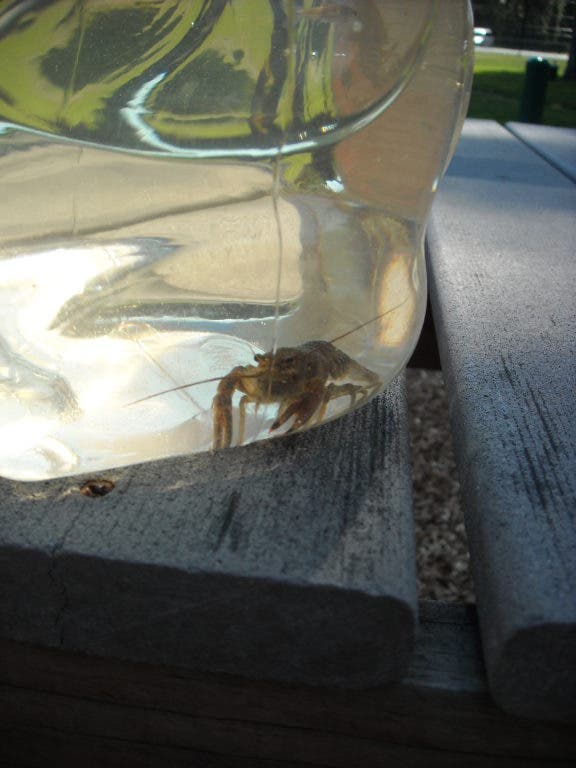


The only time I was ever in contact with a crayfish was in a bowl, steamed, someplace in New Orleans. So, it was a surprise to learn that a species of crayfish, crawfish or crawdads, as they are sometimes known, can be found in abundance in all healthy streams, lakes and rivers in Connecticut, and more specifically, Deep Brook as it runs adjacent to the Dickinson Park playground in Newtown.
I learned this from my granddaughter Kyra, 8, who was determined to capture one as a pet at Dickinson. She, in turn, had discovered this aquatic adventure from a group of young boys she met previoulsy wading in the stream.
Armed with her weapons, a net and a large covered glass jar, she set out (with her dad, Eric Rubin, sister Sophia and me) to document, capture and bring home her newest pet.
Find out what's happening in Newtownfor free with the latest updates from Patch.
It didn’t take much more than 10 minutes to round up a fairly large specimen.
I was shocked to see how many of these creatures were lurking around the rocks in the fast moving stream at Dickinson.
Find out what's happening in Newtownfor free with the latest updates from Patch.
Once securely trapped in his temporary housing, we needed to secure some feeding and care information as this was the family’s first fresh- water crustacean pet.
I whipped out my phone, logged onto the internet and learned quite quickly that crayfish eat fish, or, if fish are not readily avaiable, dropping one piece of dry cat food to sink to the bottom will keep them until proper crustacean food can be purchased. My son opted for catching some minnows from the stream to start this new guy off.
According to the website, the best food are shrimp pellets, a sinking compressed food that will remain on the bottom of the tank and can be found at any pet store that sells fish.
I also learned that crayfish, crawfish and crawdads can be a great addition to certain aquariums and are very easy keepers. And, most importantly, it's perfectly OK, at least from the info gleaned from the website, to catch one from the wild.
Entertaining to watch, they interact with most fish (except the ones they eat), forage for food, and crawl around the tank at two speeds, very slow or very fast. Solitary by nature, they are mostly nocturnal and prefer to hide during the day, thus the need for rocks or other objects to crawl behind or in.
There’s no need to heat the tank, but filters are essential due to the high level of waste. Water changes are essential as well.
There is an important rule to remember. Crayfish are natural escape artists. They can shimmy up an air tube or filter tube and out of the tank so it’s really important that the tank be covered at all times.
Some interesting crayfish factoids:
They breathe through feather-like gills.
They LOVE snails - and fish so be wary of putting them in tanks with your prized, small fish.
They must have oxygen from aquatic plants to survive. If the oxygen content gets too low they will drown. Keep lots of plants on hand since they will eat these as well.
They will only be found in bodies of water that do not freeze to the bottom.
Crayfish do not fare well in polluted water so it’s a pretty good assumption that if a body of water is inhabited with crayfish, the water is of really good quality.
They molt regularly.
Lifespan is at least two years and can be up to five or seven years.
Its been almost a week now and Rocky, the crayfish, is doing extremely well surviving on shrimp and crab pellets.
After spending time and getting to know Rocky, I don’t see myself in front of a bowl of steamed crayfish anytime soon.
If you’re interested in trying your hand at caring for a crayfish , you can contact Kyra, (she’s an old hand at this now) or access the many internet sites loaded with info on their care.
Try these two excellent sites for crayfish care: http://www.crayfishfacts.net/crayfish_care/crayfish_care.html, and http://www.bluecrayfish.com/north_american_crayfish_care_she.htm