Politics & Government
Gov. Malloy Accepts Sandy Hook Advisory Commission Report
The report makes recommendations on issues such as gun control, mental health and school safety.


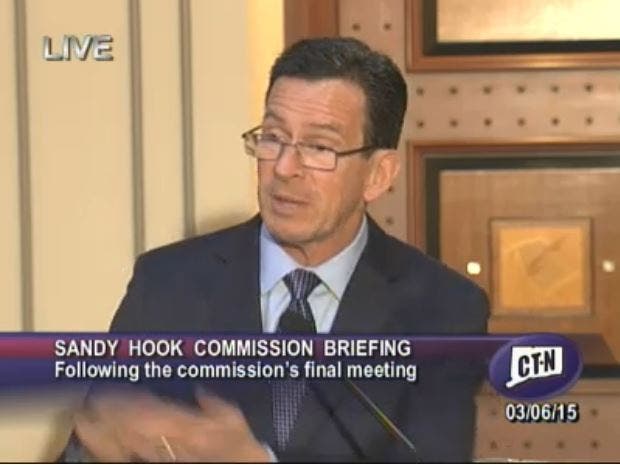
Read the entire highlight section and the full report below.
The Sandy Hook Advisory Commission officially gave Gov. Dannel Malloy their final 276-page report full of analysis and recommendations on topics as far-reaching as gun control, mental health and privacy laws.
Scott Jackson, chairman of the commission and mayor of Hamden said when he first took the mantle of chairman about two and a half years ago it was hard to envision what the end report could look like. The commission released its draft report last month, which remains largely unchanged.
Find out what's happening in Newtownfor free with the latest updates from Patch.
Related:
- Sandy Hook Advisory Commission to Send Report to Malloy
- Adam Lanza: Report Probes Dark Interior Life of The Sandy Hook Shooter
- Remembering Sandy Hook Victims 2 Years Later
- Newtown Families to Fight Bushmaster Suit Court Move
Since the Sandy Hook Elementary School shooting on Dec. 14, 2012 there have been more than 100 other school shootings, Jackson said.
Find out what's happening in Newtownfor free with the latest updates from Patch.
“The facts are clear, our schools should be sanctified places, but they are not,” he said.
The Sandy Hook shooting committed by Adam Lanza took the lives of 20 children and six adults.
Some of the commission’s early recommendations have already been acted upon, Malloy said. The state made $43 million available to about 1,000 schools to ramp-up security measures.
The state legislature passed a comprehensive gun control bill in 2013 that saw the ban of more weapons, including the AR-15 rifle that Lanza used in the shooting.
He said that compared to many other commission reports this one was relatively brief, which makes it easier to read and analyze. Jackson said the commission aimed to make a report that was dense, but accessible, and that he sees the entire document as a moral statement.
Some highlights from the gun control recommendation section are:
- Renew firearms on regular basis and should include test of firearm handling capacity. renewal now happens every 5 years, but no test.
- Limit amount of ammo can be purchased at any given time.
- Prohibit possession sale or transfer of any firearm capable of firing more than 10 rounds without reloading.
One recommendation that has potential to draw controversy is a requirement that would mandate anyone who carries a firearm to pass a suitability screening process based on the person’s evidence-based risk of dangerousness, such as a history of committing violent misdemeanors, people who have been convicted of two or more DWI or DUIS within five years. and people who have been convicted of two or more misdemeanors involving a controlled substance within five years.
The commission noted that there is tension between local firearm permit issuing authorities (often police chiefs) and the Firearm Review Board that reviews permit denials. They suggested that criteria be codified into law.
Ideas like mandating the sale of a gun lock with every gun sold are, simple, inexpensive, but make a lot of sense, he said.
“It speaks volumes about what we can do to prevent children from killing other children,” he said.
Other recommendations, such as serializing all ammunition sold would be hard to implement by just one state, Malloy said at a press conference after the commission’s meeting.
Malloy said he expects that much common ground can be made on many of the recommendations.
Among some of the recommendations are:
Gun Control
- Commission’s stance is that assault weapons like AR-15 and large capacity magazines have no legitimate place in the civilian population.
- There are 1.4 million registered firearms in state and possible 2 million unregistered.
- Require certificate of registration for every firearm after a background check, separate from permit.
- Renew firearms on regular basis and should include test of firearm handling capacity. renewal now happens every 5 years, but no test.
- Limit amount of ammo can be purchased at any given time.
- Prohibit possession sale or transfer of any firearm capable of firing more than 10 rounds without reloading.
- Trigger locks provide at time of sale or transfer of any firearm.
- Require any shell casing for ammo sold or possessed in state have a serial number laser etched on it for tracing purposes.
- Any person seeking license to sell, purchase, or carry any type of firearm in state be required to pass a suitability screening process. Evidence-based risk of dangerousness, such as persons convicted of violent misdemeanor, temporary domestic violence restraining orders, two or more DWIs or DUIS in a period of 5 years, 2 or more misdemeanors involving controlled substance in a period of five years
- Allow judge to temporarily remove firearms, ammo and carry permits from someone who is subject of an ex parte restraining order, civil protection order or family violence protective order.
Mental Health
- A diagnosable mental illness is a weak predictor of interpersonal violence. Untreated psychiatric illness in a narrow subset of the population does increase the risk of violence.
- Based on forensic psychiatrist testimony, experts haven’t devised a way to predict future events of violence even when there is the ability to identify the condition of dangerousness.
- “Connecticut has significant problems with system fragmentation resulting from diverse payment systems and a lack of coordination or consistency among state agencies.”
- Many members of society regard people with mental illness as dangerous, incompetent and at fault for their condition.
- People with mental health challenges are much more likely to be victims of violence rather than perpetrators. Less than one-tenth of a percent of homicides are mass fatalities.
- Psychoeducation of individuals and family members of those with mental health issues can promote acceptance and decrease stigma.
- The commission couldn’t come to a conclusion on adopting involuntary outpatient commitment short of involuntary hospitalization.
Schools
- Each school district should have policies in place related to threat assessment and violence management.
- There is some confusion about the intersection between Health Insurance Portability and Accountability Act and Family Educational Rights and Privacy Act law. HIPPA applies to medical records while FERPA applies to educational records. One primary area of confusion is when records involving health care are provided to students in an educational setting.
- There are provisions within existing HIPAA and FERPA laws for disclosure when a person’s behavior poses a serious and imminent safety threat. However, the laws are extremely complex and often lead to confusion as to when disclosure is legally allowed.
Crisis response and management
- The state should come up with a comprehensive statewide plan to respond to large-scale school crisis events, including short and and long-term interventions for different populations.
- The state and municipalities should enhance focus on mental health implications of disaster events.
- Educational and behavioral health agencies should be incorporated into the states Unified Command System to better respond to disaster events.
- Grant peace officer status to all sworn law enforcement officers in CT in the event of a major police emergency. This would happen after the local agency invites other agencies to help.
- Establish regional school safety planners to assist districts in planning for hazards and emergencies.
- Come up with a donation plan. Newtown was inundated with well-meaning gifts.
Image via CT-N
Get more local news delivered straight to your inbox. Sign up for free Patch newsletters and alerts.