Community Corner
Debate Over Relocating Graves Causes a Stir in One Connecticut Town
Should a community relocate historic graves for the sake of safety and economic progress?


Editor's Note: Each weekend, Patch will share a story sparking conversations beyond one town.
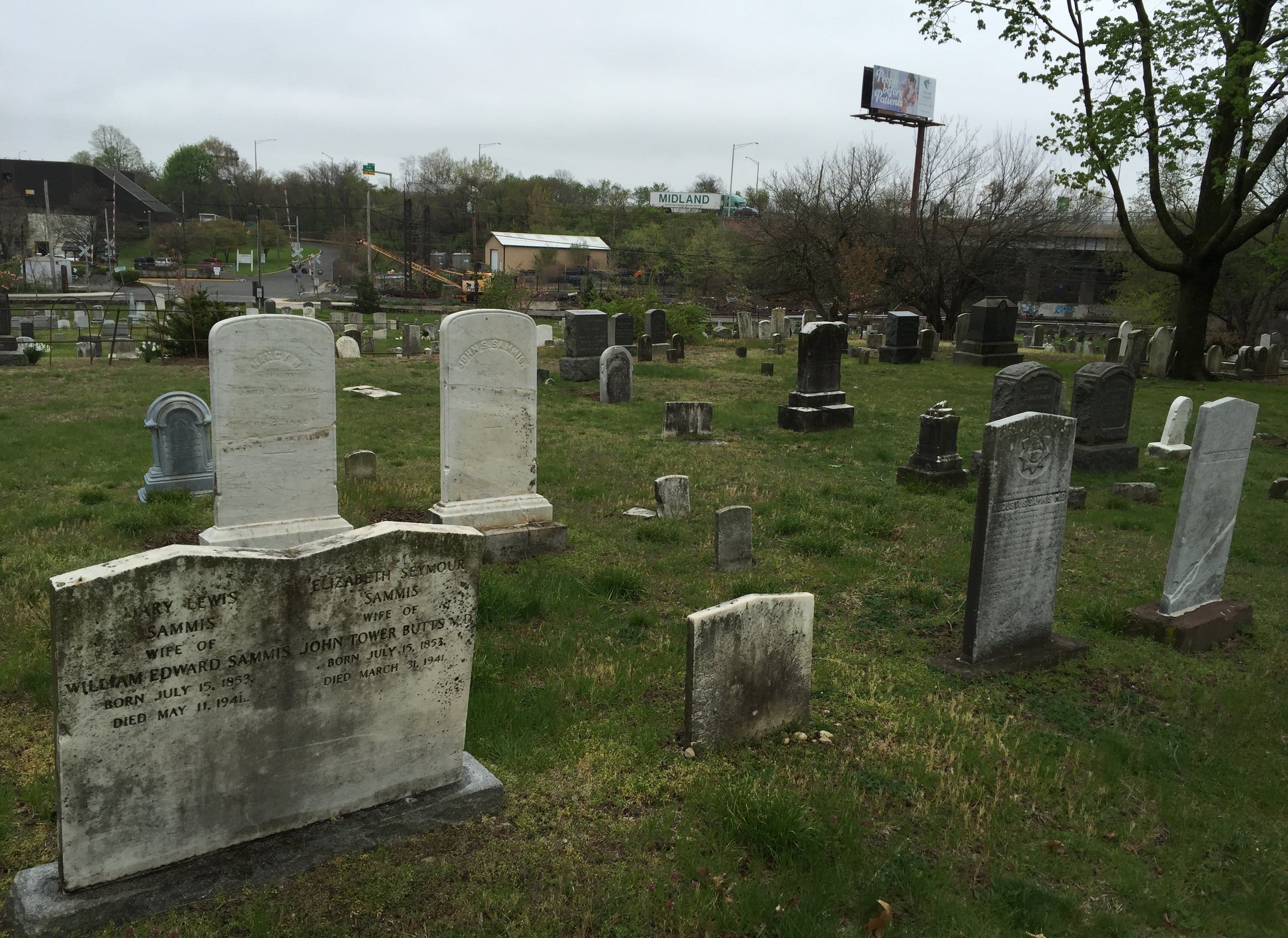
NORWALK, CT - Along a cracked road of decaying cement barriers and giant puddles lies a small piece of colonial history.
Past hordes of noisy trucks and construction machinery on Crescent Street, where the railroad cuts below the underpass for Interstate 95, graves sit intact but stained with age.
Find out what's happening in Norwalkfor free with the latest updates from Patch.
This is the site of the Pine Island Cemetery where David Westmoreland stands beneath the underpass, shielding himself from the rain as he points out the beauty in a centuries-old field of dead.
“It’s hidden away back here,” Westmoreland said, before the 10:39 a.m. train whizzes by and cuts him off mid-sentence. “It’s a little treasure.”
Find out what's happening in Norwalkfor free with the latest updates from Patch.
This treasure is from 1708 and is the second oldest of 22 cemeteries in Norwalk, where 1,800 souls were laid to rest in shallow graves.
Westmoreland, who is vice chair of the Norwalk Historical Commission, is here to discuss possibly digging some of them up. With city expansion and a proposed shopping mall underway, the commission is looking into widening Crescent Street. This would necessitate paving over or relocating 11 bodies.
'Divisive Decision'
It has been a divisive decision for residents, leaving some grim as ghosts about possibly moving them. Melissa Deranieri had not heard of Pine Island Cemetery before, however she immediately expressed opposition at moving or disturbing them in any way.
“You are not supposed to move graves,” Deranieri said. “They are supposed to rest in peace and that is the end of it.”
While many share Deranieri’s opinion that the end of life should be finite, Pine Island is not alone. Communities have found that touching graves can often be a touchy subject for residents.
For example, Chicago’s O’Hare International Airport 2011 runway expansions resulted in 800 of the 1,200 graves in St. Johannes Cemetery being relocated. The move received pushback from a large number of concerned residents with family members laid to rest there.
Even construction of large icons like the New Orleans Saints’ beloved Superdome (which could attest for some of their seemingly cursed seasons) and Shanghai Disneyland (1200 graves) have resulted in the relocation or building over of large numbers of graves. In most grave relocation cases, citizens’ complaints often fall dead.
'Setting a Precedent'
Notwithstanding awakening any ancient Fairfield County curse, the issue is not just preservation; it’s precedence. Norwalk Historian Ralph Bloom said this is a problem Norwalk has not dealt with before, leaving many concerned of what it could mean for the city going forward.
“People get very emotional about burials,” Bloom said, “and this is the first time [relocation] has ever come up regarding an access road to a commercial enterprise in this town.”
The decision is meant to aid traffic flow for the area and service people in South Norwalk as a through street when traffic increases from the new mall, particularly around the holidays. It is also a matter of safety, as it would make it easier for emergency vehicles to get into the area when necessary.
“The last thing I want to do is give away cemeteries and move graves,” Westmoreland said, “but I understand the need.”
Why its Needed
The Commission is considering making the current one lane road a two lane and expanding it approximately 11 feet; each foot accounting for one affected grave. This would cut off the curve in the Crescent Street side of the cemetery where the graves in question sit.
Westmoreland said there is no specific timeframe for a decision to be made, but it will need to be coordinated with the mall’s development over the next two years. The idea for the widening, however, actually dates back to a city expansion plan from 2012.
“I want to emphasize that we are not doing this for the mall...although it’s certainly a catalyst for it happening,” Westmoreland said. “They’re not saying [they] want [us] to widen roads and remove cemeteries. The plan they have does not include the widening of Crescent Street.”
The Mall's Place in This
General Growth Properties, the company developing the mall, Senior Director Douglas Adams confirmed that plans do not call for the widening but they are not against it.
“I think certainly widening that connection would improve circulation,” Adams said. “We’ve submitted our traffic report assuming it’s not widened so we have a good solution with it’s current configuration, but obviously the more connected things are the better they work.”
Westmoreland recommended people with concerns get in contact with the commission, as they are looking for more public input. While possible solutions like digging the graves deeper have been suggested, many residents have advocated simply doing nothing.
'It's Their Final Resting Spot'
Norwalk resident Al Raymond attended the Commission’s April 27 meeting, where he told members that Crescent Street should be left alone because there are many options for leaving South Norwalk.
“Leave the people alone,” Raymond said. “It’s their final resting spot, and now they’re going to dig them up and move them just to make the road wider. It just doesn’t make sense to me, and I know a lot of people who are upset about it.”
'Move Over a Little'
Resident Ed Spires, on the other hand, had heard of the plans and saw no reason to leave them alone.
“I think it’s perfectly alright. None of their relatives are still around, so who’s to say they wouldn’t agree to it themselves,” Spires said. “Move over a little bit so we can get a road through there.”
Spires’ wish may be the Commission’s command, as doing nothing may no longer be an option due to the necessity of fixing the aging road.
“They have to rebuild that road even to make it a one-lane road,” Westmoreland said. “The issue is that the archaeologist told us that the graves are very shallow, so we have to find out whether if we don't do anything for the graves that we already know are under the road, will they be disturbed by the roadwork we have to do any way? Then we have to make a decision on that.”
As he walks back down Crescent Street, the rain mostly passed over, Westmoreland notes how far the city’s little treasure has come.
“10 years ago, 90 percent of the tombstones you see upright were lying in the ground,” Westmoreland said, his finger extended as he then points out other Pine Island historical facets.
Balancing Act
He understands residents’ concerns, being both an architect and historic preservationist, but he also sees the need to let older aspects of the town adapt for what the future holds. While the question of whether a community can progress and preserve each historical gem does remain, Westmoreland keeps his mind on the living in this issue first.
“We have to balance history with the need for public safety and access for the people who live and work in South Norwalk to have direct routes in and out of that part of town,” Westmoreland said. “It’s a real balance, and a real struggle.”
Bloom, meanwhile, reinforced the idea that while there is no precedence for the city in this instance, now would be the time when it is set.
“This is a case where it’s an unknown,” Bloom said, “and everyone is going to have to guess ahead how much of an effect it’s going to have.”
Get more local news delivered straight to your inbox. Sign up for free Patch newsletters and alerts.