Schools
A Look at Oxford's Many Center Schools
Town historian looks at the various buildings that used to be home to Oxford Center School.

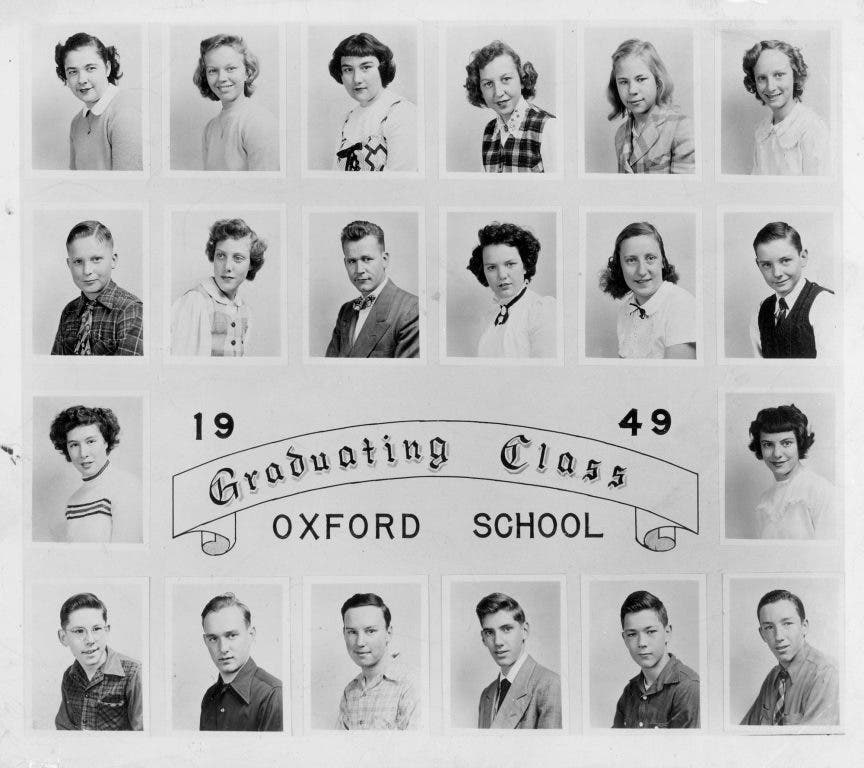


Connecticut is known as the "Land of Steady Habits." Here in Oxford, we have had four different school buildings named Center School, each located on different properties.
In 1795, while Oxford was still part of Derby, the Oxford School Society was formed, three years before the town was incorporated. When Oxford was incorporated in 1798, the town became responsible for educating all the children within the new community. Roads and transportation were limited, schools were basically neighborhood affairs and each neighborhood operated its own district school. A School Committee, provided a one or two-room schoolhouse, hired its own teachers and set a district tax for education. The town tax collector collected the various district school taxes and distributed the money to the neighborhood school district committees.
Many of the early Oxford school district records are missing. With no early Town Hall, school committee members kept district records in residential homes. When Oxford built its first Town Hall in 1933, many of the old records were never gathered from private homes. Hopefully with the opening of the Historical Society Museum later this year, some of those records will be donated to the Society for preservation. Then they will be available for historical and genealogical research.
Find out what's happening in Oxfordfor free with the latest updates from Patch.
The 1868 Beers Map of Oxford shows 13 School Districts. The Oxford Center area was District 1. The school was at the corner of Riggs Street and Academy Road. This building was originally a public school.
Later, Nathan J. Wilcoxson as a private school used it.This led to the name Academy Road. The district school committee then held public school at the old Masonic Hall. Both buildings are now gone. The old Masonic Hall later served as the Parish Hall of the Oxford Congregational Church. The church demolished it to make room for the addition of the educational and fellowship wing of the church.
Find out what's happening in Oxfordfor free with the latest updates from Patch.
The third Center school, the "New" Center District School, was originally a one-room schoolhouse. Later a second room was added in the rear. A photo (attached to this story) shows the six windows in front classroom and two windows in rear room, and the new Consolidated School nearing completion in the background. A photo of students at the "New" Center District School shows the school sign above the front door. This sign now occupies a space in the hallway of the present Center School.
By 1935, Oxford residents were considering consolidating the district schools. In the 1935 Town Report, the state-appointed supervisor of education wrote, "During the year there has been an individual expression by people regarding consolidation. People promoting consolidation do not discredit the services rendered by one-room schools but they realize that these old one-room schools do not meet the educational needs of the community today. Education today is being thought of as a planned community program and makes available educational experiences and opportunities to all the people of the community. Children in one-room schools are denied the social and health values that are appreciated and experienced in the consolidated schools."
At the time, Oxford had few students. In 1947, the average daily attendance at all district schools was about 200 students. They included:
Center School - 61.89
Christian Street - 21.65
Church School - 52.01
Quaker Farms School - 42.48
Riverside – 22.16
High School students attended either Ansonia, Derby, Naugatuck or Seymour high schools, depending on where they lived.
At a town meeting held in Oxford Grange on Oct. 10, 1947, led by moderator Edward P. Rowland, residents voted to build a consolidated school. The meeting approved up to $255 000 for a school. It included eight classrooms, lavatories, offices and combined cafeteria and auditorium to seat 400 people with a stage.
Many residents thought the building was extravagant. As it later developed, the community realized the building was too small. While the building was still under construction, it was apparent that more room would soon be needed. In 1948 Town Report School notes, "The Town of Oxford should already give thought and action to the construction of two new classrooms onto the new school." Additions were soon required.
After the Oxford Consolidated School opened, the old District school was no longer needed. The local fire department cut the building in half, and moved each room to the other side of the Grange Hall. Firefighters built a garage to house the fire equipment, and put one room on each side of the firehouse. One room on the south side of the new garage served as the firehouse room, and the other room was placed on the north side of the building to serve as the public library. The upstairs of the library included an office for the town selectmen. Attached photos of the Center District schoolhouse compared to the firehouse photo show how the firemen used the old schoolhouse for their new facility.