Community Corner
Centennial Commemoration for Stevenson Dam
Historical Society to feature John Babina at Nov. 17 Program
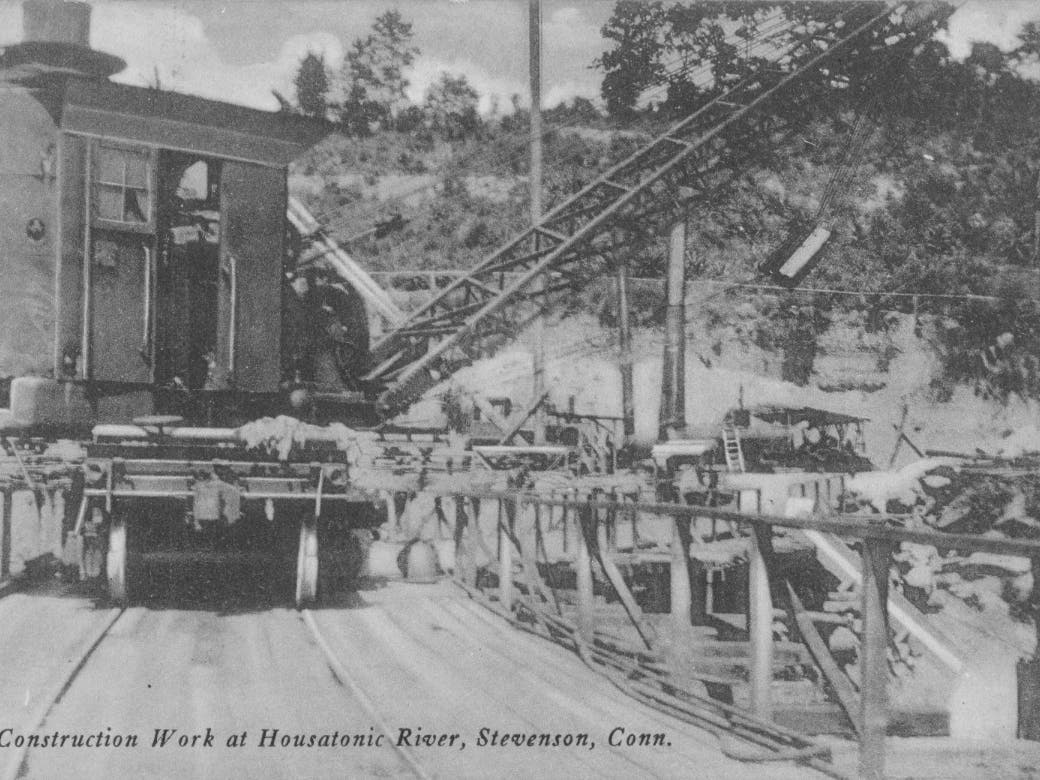

The Oxford Historical Society will commemorate the 100th anniversary of the completion of the Stevenson Dam on Sunday, Nov. 17, at 2 p.m. at the Riverside Fire House, 151 Coppermine Road, Oxford. Stevenson Dam historian John Babina will show slides of the construction project, explaining the various methods and equipment used in the project. The slide show includes twenty newly-found photographs of the construction project.
The dam created a ten-mile lake on the Housatonic River. Built for the Connecticut Light and Power Company, the structure was the work of J. A. P. Cristfield Contracting Company of Philadelphia, with H. J. Hoard and C. W. Blakeslee and Sons as sub-contractors. The project was one of the largest ever attempted in the eastern states and the dam itself was one of the largest constructed in New England at that time.
Preliminary work was started in August, 1917. The project required construction of 6 miles of railroad tracks and three temporary bridges across the river during the project.
Find out what's happening in Oxfordfor free with the latest updates from Patch.
The dam and power house were built on bed rock. The dam, from the deepest part of the foundation to the crest of the dam is 125 feet. The dam is 81 feet wide at its base and tapers to its crest. The highway is 20 feet above the top of the dam and 23 feet wide. It replaced the old Zoar and Bennett Bridges which were abandoned to make way for the lake created.
Eight standard gauge locomotives, five narrow gauge locomotives and forty-five cars were used in hauling material. A machine shop and carpenter shop, as well as a field laboratory to test concrete samples were utilized. A temporary power house was also built for the equipment.
Find out what's happening in Oxfordfor free with the latest updates from Patch.
Seven steam shovels; nineteen derricks and hoist engines; two drag line equipments, with 1,200 feet, fifteen ton cableway; and thirty-five pumps of various sizes and descriptions were used during the course of the construction of the dam and powerhouse.
As many as 800 men were employed, often working in shifts night and day. A dining room to seat 300 men was utilized, as well as a hospital with doctors always in attendance in case of an accident.
When completed, the lake covered about 1,500 acres, and held one and a half billion cubic feet of water. Power generation began at the site in early December, 1919.
Babina's talk highlights the construction process, noting the project was done during World War I. It provides a rare look at this massive construction project of a century ago. General admission will be $5.00, members, $3.00. Because a large attendance is anticipated, persons are encouraged to car pool to save parking space. Proceeds from the program will be used in the relocation and preservation of Mr. Munn's one-room 1850's schoolhouse.