Arts & Entertainment
It's a 'Hoppy' Time of Year at the Oxford Public Library
Children's librarian to offer programs that celebrate Easter and its four-legged mascot.

When I was 7 years old, I awoke on the night before Easter to discover strange shadows moving across my bedroom door. When I focused my eyes, I could hardly believe them. It appeared that the shadows belonged to the Easter Bunny and my family’s rabbit decorations, magically dancing in the night!
I was so convinced of this that I wrote and illustrated an account of the experience to share with my second grade class. One or two kids may have been able to claim that they had spied Santa on Christmas Eve, but no one else said they had seen any sign of the far more elusive Easter Bunny.
Almost 20 years later, the cotton-tailed holiday mascot continues to surround himself in mystery. When I asked the library’s young patrons about him last week, I received conflicting stories about even the most basic details.
Find out what's happening in Oxfordfor free with the latest updates from Patch.
For example, no one can be sure where the Easter Bunny lives. When asked about his home, 5-year-old Anna-Maria became quiet, her brow furrowing slightly. After several moments of contemplation, she replied logically: “In a hole.”
Yet when Bailey Cayer, age 3, was asked the same question, she immediately proclaimed that he has “a house up in the sky.” There couldn’t be two more opposite theories. Clearly, the Easter Bunny hides secrets about his identity as well as he hides eggs.
Find out what's happening in Oxfordfor free with the latest updates from Patch.
However, a little research can uncover some of his history. According to Patrick Merrick’s Easter Bunnies and Time.com, the Easter Bunny’s origins have little to do with the Christian concept of Easter. Instead, he evolved from the ancient Anglo-Saxon myth that the goddess Eastre caused spring to arrive – as long as she was happy. If she was angry, she would refuse to end winter. To prevent an eternal season of ice and snow, people hosted festivals for Eastre and her favorite animal, the hare, a symbol of spring-like fertility. Eventually elements of the pagan ritual were incorporated into the Christian holiday.
The Easter Bunny’s evolution continued in the late 1700s when German settlers brought the story of the “osterhase” to America. According to Time.com, the osterhase was a rabbit that laid eggs, similar to the modern concept of everyone’s favorite bunny.
Folklore from other cultures reveals that the Easter Bunny has help delivering eggs around the world. In We Celebrate Easter, Bobbie Kalman writes that white horses pull chariots of eggs in parts of France and Italy. In other parts of those countries, Kalman adds, egg deliveries are attributed to flying church bells. Although church bells ring throughout the year, they stop on the Thursday of Holy Week and remain silent until Easter morning. Children are told that the silent bells have flown to see the Pope and that they will return with Easter eggs. Some youngsters stand on hilltops to try to sneak a peak at the flying bells.
Back in America, children are less interested in observing Easter deliveries. They are willing to allow the Easter Bunny his privacy as long as he distracts them with exciting treats. During a recent storytime, the children’s eyes sparkled at the thought of finding golden Easter eggs.
If you find one of these eggs, 4-year-old Abby Zodl explained, “You get lucky.” Three-year-old Alex Hite elaborated – golden eggs have money inside them. (Someone get me a basket. I’m going egg hunting!)
While the specifics about the Easter Bunny may remain in shadow, one thing is clear: his generosity makes kids “hoppy.” Smiling children are a cause for celebration no matter what your religious beliefs.
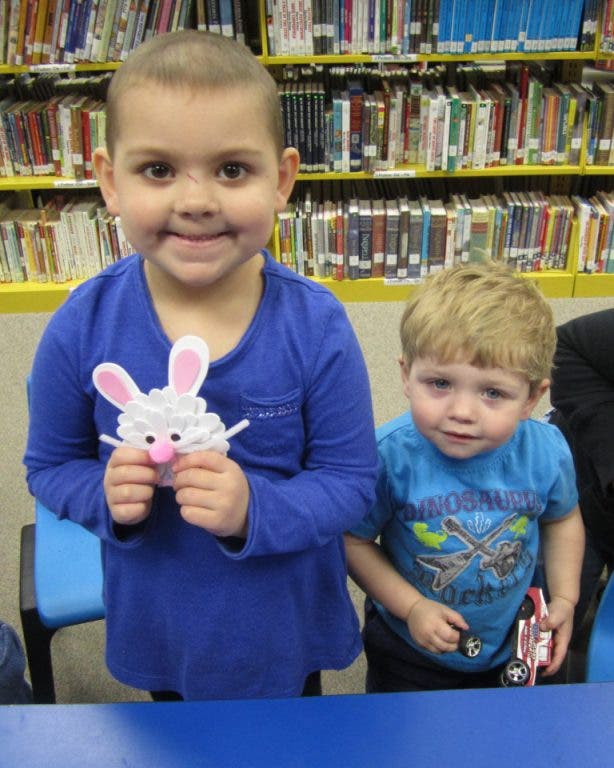
This week, children are invited to the Oxford Public Library to listen to a story about the Easter Bunny and then make a bunny craft. Easter storytime will be held on Tuesday, April 19 at 10 a.m. and 2 p.m. and on Wednesday, April 20 at 9:30 a.m. No registration is required for this free event.