Community Corner
Revolutionary Family Leaves its Mark on Oxford
Town historian tells us about a well-known Colonial-era family that is responsible for several well-known buildings in Oxford center.
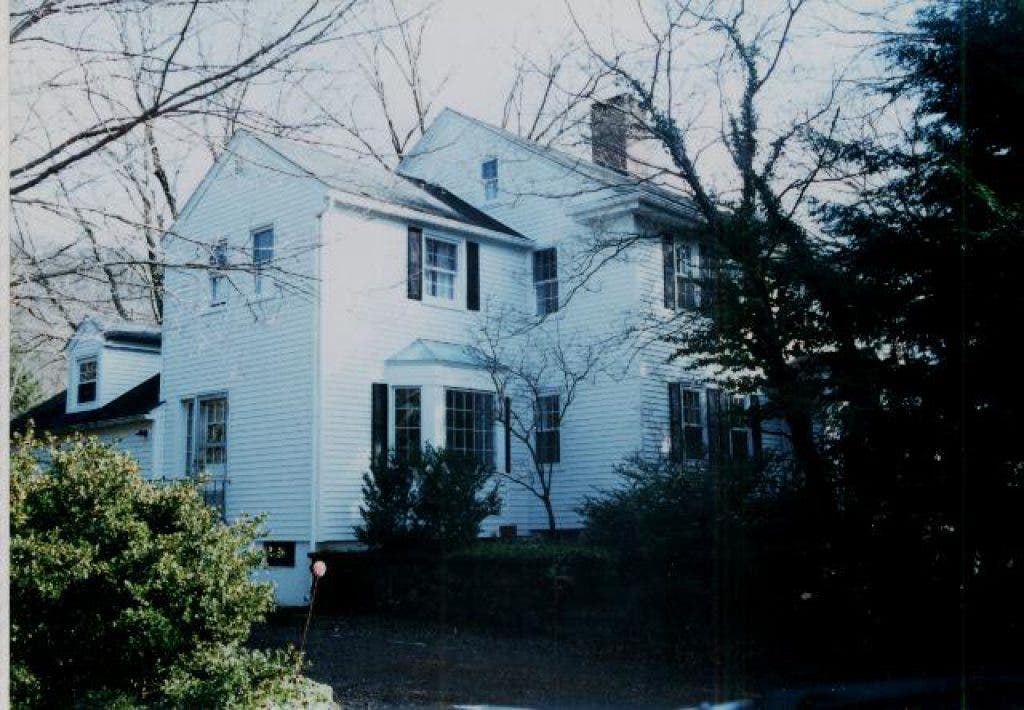


Probably the most influential family in Colonial-era Oxford was the Candee family.
Caleb Candee was born in West Haven in 1722. He settled in Oxford around 1730. His tombstone in Jack's Hill Cemetery is unique in that it is shaped in a semi circle with simply the initials C.C. engraved in it.
Before his final resting spot, Candee lived in the a house, which is now gone, on the former Robinson Farm on Christian Street near the Larkin Bridle Trail. The Army and Navy Journal of March 27, 1880, featured an article about the Candee family. It states:
Find out what's happening in Oxfordfor free with the latest updates from Patch.
"A family which has been represented in the Army and Navy of the United States from the very earliest period in the history of this country, furnishes one of the curiosities of longevity which is worthy of mention... It was a hardy race of a mixture of Huguenot and Puritan, and they lived primarily in the township of Oxford, in New Haven County. One of them, Caleb by name, married in 1742 Lois Mallory, and of this marriage were born nine sons, one of whom reached the age of 94, three of them 87, one 87, one 83, one 78, one 70 and one 69, an average of a little more than 82 years.
“All of the children of Caleb were born subjects of Great Britain and all of the sons, we believe, served in the Revolutionary Army. Nehemiah... served at Ticonderoga when bluff old Ethan Allen was in command of the forces in that vicinity and some of his sons served during the War of 1812.”
Find out what's happening in Oxfordfor free with the latest updates from Patch.
The names of the sons were Caleb, David, Gideon, Timothy, Samuel, Justus, Nehemiah, Job, and Daniel. Most of them are buried in Oxford’s cemeteries.
The oldest son, Caleb Candee, married Anna Sperry. Their daughter Anna Candee married Jeremy Hull Twitchell, and they lived in the old Twitchell-Rowland Homestead. The Oxford Historical Society is preparing it for opening as a local history museum later this year.
Oxford Center still shows the workmanship of the sons of Caleb and Lois and their influence in early Oxford. The following text and photos are from Early Houses of Oxford published in 1976. Now out of print, the Oxford Historical Society plans to update the book and republish it in the future.
- Oxford United Church Of Christ, Congregational 1795: The Oxford United Church of Christ, Congregational is a white clapboard building of the Classical Revival or Federal style. It has a pedimented front gable with superimposed flat Corinthian columns flanking the main entrance. An earlier Oxford Congregational Church in a simpler style was constructed in 1741 one hundred feet south of the present structure. After the original church burned, the present church was built on “Meeting House Acre” in 1795 on a knoll at the intersection of Academy and Oxford Roads. The extant church was built for the Ecclesiastical Society of Oxford by Timothy Candee at a cost of $3,300.
- Hudson House C. 1814: Located at 430 Oxford Road, Hudson House is one of the original old homes that formed Oxford Center. Research indicates that it was built about 1814 by Timothy Candee. The present house is two and one-half stories with an addition built in 1958. Another annex on the south side was used in the 1930’s as a tearoom, “Mary’s Little Lamb,” by the house’s owner at that time, Miss Mary Russell, to benefit the William Grenfell mission to Labrador. The house has the central chimney with six fireplaces. There are fine ornamental friezes adorning the tops of the windows and under the eaves. In the interior the entrance hall is highlighted by the original spiral staircase. The present (1976) owners, Jayne and Allen Crepeau, have carefully maintained Hudson House. Mr. Crepeau has hand stenciled the walls of the entrance hall in an early colonial pattern.
- The home of Mr. and Mrs. Joseph Bilanin at 426 Oxford Road was built in 1814 by Timothy Candee. This is the same builder who built the “Hudson House” next door. Notice the almost identical architecture. The portico on this house is slightly more elaborate than that of the “Hudson House.”
- Oxford Hotel 1795: The Oxford Hotel on Oxford Road was built as an inn in 1795 by Daniel and Job Candee. Daniel Candee, who was also Oxford’s first postmaster, operated the inn until about 1811. David Candee succeeded him as the innkeeper until his death in 1851. Frederick Candee then inherited the inn from his father and ran it for some twelve years 1865 the inn passed through inheritance David R. Lum; he was followed by Mary Lum and then Franklin Lum in 1873. Thereafter, the hotel was owned and operated by Harriet Warner and Charles Walcott, then by George Oatman in 1885, Willa Gertrude Riley in 1899, and William and Fannie Gabler from 1910 to 1939. In 1941 it was discontinued as a hotel and remodelled by Mr. Eldridge Seeley for his residence. In 1950 the building was purchased by James and Dominica De Maio who reopened it to the public as a country restaurant, now known as the Oxford House. The building is a large two and one-half story white clapboard structure. Over the years it has been extensively remodeled both inside and out. Additional dormers and the two-story colonade were constructed, and the porches were removed. At the time Oxford Road was paved with concrete the building was moved back from its original site some thirty feet. Today this handsome structure is still operated as a country restaurant, thus continuing the long tradition of the Oxford innkeepers.