Crime & Safety
Malloy's Budget Proposal Drops $4.4 Million 'Hammer' on Ridgefield: First Selectman
First Selectman Rudy Marconi spoke about the governor's proposed budget and how Ridgefield would be affected by state funding cuts.


RIDGEFIELD, CT — If Gov. Dannel Malloy's proposed budget is passed by the legislature, Ridgefield and other suburban communities will take a significant financial hit.
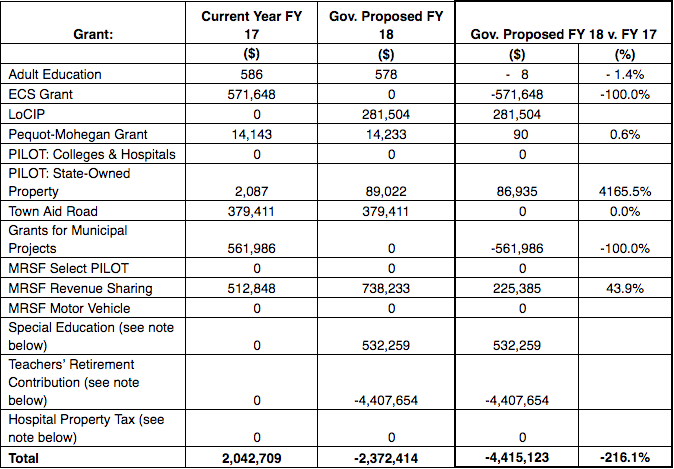
According to documents released by the Malloy administration, Ridgefield stands to lose approximately $4,415,123 million in state funding based on the proposed budget. Ridgefield is set to receive $2,042,709 in state funding in the current fiscal year, but would required to contribute $4,407,654 to the teachers' retirement system.
That means the town would be one of several communities, many of which are in Fairfield County, that are required to write a check to the state for teacher retirement payments. According to the most current projections, Ridgefield would be required to pay $2,372,414.
In an interview with Patch, First Selectman Rudy Marconi said Wednesday that the proposed budget will ruin suburban communities if it passes.
"The ramifications of what this does is far above and beyond what the Governor or his staff considered," said Marconi."You can't drop a hammer of $4.4 million and say "that's what you owe this year.""
READ MORE:
According to the most current estimates, the significant cuts are seen in the Education Cost Sharing (ECS) grants and grants for municipal projects. Ridgefield would see a 100 percent decrease in ECS grants under the proposed budget, a loss of $571,648 compared to the current fiscal year. The town would also lose all of its grants for municipal projects, a loss of $561,986.
The town would be given a new grant for special education totaling $532,259, as well as a 43.9 percent increase in funds from the Municipal Revenue Sharing Program. Below is a preliminary look at grant estimates for Ridgefield for certain key programs. The budget documents are still under review, and full details are forthcoming.
Marconi added that it is important to note the budget presented in Hartford Wednesday is a proposal, and that the legislature tossed the Governor's 2016 budget proposal. However, structural changes within the budget would provide more aid to impoverished communities and less to wealthier communities on a sliding scale.
That is achieved through a new education cost-sharing formula, shifting a third of teacher pension obligations onto towns and other means. The rationale behind the decision is that wealthy school districts that have higher pension obligations.
However, Marconi noted that the cost of teachers has become even higher in the cities due to the changes in enrollment, and that as Ridgefield experiences declining enrollment, its cost per student increases.
"To just throw money at it isn’t the answer," Marconi said."Money will be spent, and there have been other areas that have followed the same course and haven't seen improvement."
The First Selectman highlighted what he believes are three factors to a successful school system; the quality of the teachers, classroom size and parent involvement. While noting that it is not true across the board, he said that Ridgefield's success has been driven in part by parent involvement, and that city school districts don't always have that same luxury because many parents didn't receive a quality education themselves.
Noting that all parents want to be involved and provide their child with a good education, he suggested that money could be better spent providing an avenue for inner city parents to get involved in their child's education.
"It’s a vicious cycle and parents who do not have that education don’t benefit may not recognize that deep need for a good education," said Marconi."There is no question that the cities need help, and if the money is used on proper programs, let's get our cities where they belong."
Marconi said the cuts could force the town to raise taxes, and implement other cost saving measures to make up for the loss. In addition, it could affect the town's ability to bond for projects and potentially impact the town's bond rating. Marconi suggested the addition of tolls to highways in the state as an alternative to the cuts, saying that people pay for trains and airplanes but not for roads in the state.
"Estimated revenue could be one billion per year, but yet they want the municipalities to pick up a share of the [teacher's] retirement fund," Marconi added."You've got to come up with something better than that."
Editor's Note: This story was posted earlier this week. Here it is again in case you missed it.
Image via the Town of Ridgefield