Business & Tech
At WSHU, a Velvety Voice Glides Listeners Through the Morning Rush
Broadcaster Tom Kuser massages microphone and multi-tasks in wee hours


When the sound waves he projects land on your eardrum, they zero in on a pleasure zone and keep resonating there.
The unmistakable velvety voice belongs to Tom Kuser, morning host for WSHU public radio’s “Morning Edition,” broadcast from a small studio on the campus of Sacred Heart University in Fairfield.
Kuser may be talking about impending snow and ice storms, hazardous road conditions and global turmoil, but the impossibly buttery-rich intonations that massage the microphone are a constant.
Find out what's happening in Shelton-Derbyfor free with the latest updates from Patch.
As they tune in to the program, up to 322,400 listeners awakened by alarm clocks or slowly grinding their way on the Merritt or the back roads of Fairfield County – and Suffolk County, N.Y., where the signal also reaches – may be conjuring images of the face to match the voice.
WSHU does not post pictures of its broadcasters and staff on its website, leaving listeners to imagine the face behind the voice.
Find out what's happening in Shelton-Derbyfor free with the latest updates from Patch.
Patch recently spent a morning in the studio to match that voice to a face and be a fly on the wall during the broadcast.
Patch met up with Kuser at 4:45 a.m. as he was preparing to go live at 5 a.m.
Kuser, who’s been Morning Edition host for WSHU since 2000, is entirely alone in the studio within the modest two-story home on the edge of the campus during the early hours each weekday morning.
In appearance, Kuser has dark thoughtful eyes, wears his graying hair stylishly coiffed and has a matching beard. His is the kindly manner of one who has taken in two rescue goats and a rescue dog.
In his work, he’s a jack-of-all journalists who will be editing Associated Press copy, setting up reports from staff reporters, checking weather, traffic and sports updates and turning his eye frequently to the tiny monitor attached to the thermometer outside the studio to give the temperature as the morning wears on and as the darkness yields to daybreak.
Because he’s soloing, without technical staff - a not uncommon feature of public radio broadcasting, according to station news director Naomi Starobin - that means he has to deal with whatever technical glitches may arise as he’s broadcasting live.
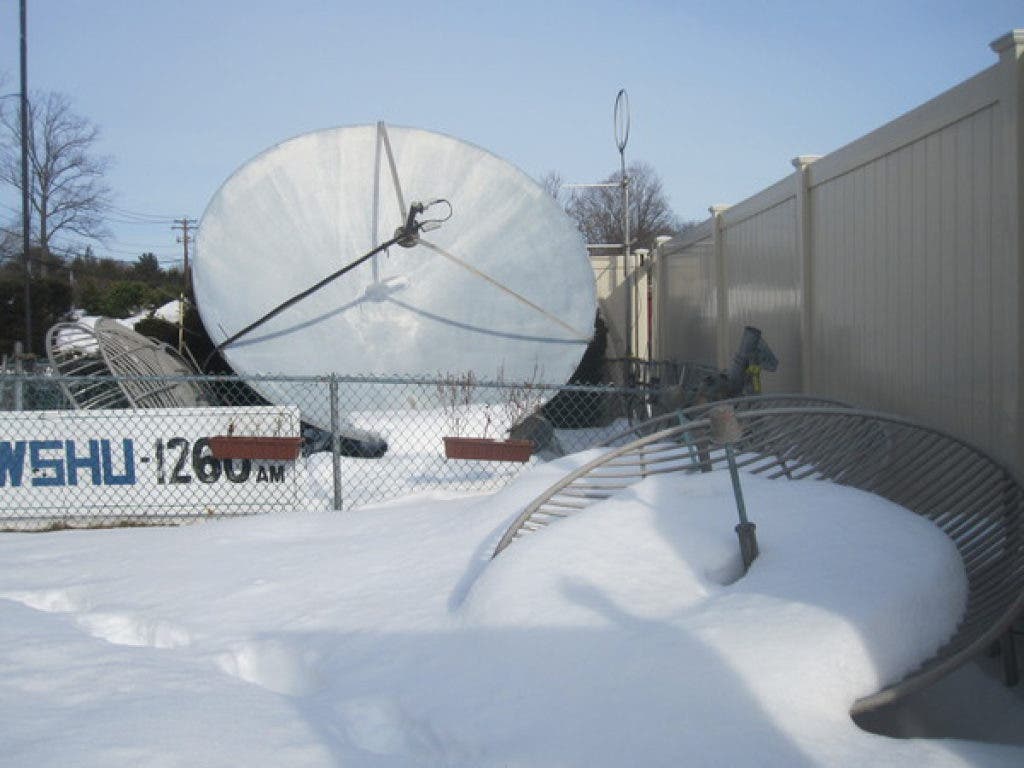
Luckily, Kuser is handy with a broom. During a recent blast of snow, a satellite dish outside the studio froze under the unusually deep accumulation. Broom in hand, Kuser braved the elements and swept away the pile of snow. That did the trick.
For just a few seconds, the signal had gone dead, but Kuser is confident only a few insomniacs may have noticed.
And just the day before, Kuser had been playing audio feeds back from a critical computer minutes before the show was to air when it crashed. With the computer down, it would be impossible to insert pre-recorded announcements and news stories generated by the five-member WSHU news staff during the morning broadcast.
As Kuser scurried with his scripts and cup of tea into a back-up studio, he called station engineer Paul Litwinovich at home. The droll-witted engineer can interact with the station’s complex technology from his home computer and he got the studio computer up and running from his remote location.
Kuser said the programming went on flawlessly.
“That’s what we try to achieve,” Starobin said later.
“The analogy to the duck is useful,” she added. “On the surface, you see the duck gliding smoothly and effortlessly across the pond, but if you could look underwater, you’d see the duck’s feet paddling like crazy.”
“Listeners should never see the paddling.”
The morning Patch visited was the morning after President Obama’s State of the Union speech. The temperature was 21 degrees, a snowstorm weather watch was in effect, Gabrielle Gifford’s condition had just been upgraded to “good,” Gov. Malloy was saying the state faced the worst per-capita debt in the nation and it was Lucinda Williams‘ 58th birthday.
The "Morning Edition" broadcast is split between the WSHU and National Public Radio, broadcasting from Washington D.C. Kuser’s on-air partners this morning are Steve Inskeep and Renee Montagne. (He’s met Inskeep in person, but he only imagines Montagne’s face.)
Washington carries the burden of the broadcast with national and international news from 5 a.m. to 6 a.m. – when Kuser is busy listening with one ear to the broadcast while editing down AP copy to make it radio-readable at his desktop computer. He never misses a beat. On subtle cue, his slender form dressed in a gray workshirt with rolled-up sleeves and belted Levi’s, he's at the mic giving weather and traffic updates. The 6 a.m. to 7 a.m. segment is more focused on local news inputs.
Kuser gets himself a hot cup of tea from the studio kitchen and warns that he would be talking to himself to get his voice ready for the broadcast.
“You don’t want to open your mouth and suddenly there’s nothing there,” he chuckles.
Kuser would hydrate his throat with nothing more than a sip of tea every now and then. (Kuser does clear his throat and cough, but there’s a “kill” button he can depress to avoid an on-air cough.)
The countdown to 5:00:00 a.m. is on.
At 4:48:38, hosts from the British World News are chattering about Academy Award nominations in their British accents as Kuser inserts the words “winter storm watch” into the script of his first weather announcement of the day.
At 4:57:58, he prints out the weather announcement and checks basketball and hockey scores from the previous evening.
At 4:59:02, the British broadcaster curtly says “Goodbye.”
“She says Good Bye and I get up,” Kuser remarks as he springs to close the door to the studio at 4:59:46 and clears his voice.
Glancing to the digital clock prominently facing the broadcast microphone, Kuser stands up at the controls ready to greet listeners with split-second timing, his feeds interwoven with the national broadcasters’.
At 5:00:03, the voice of Renee Montagne begins the day’s "Morning Edition" broadcast with a word about the President’s State of the Union address.
Without missing a beat at the pause, Kuser jumps in with his own succinct “Good morning,” mostly cloudy 21-degree weather report, “with snow coming in.”
As the program returns to Washington, Kuser dashes out of the studio to take transmitter readings required by the FCC and returns, whistling like a bird, to edit the AP copy, listening for his next cue to go live.
At 5:05:56, NPR Washington reports that convicted murderer Emmanuel Hammond of Georgia was executed overnight, his last appeal to the U.S. Supreme Court having been denied after a short stay.
Kuser takes over to give the station identifications – WSHU is one of three listener-supported affiliated stations broadcasting with nine frequencies and WSHU at 91.1 FM is its flagship. His voice travels from Greenwich to New Haven and to the south shore of Long Island.
At 5:17:54 he shoots an e-mail to Starobin.
“She’s here when she’s not here,” he explains.
Shortly before 6, he blurts out, “Naomi’s up!” having received an e-mail from Starobin, the station news director, responding to his earlier one.
The two e-mail back and forth about inserting audio clips of comments on the State of the Union address that had been provided by a capitol radio news service, which tracked down Senator Joe Lieberman and Congressman Jim Himes in the busy Congressional chamber.
Starobin had relayed the audio clips from her home computer directly into the computer an arm’s length away from where Kuser was sitting, where the segment was stored until the time came to air it. Once it came in, Kuser popped over to the console to play the beginning back to be sure it was set to go, all the while alert to the voices of Inskeep and Montagne, listening for signals their segments were coming to a close.
This morning, there would be no untoward glitches.
Throughout the morning, from 5 a.m. to 9 a.m., Kuser would spring to the mic to gave the local weather, radio station identification, read edited AP copy and introduce pieces by staff correspondents.
The computer in his brain alerts him when to make his moves to the mic.
“The schedule is imprinted in my brain,” he says, speaking of an almost extrasensory perception of time that keeps the split broadcast – from Washington and Fairfield – seamless.
The temperature is inching up a degree every few minutes and Kuser opens Venetian blinds to reveal a lightening sky.
By 8 a.m., the worst pressure is off, as NPR is beginning to go on a repeat cycle and all systems have been go for that morning.
The temperature has risen to 28 degrees by 8:48:48 and Kuser tells listeners to stay tuned for Kate Remington’s classical music program beginning at 9 a.m.
Remington has already entered the studio to say good morning to Kuser and they have bantered together while he’s been off the air.
A few minutes earlier, listeners had heard Kuser saying good morning to Remington on the air but, in fact, that segment had been pre-recorded the previous day.
“That’s how the sausage is made,” he acknowledged.
The only apparent glitch of the morning was a disparity between the National Weather Service forecasts and what Kuser could see with his own eyes through the studio’s “weather window”: as of 9:00:00, the snow was already starting to come down.