Politics & Government
South Windsor Officials Discuss October Snow Storm Response, Lessons Learned
Town Manager Matthew Galligan and Police Chief Matthew Reed said that town employees performed amiably, though some work needs to be done to prepare for a more severe weather event.


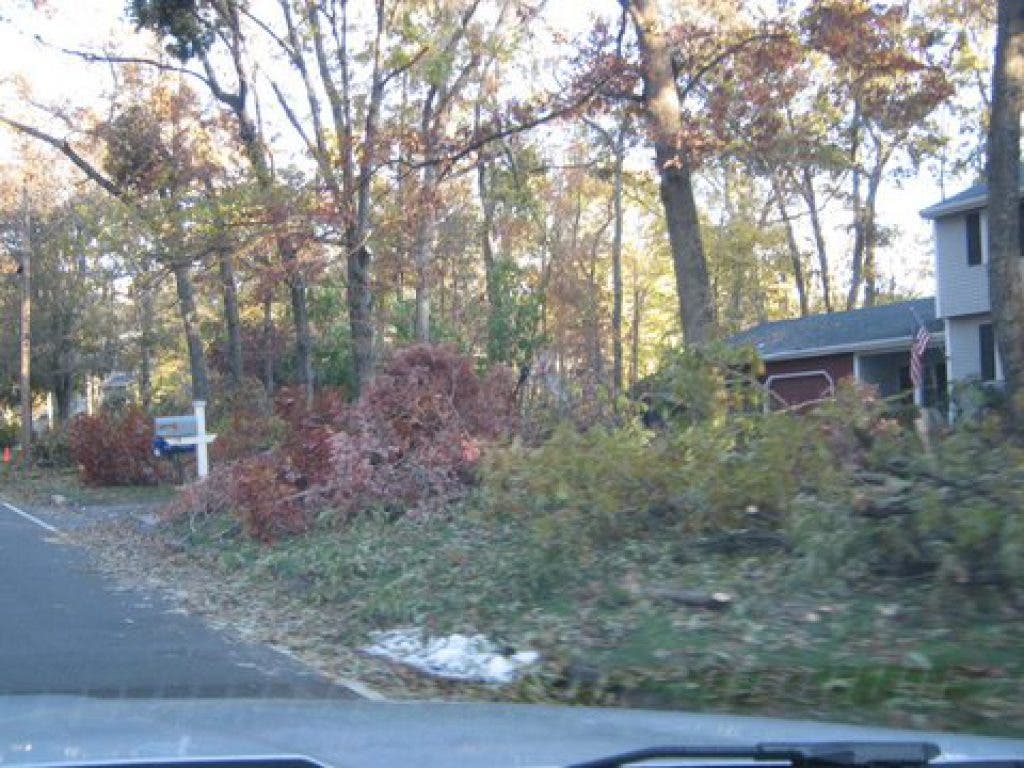


One year later, officials from the town of South Windsor have learned a lot in terms of emergency preparedness as a result of the late October snow storm that knocked out power in and around north central Connecticut for up to two weeks.
Town Manager Matthew Galligan said that South Windsor employees and volunteers performed well to meet the demands of feeding, sheltering and providing warming and charging centers for residents.
At peak demand, Galligan said that the emergency shelter at the high school was providing 800 people with meals. The town’s park and recreation department staff stepped up and provided entertainment - games and movies for children and adults, while the police department, fire department and department of public works crews worked to clear the roads and keep residents safe.
Still, Galligan acknowledged that the weather event - a freak snow storm - was nothing compared to the aftermath that could have been left in the wake of, say, a Category 3 hurricane.
“This is just a snowstorm that happened at the wrong time,” said Galligan, noting that in 1935, a Category 3 hurricane devastated the New England coast. “My fear is if that were to happen now, what if the shelter at the high school fails?”
What’s more, if such a storm were to hit, various sections of town would likely be cut off from one another. As a result, Galligan said that he believes that every school should have the capability of turning into an emergency shelter. That means fitting every school building with a generator, according to Galligan.
Another issue the town should resolve, Galligan said, is committing one building, like the Charles Enes Community Center, into a shelter specifically for the town’s employees and their families. Galligan said that this is not an issue of preferential treatment or favoritism, but one of pragmatism. Police, firefighters and public works employees cannot be expected to perform their jobs in the aftermath of a devastating storm if they are worried about the general health, welfare and safety of their families.
“Those family members can then become volunteers for the town,” Galligan said.
In addition, Galligan said that the town could use some communication redundancies, which is why he applied for a state grant to help turn the old post office on Sullivan Avenue into, among other things, an emergency operations center that is equipped with backup in case the town’s major communications tower goes down.
But with those three things in mind, Galligan said “overall our crews did well.”
Working well together
Chief of Police Matthew Reed put together several informational and safety videos - where to charge electronics and shower as well as update the progress of CL&P crews - that were uploaded to YouTube for people to view, while the town leveraged its website and social media - most notably its Facebook page and Twitter account - to keep people informed of the latest developments. Galligan said that there were about 100,000 hits to the town's Facebook page and website alone for November 2011.
Reed said that the town’s response was a result of the how well South Windsor’s employees worked together.
“Overall, I think the town was well-prepared,” Reed said in a telephone interview. “We contemplate these events … we knew the manager is in charge and we got together and said, ‘Here’s what we need to accomplish.’”
Find out what's happening in South Windsorfor free with the latest updates from Patch.
Reed said that there were minor things, like how much to stock up on consumables and pillows, that were lessons learned from the storm and power outages. In addition, public safety officials learned that with a significant number of older residents, people aren't necessarily going to receive messages through electronic communications.
Reed said that future emergency events may require more door-to-door visits from public safety officers, as well as possibly creating signs and communicating through loudspeakers.
Find out what's happening in South Windsorfor free with the latest updates from Patch.
"People aren't always linked in to the latest modes of communication," Reed said. "We need to work on that."
All in all, though, the experience went relatively smoothly, according to Reed.
Cleanup controversy
The biggest challenge, according to Reed, wasn’t so much the response as what to do with all that debris - some 310,000 cubic yards of it littered the town roads alone.
“Some parts of the town were particularly hard-hit, like Oak Street, Laurel and Williow Street,” said Reed, noting that those roads were named after trees for a reason.
Galligan said that the decision was made relatively early to use the state-bid contractor, which wound up costing about $8 million for the cleanup. The town is eligible, but still has not received, 75 percent - or about $6 million - of the total cost in reimbursement from the Federal Emergency Management Agency. There may even be more funds along the way, as there is a provision that the cleanup for roads that connect to other towns - like Sullivan Avenue and John Fitch Boulevard - are eligible for 100 percent reimbursement.
The town council, at Galligan’s behest, decided to bond the cost of the cleanup (it’s allowed under rare circumstances if the governor, the state attorney general, and head of OPM sign off on it) over a period of 10 years. While not an ideal solution, it’s one that Galligan said was the best one in lieu of all the other options, which included using the fund balance to cover the cost.
The decision to use the state contractor rather than have the town go out to bid as well as not using the fund balance to cover the cost has opened Galligan up to some criticism that he readily acknowledges.
But, as Galligan noted, going out to bid for a project of that type would have delayed cleanup by as much as three weeks. With winter fast approaching and residents - notably children- walking to school on the roads, the matter was one of public safety.
Also, the company utilized by the town for the cleanup was familiar with FEMA regulations, so everything was properly monitored and measured, Galligan said, meaning that the application for reimbursement went smoothly. The company, at the town’s recommendation, also hired South Windsor residents to act as monitors.
“The council made a tough decision,” Galligan said. “But in the end the cleanup was done in just six or seven weeks.” (Reed called the council’s decision “courageous.”)
The criticism that was levied his way was muted by the compliments he received for the swift cleanup that was done well. In addition, other municipalities that used their fund balances to cover the cost of cleanup jeopardized their bond ratings, Galligan said.
Get more local news delivered straight to your inbox. Sign up for free Patch newsletters and alerts.