Community Corner
Stamford Museum & Nature Center Removes Old Telescope
In order to demolish the now-abandoned Stamford Observatory, the historic Gregory Maksutov Telescope was removed from its dome on Tuesday.


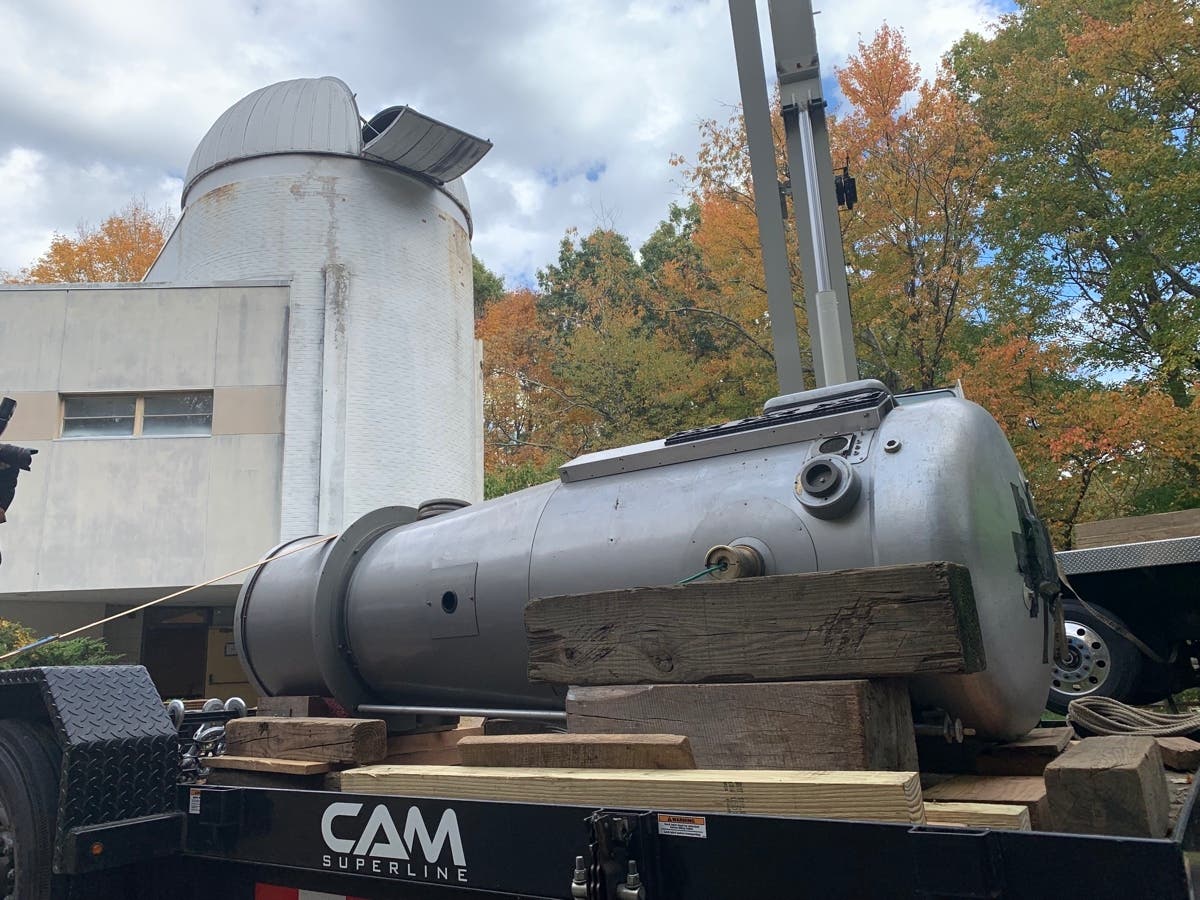

STAMFORD, CT — The Stamford Museum & Nature Center (SM&NC) took one giant leap on Tuesday afternoon towards the construction of a new planetarium and astronomy center at its campus at 39 Scofieldtown Road.
In order to make way for the demolition of the now-abandoned Stamford Observatory, the historic 22-inch Gregory-Maksutov Telescope was lifted out of its dome and loaded onto the back of a flatbed truck.
It will now travel roughly 2,100 miles to Magdalena, New Mexico, where it will be used by The Astronomical Lyceum.
Find out what's happening in Stamfordfor free with the latest updates from Patch.
At nearly 10,000 square feet, the new planetarium and astronomy center will feature three levels that include a first-floor, 100-seat planetarium auditorium with state-of-the-art technology; a second floor science lab classroom; and a third-level that includes housing for a new, modern 22-inch lunar telescope, a solar telescope and a rollback roof to a public viewing deck.
Additionally, the facility will serve as a center for STEAM (Science, technology, engineering, arts and astronomy, and math) education, that supports Connecticut state standards and new generation science standards.
Find out what's happening in Stamfordfor free with the latest updates from Patch.
The first phase of renovations to the 118-acre SM&NC campus was completed in 2018, when the Knobloch Family Farm House was opened.
Elected officials, community members and leaders from the SM&NC were on hand Tuesday at the observatory to witness the historical removal of the telescope and the beginning of the new phase of the center's master plan.

"At 10,000 square feet, the planetarium and astronomy center will create an enhanced signature venue for this museum," said SM&NC Board President Harry Day. "It brings together existing Stamford Museum and Nature Center programs under one roof for the first time in our 86 year history."
Stamford Museum and Nature Center CEO Melissa Mulrooney said, "We're interested in building a new planetarium and astronomy center that is simple and elegant."
In total, the facility will cost about $10 million. Mulrooney thanked Stamford's delegation to Hartford, Mayor Caroline Simmons, and private sector donors, for their support in moving the project along.
"This is truly going to be a world class gem for our city. I can't wait to see all the lives that are going to be touched… I can't wait to see the joy and creativity and educational programming that this will spark for so many in our community," said Simmons. "It's also going to be a world class attraction for our region and for our state, bringing in economic development and tourism dollars for our state."
With input from its Science Advisory Council and other experts, SM&NC decided to relocate the old telescope to The Astronomical Lyceum in Magdalena, New Mexico.
The Lyceum will be able to maintain the telescope, and provide dark-sky viewing and virtual programming for SM&NC members, something that's almost impossible on the East Coast in the New York City metropolitan area.
The telescope was first installed at the observatory in 1965 by the family-company Frank Compo & Sons Inc. Symbolically, the same company was on hand on Tuesday to remove the instrument.
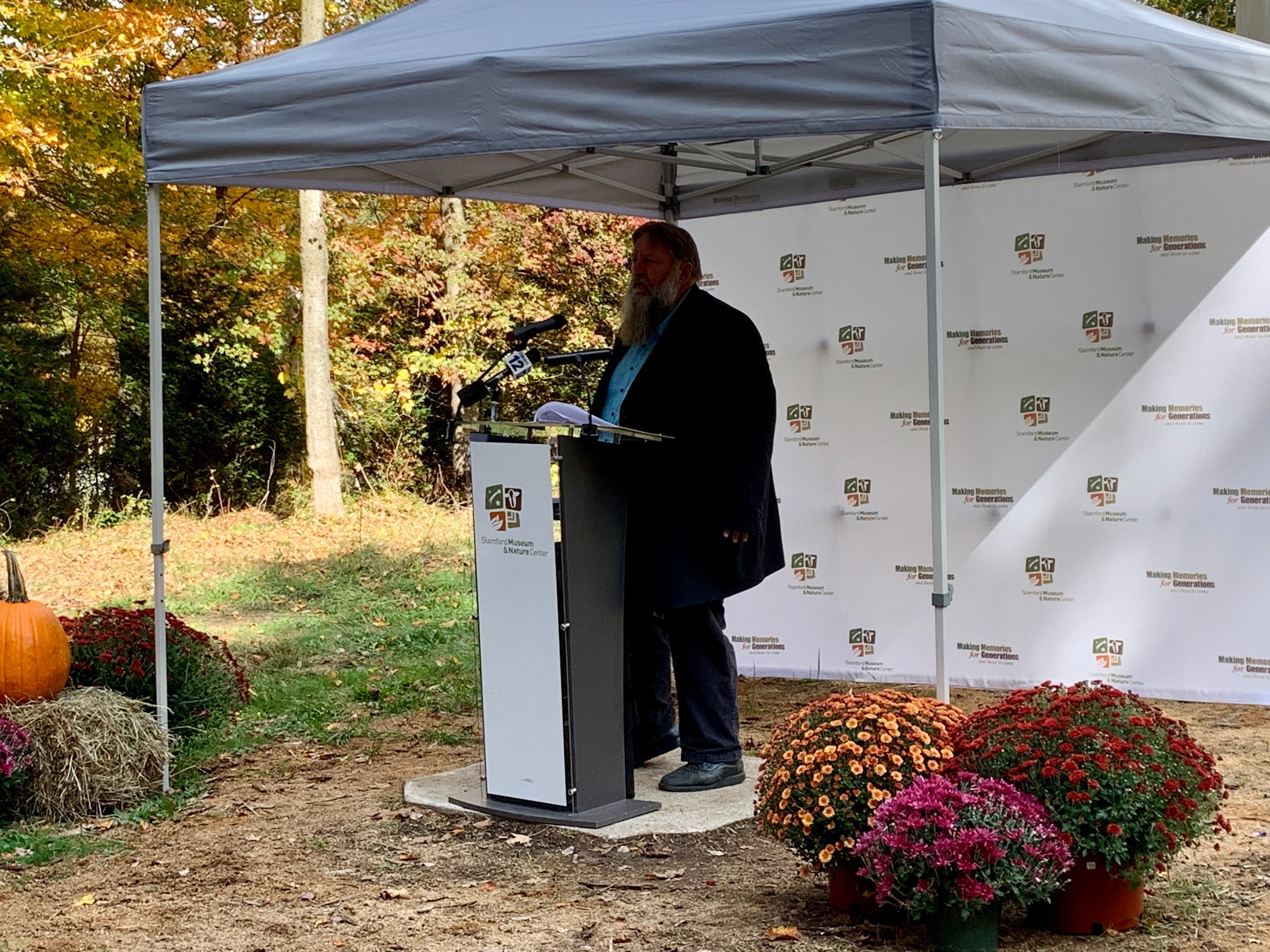
John W. Briggs, a telescope and observatory engineer and the curator at The Astronomical Lyceum, spoke briefly about the impact SM&NC and astronomy programs have had on his life.
In 1973 as a young middle school student from Massachusetts, Briggs attended a Symposium related to variable stars, hosted in part by the American Association of Variable Star Observers, at the old Stamford Observatory.
The symposium made such an impression on Briggs that he decided to devote his life to telescopes. He said it was "a little mind-blowing" to return to Stamford and now take the old telescope under his care.
"This particular telescope here was created as a wonder of the space age. The people who built it were particularly gifted engineers who had a love of astronomy," Briggs said.
The telescope was invented by Russian Optician Dmitri Maksutov. Its optical system was designed by Fairfield County Astronomical Society member John Gregory, who helped improve the performance of the instrument by building an extra secondary mirror to convert the telescope into a very wide-field camera.
"These instruments are just so fabulous and wondrous… I and my friends, who just adore telescopes, have the capability to take care of this one appropriately in the future, and we look forward to setting it up in New Mexico," Briggs added.
Briggs said the new facility and programming at SM&NC will inspire children, just as he was inspired 49 years ago. He also said it will help create a community among people with similar interests.
"There's a lot of kids who are already interested in science," Briggs said. "But if you give them a chance to learn about it in an extra-curricular way, it's very important."
Get more local news delivered straight to your inbox. Sign up for free Patch newsletters and alerts.


