Schools
Stamford HS Art Students Study At The Bruce Museum
The Museum's Educators offer a range of programs and workshops.

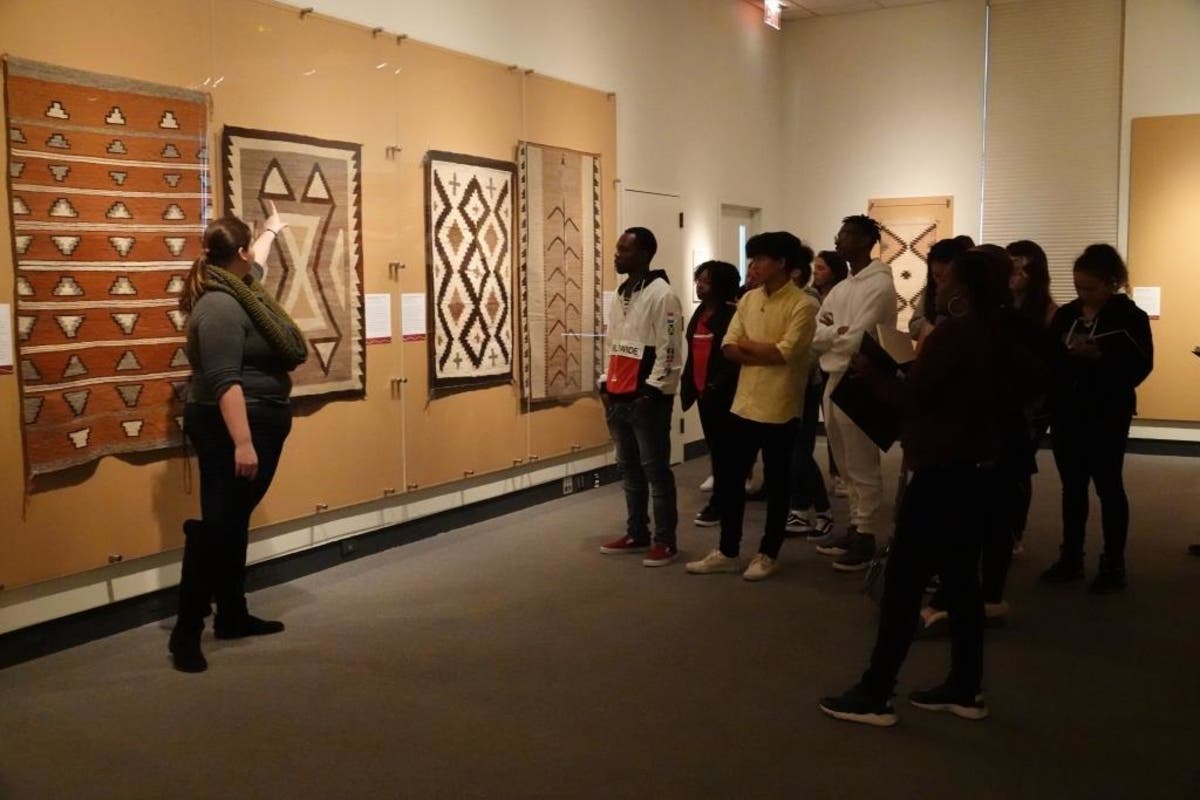
STAMFORD, CT - From the Bruce Museum: Each year, the Bruce Museum in Greenwich hosts thousands of students enrolled in dozens of schools from across the greater community. Much more than a day away from school, the Bruce serves as a classroom annex, albeit one chockful of wonders from the intersecting worlds of art and science.
The Museum’s Educators offer a range of programs and workshops that feature inquiry-based
learning, hands-on activities, and tie-ins to school curricula. Guided tours and thematic
workshops are designed to enhance a student’s understanding of scientific phenomena and
artistic concepts, enabling them to make important connections between the sciences and
humanities.
A recent visit by a group of students from Stamford High School brings the Museum’s role as an
educational institution, and its approach to partnering with local schools, into focus.
Find out what's happening in Stamfordfor free with the latest updates from Patch.
“The Bruce is a smaller museum, but the variety is awesome and the varying shows are a real
eye-opener for our students,” says Paul Cusano, chair of Stamford High’s Fine Art Department
and the AP Studio Arts teacher. “The natural history section of the collection, with its birds and
other objects, makes a great setting for observational studies, which is part of the AP students’
coursework. Colleges look for that in students’ portfolios.”
Cusano’s 13 AP Studio Arts students were joined by students from an IB Visual Arts class
taught by Module Downer. A component of Stamford High's International Baccalaureate
Diploma Program, the two-year IB course is one of seven courses that students take as part of
the internationally renowned and rigorous diploma program. It features an inquiry-based
curriculum, with an emphasis on writing and critical thinking.
Find out what's happening in Stamfordfor free with the latest updates from Patch.
Mrs. Downer’s IB students, all juniors, are required to make several visits to museums and
conduct gallery walks as a part of their curriculum. “The fact that the Bruce offers four distinctly
different exhibitions gave our students a wide variety of artwork to examine and consider in their
comparative study where they must research at least two artists with different contexts and use
that as a foundation in creating their artwork,” says Downer. “Seeing original artwork in person
provides students with an interactive experience with the art itself.”
The Stamford students began their tour of the Bruce in the Bantle Lecture Gallery, where the
exhibition, A Continuous Thread: Navajo Weaving Traditions is on view through November
25.
Featuring a dozen pieces from the Museum’s Native American ethnographic collection – some
of which have never been publicly exhibited – the exhibition traces the history of the Navajo
weaving tradition from the earliest Mexican-inspired Saltillo serapes, c. 1880, to mid-20th
century pictorial rugs. Each piece is an extraordinary example of artistic creativity and technical execution, Coordinator of Interpretative Services Diana Rafferty told the students in her interactive tour of the installation.
“It was inspiring to watch the Museum Educators engage our students in meaningful dialogue
about art, which gave them experience using art vocabulary outside of the classroom,” says
Downer. “Diana’s guided tour will come in handy as we do more critiques and museum visits.”
For Paul Cusano, the Navajo textiles also provide a tangible link that connects his AP art
students to the real world. “It was fascinating to learn how over time the weavings transitioned
from ‘homespun,’ functional textiles to more modern designs using brighter, more synthetic
materials,” he explains. “For the Navajo, it was a business decision, with artists following the
market not just to make art for tourist visitors, but a living for their families. Art students don’t
always get to address the more mercantile aspect of the subject they’re studying.”
The Museum’s major fall show, ReTooled: Highlights from the Hechinger Collection, “was
really enlightening and encourages critical and creative thinking in a similar way,” says Cusano.
Featuring more than 40 imaginative paintings, sculptures, works on paper and photographs, the
exhibition brings life to the unexpected subject of tools by profiling 28 visionary artists from the
Hechinger Collection, including Red Grooms, Walker Evans, Jim Dine, and Claes Oldenburg.
ReTooled is on view through December 30.
“We have testing that prompts students to define creativity, and ReTooled is custom-fit for
allowing students to explore the change process, to see how tools can take on new meaning,”
says Cusano.
The third exhibition on the tour was “right in our wheelhouse” for both groups of Stamford
students. Expressionism in Print: The Early Works of Richard Haas, 1957-64, which closed
on October 21, featured a selection of woodcuts and prints produced early in Haas’s career that,
in many ways, encapsulates the artist’s graphic evolution.
Wild Bees: Photographs by Paula Sharp and Ross Eatman may be the Museum’s smallest
current exhibition by space if not subject, but it had an oversized impact on the Stamford
students.
The exhibition, on display through November 11 in the Science Gallery, features exquisite color
photographs of native bees in their natural habitats, along with an exploration of their varied
lifestyles. The photographs are part of an ongoing wild bee project undertaken by
photojournalist and writer Paula Sharp and nature photographer Ross Eatman, who began
documenting wild bees inhabiting New York's Rockefeller State Park Preserve and neighboring Stone Barns Center for Food and Agriculture in 2014. Their lenses capture in beautiful detail the tremendous variety of shapes, colors and sizes of the insects. The essential role bees play in our planet’s health also comes into view.
“One subject we’re working on in AP Studio Art is microphotography, getting close to things,”
says Cusano. “We loved the photos, and the fact that the exhibit touches on larger themes is
important. Conservation is a subject for students to reflect on. The show has artful photos, but they also give students a jumping in point to tie that art back to larger issues, the health of our environment being chief among them.”
Soon after the Stamford students completed their tour of the Bruce, the teachers were already
brainstorming their next class visit with Corinne Flax, Manager of School and Community
Partnerships. She mentioned the hands-on potential of the upcoming exhibition Pressed for
Time, which will focus on botanical collecting in Connecticut from 1885 – 1944, through the
presentation of beautiful and fragile, historical herbarium sheets from the Museum’s
collection. Other new shows and learning opportunities await, from miniature sculptures to
cartoon art to sharks.
“I’m always open to doing something different, using our collections and inquiry-based STEAM
programs to complement and enrich a school’s day-to-day practice, of any grade level.”
Flax has one further tool in her kit, and for some schools it makes all the difference. Thanks to
generous support from GIVE: The Steven & Alexandra Cohen Foundation, the Bruce is able to
offer bus scholarships that enable schools to have their transportation costs covered by the
Museum, as well as having their onsite program fees waived.
“It’s nice to know that the Bruce has grant opportunities for students who may not be able to
afford this field trip,” says Downer, who learned about the scholarship after coordinating a PD
for Visual Arts Teachers as the District Content Leader for Visual Art in the district. “Not every
institution has that level of support from the community, and we’re grateful that the Bruce has
that capacity and the interest to share with school districts. It’s a win-win for both students and
teachers – and community.”
For more information about the Museum-based or BruceMobile Outreach Educational
Programs, please visit brucemuseum.org or contact Corinne Flax at cflax@brucemuseum.org or
203-413-6742.
Photo courtesy of Bruce Museum