Community Corner
UConn Business Professor Recognized for Wide-Reaching Efforts to Convert Agricultural Waste into Much-Needed Goods
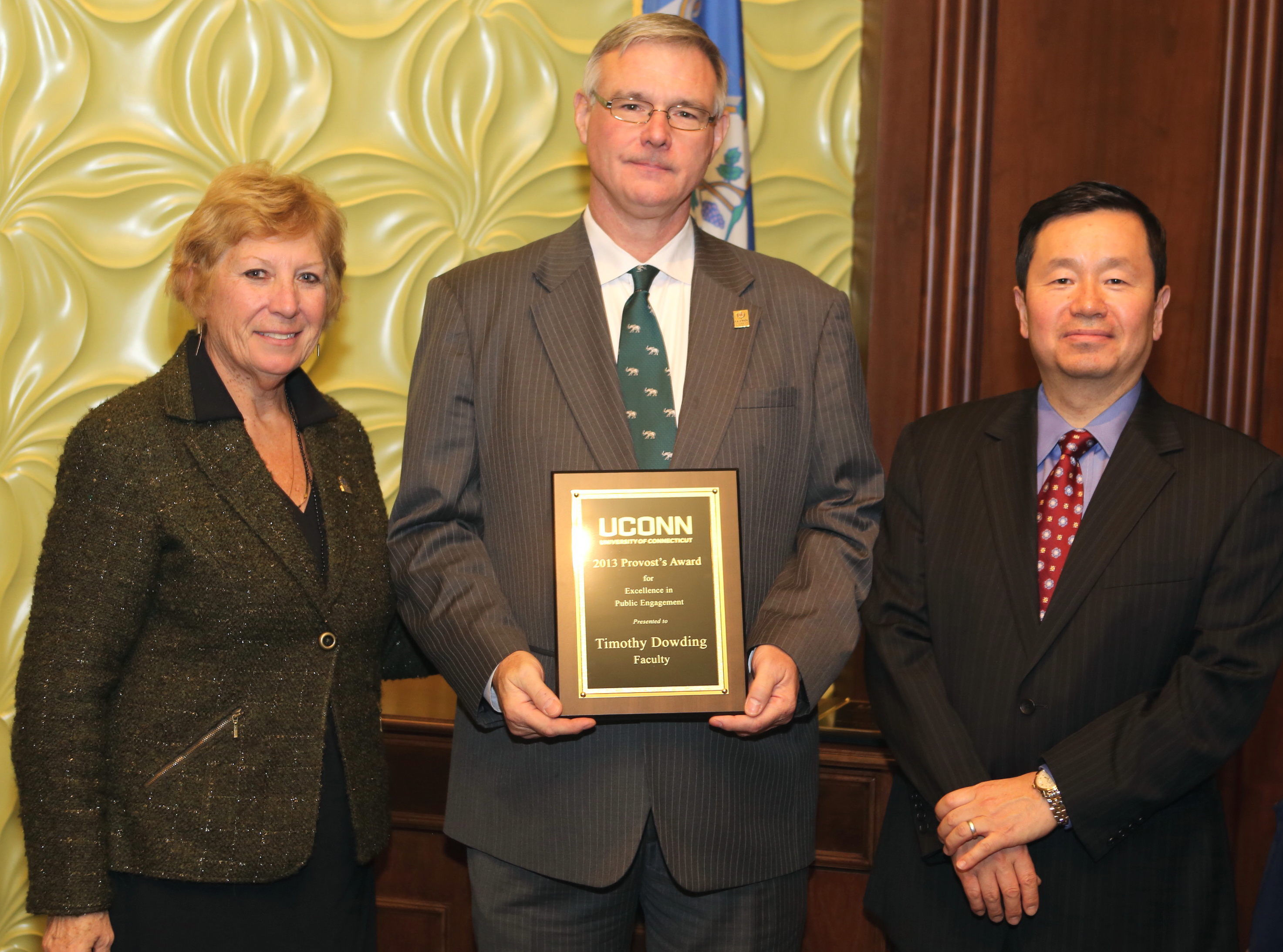
STORRS, CT (12/20/13) – UConn professor and Neag alumnus Timothy Dowding, who teaches at UConn's Stamford campus, recently received a 2013 Provost’s Award for Excellence in Public Engagement. Dowding was one of nine recipients chosen for their exceptional leadership, innovation and research efforts, which extended and enhanced the University’s presence in communities throughout and beyond Connecticut. Dowding's research has the potential to impact the world.
Carol Polifroni, director of UConn's Office of Public Engagement, heralded Dowding’s work to convert agricultural waste into profitable commodities as not just impactful, but “revolutionary, fulfilling the mutually beneficial purposes of community-UConn partnerships on local and international levels.”
Find out what's happening in Stamfordfor free with the latest updates from Patch.
Called the Tropical Emerging Market Eco-Industrial Park (TEMEIP) project, Dowding's work is as much dedicated to eco-sustainability as economic profits. It consists of converting wastes like seaweed into liquid fertilizer and coconut fiber into particleboard, as well as implementing the processes in countries where these natural resources and emerging markets exist, such as Haiti and Sri Lanka.
Find out what's happening in Stamfordfor free with the latest updates from Patch.
“While I’m flattered to be the recipient of this award, it really is not mine," Dowding said. "It belongs to the dozens of faculty and students from across many UConn schools and departments who’ve worked on a variety of interdisciplinary projects focusing on entrepreneurship and intellectual property commercialization.”
In his project poster “Helping Others Help Themselves: Outreach and Engagement through Sustainable Strategic Planning & Economic Development,” Dowding cited additional natural resources that can be converted into much-used and economically profitable ones, such as distilling sugar cane to make butanol, which can be sold for gasoline, and composting municipal solid waste to create clean compost for soil management. Compost solids can also be recycled or used for landfill.
Working with the Fulbright Commission, UConn Haiti Working Group and other organizations, Dowding has also shown an interest in promoting educational exchange and cultural awareness. His work could lead to international collaborations, including those through UConn's membership in the United Nations Academic Impact Consortium, faculty and student exchanges, and UConn's participation in Principles of Responsible Management Education, an international organization that matches countries' needs with university research efforts.
While grateful for the 2013 Provost’s Award, Dowding stressed that it hasn't been him alone working on this important initiative: “This recognition belongs to our community leaders and members who’ve worked with me over the past 10 years on a portfolio of projects to further UConn’s mission and goals, while enhancing and promoting our reputation as an international class university.”
“I’m merely the representative for all these people," Dowding continued, "and want to make sure they are all acknowledged, for without their help, none of this would have been accomplished. If we are not working together to help make the world a better place, why are we here?”
More information on UConn’s Engagement activities can be found at http://engagement.uconn.edu/.