Politics & Government
Judge Orders Prayer Banner Written By Stonington Man Removed
U.S. District Court Judge Ronald Lagueux issued a decision in the case against the prayer banner at Cranston West in favor of the ACLU and plaintiff Jessica Ahlquist.


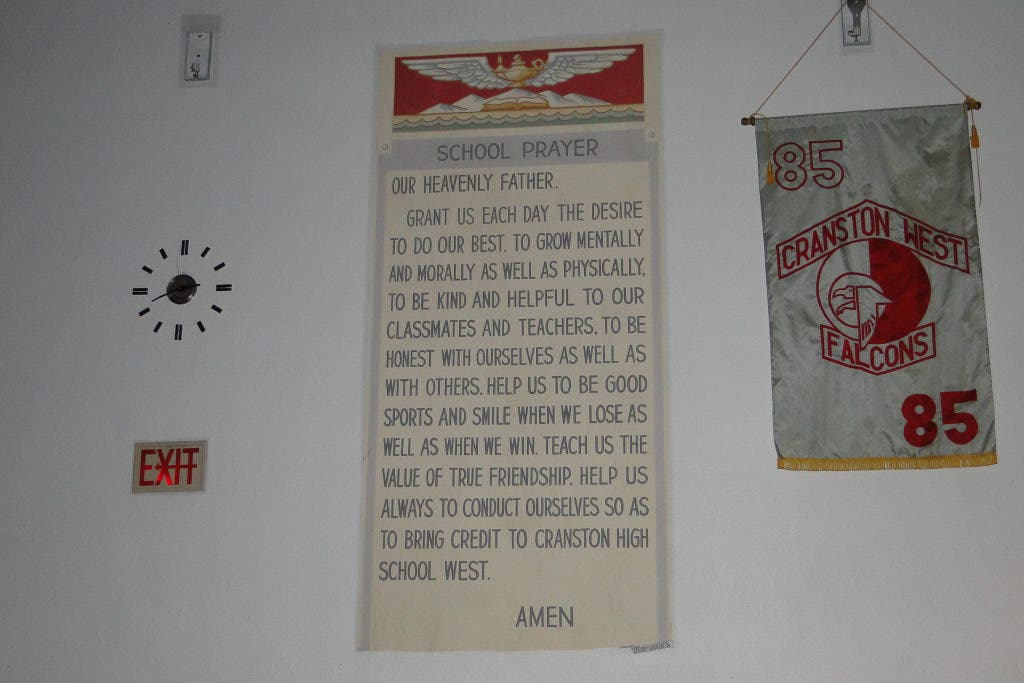
A judge has ordered a prayer banner written by David Bradley of Stonington and hung at , in Rhode Island removed from the school.
The prayer banner sparked a citywide discussion about religious freedom and separation of church and state that continues in the wake of Wednesday’s decision by U.S. District Court Judge Ronald Lagueux.
The banner was a present to the school from the Class of 1963.
Find out what's happening in Stonington-Mysticfor free with the latest updates from Patch.
Bradley said he was upset and disappointed in the decision on WPRO Morning News with Tara Granahan and Adnrew Gobeil.
“It’s a shame that some judge with an appointment out of a Cracker Jack box can make a ruling like that,” said Bradley.
Find out what's happening in Stonington-Mysticfor free with the latest updates from Patch.
The Cranston School District has 10 days to respond to the decision.
School Committee Chairwoman Andrea Iannazzi said in a telephone interview that she is "dissapointed in the end result,” and the School Committee will dicuss the decision next Tuesday when they should have a better of "where to go from here."
In the decision, Lagueux said Ahlquist "is clearly an articulate and courageous young woman, who took a brave stand, particularly in the light of the hostile response she has received from the community."
Lagueux states that "no amount of debate can make the School Prayer anything
other than a prayer, and a Christian one at that."
"The Prayer concludes with the indisputably religious closing: 'Amen;' a Hebrew word used by Jews, Christians and Muslims to conclude prayers. In between, the Prayer espouses values of honesty, kindness, friendship and sportsmanship. While these goals are commendable, the reliance on God’s intervention as the way to achieve those goals is not consistent with a secular purpose."
Lagueux referred to the School Committee's meeting during which the majority voted to formally defend the mural, stating "while the tenor of the School Committee's open meeting at times resembled a religious revival," committee members offered varied reasons why they felt the banner should remain, including two members who "were clearly motivated by their adherence to strong Catholic religious beliefs."
"The Court refrains from second-guessing the expressed motives of the Committee members, but nonetheless must point out that tradition is a murky and dangerous bog. While all agree that some traditions should be honored, others must be put to rest as our national values and notions of tolerance and diversity evolve," Lagueux wrote. "At any rate, no amount of history and tradition can cure a constitutional infraction. The Court concludes that Cranston’s purposes in installing and, more recently, voting to retain the Prayer Mural are not clearly secular."
To read the entire 40 page decision, click .
For a list of all stories about the mural issue, which will give you a detailed play-by-play of the lengthy and contentious pubic debate, click HERE.
Get more local news delivered straight to your inbox. Sign up for free Patch newsletters and alerts.