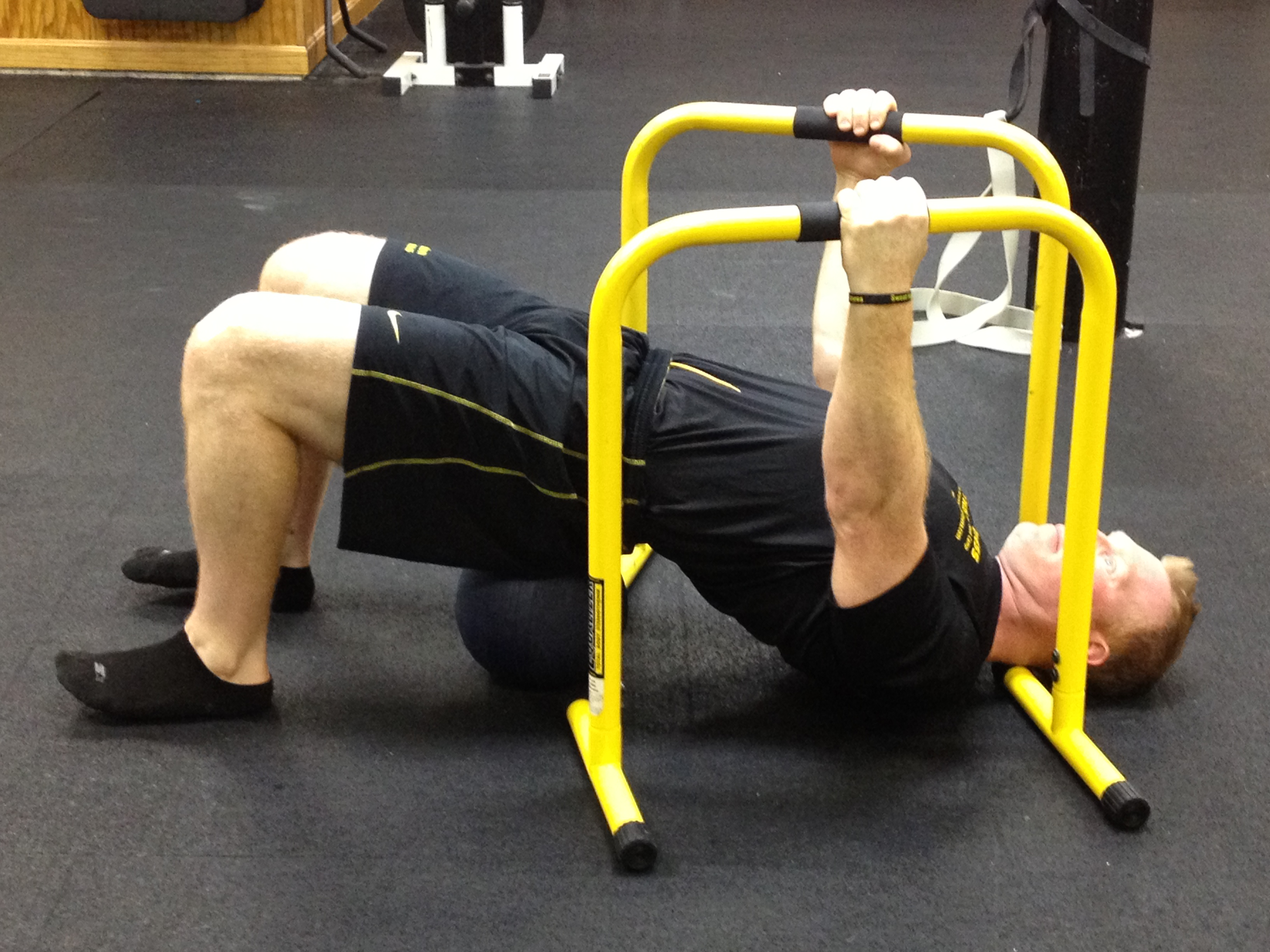


I love body weight exercises. I think they should be the basis of any training program. Body weight movements can be used for warming up, for cooling down, for flexibility and mobility. Body weight is way more than just push-ups, sit ups and planks…which are all great exercises by the way! Once you learn these movement patterns, they can be progressed to truly test one’s individual strength. You can progress body weight exercises to advanced movements like pistol squats, pull-ups, handstand push-ups and one-arm push-ups. However, there always seems to be one major body weight exercise that is left out of the equation, it is my missing link exercise...the body row.
When I design my training programs, I train opposing muscles groups or movement patterns. For every action – there is an equal and opposite reaction. For example, we all know that the push up is a fantastic upper body strength exercise – but when overused, it can cause some issues. The big muscle groups like the upper pectorals; shoulder and the internal rotators of the arm and shoulder can become shorter and tighter than the external rotators and scapula retractors. This tightness can possibly cause a forward rounding posture and possible neck and shoulder injuries. So to make sure I don’t cause these possible issues, I always have an opposite movement paired with the exercise, in this case, the body row. This is my push/pull relationship method of training.
The body row is the sister exercise to the push up, however, it is much less utilized. It also incorporates almost all the same muscle groups as the push up. The exception is that the prime movers are the back of the body (posterior chain) as opposed to the front (anterior chain) of the body. Most of the attention goes to the Pull Up as the ultimate body weight back exercise, which is of course an awesome exercise, but until my clients are strong enough to do them correctly, the Body Row rules the roost!
Find out what's happening in Stonington-Mysticfor free with the latest updates from Patch.
The Body row is technically a horizontal pull. Like I said, I use the Lebert Equalizers for my horizontal pulls because I can add some great variety to the pulls as well as bring them with me to where ever I want to train, inside or outside. Always having a place to do a pull up is sometimes an issue. So, if I am outside and want to add in some pulls, I can. I will also use a barbell set up in a squat rack and a TRX to mix it up.
Here are the main points on proper form for doing a body row using the Lebert Equalizers. When you get into your starting position, dig your heels into the ground and fire your glutes to keep your hips locked and aligned. Think of it as a straight line that continues from your knees to your hips to your shoulders to your ears. Think Perfect Plank too. Grab the black grips with a firm hold to fire the forearms. Before every pull (rep), make sure you are really squeezing the bar. Keep a neutral spine as you pull yourself off the ground. When you progress to the single arm body rows, your body will want to rotate on you. Do your best to keep your shoulders and hips parallel to the floor. Your core will get quite a workout here too!
Find out what's happening in Stonington-Mysticfor free with the latest updates from Patch.
So there you have it, the missing link in obstacle course/mud run training that not only enhances your racing but also increases your overall strength.