Community Corner
Stratford's Great Meadows $4M Restoration Project Unveiled
Thirty-four acres of salt marsh was restored with the help of 12 "Salt Marsh Stewards" from Stratford and Bunnell high schools and others.


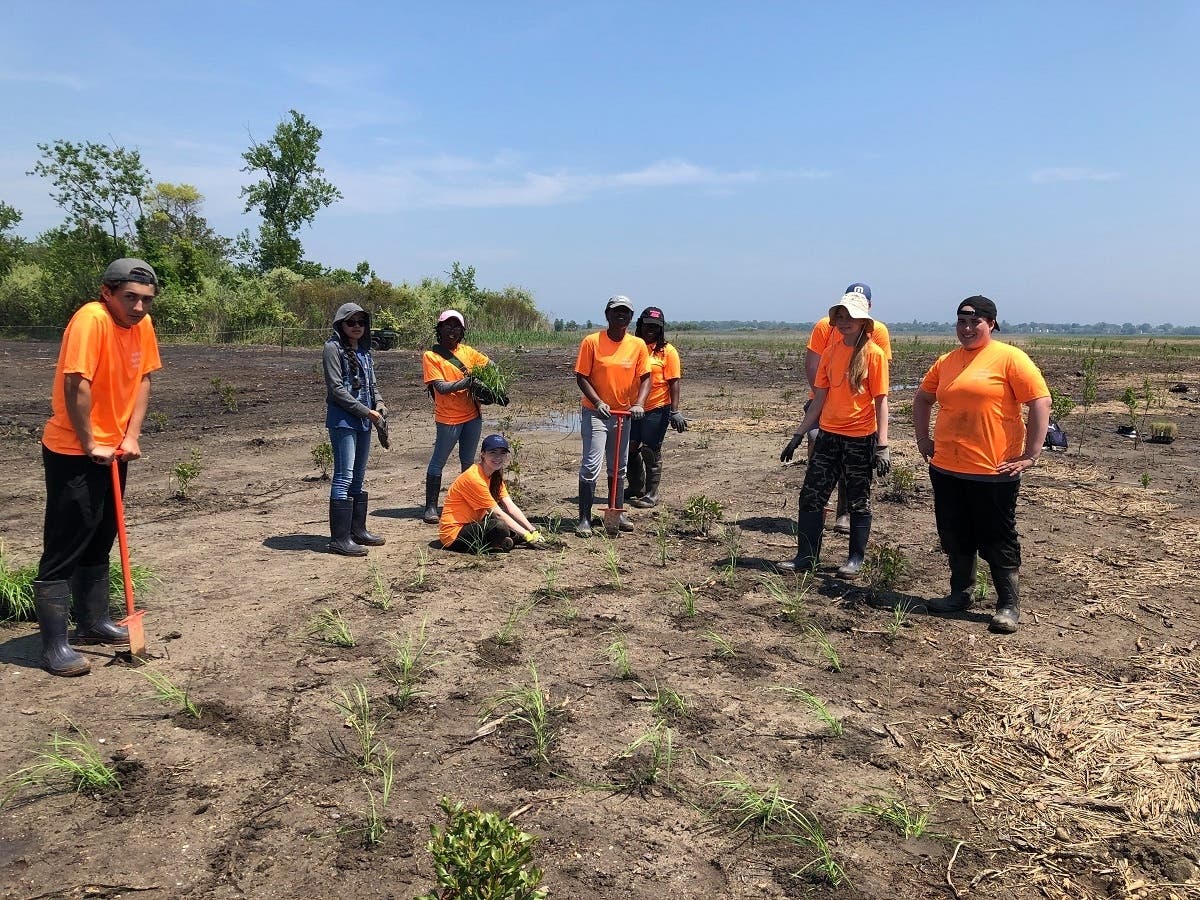
STRATFORD, CT — The $4 million restoration project of Stratford’s Great Meadows Salt Marsh was celebrated with a ribbon-cutting ceremony on Tuesday.
After years of planning and fundraising, 34 acres of salt marsh and other important coastal habitat has been restored at Great Meadows Marsh, a Globally Important Bird Area, and part of Stewart B. McKinney National Wildlife Refuge, according to officials.
The public is now welcome to visit the marsh’s old - and new - trails, and take in the sights of fall migration via two viewing platforms, officials said.
Find out what's happening in Stratfordfor free with the latest updates from Patch.
Since construction began in October 2021, Great Meadows Marsh has “transformed into a haven for threatened plants and animals, and community access has been greatly improved,” according to a news release.
More than 155,000 native coastal plants and shrubs were added to the site by 12 paid, seasonal “Salt Marsh Stewards” from Stratford and Bunnell high schools - with the help of three crew leaders and more than 150 volunteers; a new creek restored the natural flow of salt water in and out with the tides; grassy mounds were created to provide an elevated home for nesting Saltmarsh Sparrows; and two viewing platforms were built (soon to become ADA-accessible), the news release states.
Find out what's happening in Stratfordfor free with the latest updates from Patch.
“I would have never applied to Aquaculture high school in Bridgeport if I hadn’t gotten this experience, because it really opened my eyes for the way you can change ecosystems around you and improve them, even if they’re just 10 minutes away from your home,” said Amelis Medina, salt marsh steward.
Monserrat Martinez-Garcia, also a salt marsh steward, said, “Before, I decided I wanted to be a biochemist, to major in biochemistry, but during the duration of this job I actually am thinking of switching my major into environmental conservation, and seeing what I can do to help the environment, and make it better than what it is now.”
State Sen. Kevin Kelly (R-Stratford) said it was an “incredible accomplishment resulting from the work of so many to restore and revitalize the marsh, protect wildlife, rebuild ecosystems, and combat the effects of climate change.”
“To see this project completed with the restoration of 34 acres of salt marsh is wonderful and transformative,” Kelly said. “This could not have been done without the 12 students from Stratford and Bunnell high schools who worked as Salt Marsh Stewards, as well as their crew leaders and over 150 volunteers who gave their time. Our entire community shares our deepest gratitude with all who invested in this project to improve CT's coastline and give our beautiful native plants and wildlife the ability to thrive. I look forward to visiting with my kids and grandkids, and seeing future generations learn about the importance of protecting and preserving our coastline and salt marsh."
Democratic State Rep. Joe Gresko, House Chair of the Environment Committee, said: “It was an honor meeting and working with the Stratford high school stewards to help restore the native plant species. You can see new growth already. Many thanks to all who saw this project through many years. The Stewart B. McKinney National Wildlife Refuge and Great Meadows Marsh protect our coast from the effects of climate change, while hopefully fostering continued thoughts of environmental conservation for all of Connecticut.”
U.S. Sen. Richard Blumenthal (D-Conn.) said it was a “banner day for Great Meadows Marsh.”
“Less than a year ago, we stood here to announce that this important coastal habitat would be restored and today we celebrate the completion of that worthy and necessary project,” Blumenthal said. “This restoration of 34 acres of salt marsh has not only created a healthy habitat for birds, fish, native plants and all kinds of animals, but also a recreation opportunity for people to fish, bird walk and talk a peaceful walk.”
Read more about the project from the news release below:
While there is much to celebrate, project partners Audubon Connecticut, the National Oceanic and Atmospheric Administration, U.S. Fish and Wildlife Service, and Connecticut Department of Energy and Environmental Protection will dedicate three additional years to monitoring project outcomes and improving upon their successes. Invasive species will continue to be managed, and additional native plants and shrubs will be put in the ground.
The salt marsh at Great Meadows was once more than 1,400 acres, but largely due to development, it had been reduced to less than 700 acres. As well, because of dredged soils brought in as fill, colonization by non-native plants, and sea-level rise, portions of it no longer functioned properly. The degraded marsh produced abundant mosquitoes that plagued locals and visitors for years.
Now, the restored marsh and its creeks provide healthy habitat for Horseshoe crabs and Blue crabs, the beautiful and endangered Marsh Pink flower, Saltmarsh Sparrow and other migratory birds, and fish like Atlantic Silverside and Menhaden.
Since the project was announced in 2019, it grew to represent a $4.65 million investment in Connecticut’s coastline. $3.65 million in support was raised thanks to the U.S. Fish and Wildlife Service, the U.S. Environmental Protection Agency, The Nature Conservancy, the Army Corp of Engineers In Lieu of Fee Program, the Robert F. Schumann Foundation, and the Jeniam Foundation. Funding of nearly $1M came from three natural resource damage case settlements related to contaminated sites close to the area: Raymark Industries, Lordship Point Gun Club, and Housatonic River/General Electric. These case settlements supported planning and engineering, and leveraged funds for the project construction and future monitoring.
Additional project successes include:
● Habitat restored and/or improved for fish and other aquatic wildlife. Over 2,000 linear feet of tidal channels have been created on site. The removal of berms improves access to nesting areas for diamond-backed terrapin turtles.
● Mosquito populations reduced and human health concerns addressed. A more natural flow of salt water in and out of the marsh with the tides - rather than pools of sitting water – has reduced breeding grounds for mosquitoes.
● New strategy tested to create habitat for declining Saltmarsh Sparrow. Within the marsh, scientists built “hummocks” – mounds of dirt that act like elevated islands. On those mounds, they planted grasses that thrive in the high marsh, like saltmeadow cordgrass (Spartina patens) and saltgrass (Distichlis spicata). The elevated hummocks allow Saltmarsh Sparrows to nest higher up in the marsh to avoid fatal flooding. The birds will be monitored next spring and beyond, and if effective, the strategy could be expanded coast-wide.
The U.S. Fish and Wildlife Service manages this portion of the Great Marsh as part of Stewart B. McKinney National Wildlife Refuge, part of a national network of more than 560 refuges spanning the country. These lands protect iconic species and provide some of the best wildlife viewing opportunities on Earth. The trails and viewing platforms at Great Meadows are open to visitors daily from half an hour before sunrise to half an hour after sunset.
Get more local news delivered straight to your inbox. Sign up for free Patch newsletters and alerts.