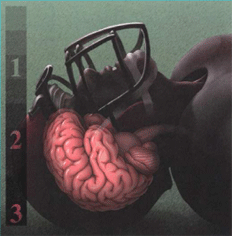


This has been the season of the concussion in the National Football League, where the kind of violent hits that were once celebrated by the league are now drawing $75,000 fines. Never before has so much attention been focused on the risk of injury football players accept by putting on a helmet and shoulder pads. This is a good thing — the danger is not limited to professionals but is present at all levels of the game, including high school and youth football.
As the sports world debates how to make football safer without turning it into two-hand touch, young athletes and their parents should realize that football is not the only game that carries risks.
A study by the Center for Injury Research and Policy at Nationwide Children's Hospital in Columbus, OH, published in the October issue of the Pediatrics journal, revealed that basketball-related concussions rose by 70 percent over the past decade, even as other injuries in the sport declined.
Find out what's happening in Tollandfor free with the latest updates from Patch.
There are a number of possible explanations for the increase. Researchers suggest better medical attention has left fewer concussions undiagnosed. As girls basketball players were more likely to be treated for concussions than boys, there is also the question whether girls are more likely to seek attention when suffering from headaches, confusion and dizziness.
Whatever the reasons behind the findings, parents can at least be assured that Connecticut is at the forefront in ensuring kids who suffer a concussion while playing sports are properly diagnosed and treated.
Find out what's happening in Tollandfor free with the latest updates from Patch.
Last summer, the state legislature passed a bill requiring all high school coaches to undergo training that would allow them to better diagnose a possible concussion. The new law also set guidelines for when an athlete suspected of having a concussion can return to action.
No doubt there are problems with the law, most notably the logistical and financial burdens it has placed on school districts. Small school districts, especially, are already feeling the squeeze of tightening town budgets.
The law also ignores youth sports coaches, including AAU and travel team coaches, who are an ever increasing part of a young athlete's life.
Still, the law is a good start. The stakes are high.
Consider a study by the University of Illinois in which athletes from a variety of sports were asked to complete a series of cognitive tests. Almost half of the athletes had suffered at least one concussion during their athletic career.
The results were sobering.
While the athletes who had previously suffered concussions scored about as well as those who had never suffered a concussion, analysis of their brain activity indicated less activity in the area of the brain related to attention. More simply put, athletes who had experienced concussions had to devote more time to achieve similar results than those who had not sustained a head injury. This naturally raises questions about the potential long-term damage even one concussion might cause.
As the researchers concluded: "It is not clear if these persistent deficits will manifest into clinical pathologies later in life."
This is certainly not a call for kids to stop playing sports. The more active our youth are, the better, considering the rise in obesity among young people. Yet parents need to know the risk doesn't disappear once games move indoors.
Adults should pay close attention to kids who have suffered a bonk on the head during any sport and seek treatment if their child seems confused or has trouble sleeping. They should also be thankful to live in a state where coaches are trained to spot a kid in trouble.
After all, a majority of sports injuries occur in practice, while parents are off at work, having left their children in the care of others. It's just good sense to make sure that those in charge are as knowledgeable as possible.