Business & Tech
Eversource Answers, 'What Am I Paying For?' On Summer Power Bills
On average, Connecticut customers use 35 percent more electricity during the summer months, primarily to stay cool, utility officials said.


CONNECTICUT — Eversource Energy this week offered to answer the age-old question — "The electric bill: what are customers paying for?"
Eversource officials said customers' energy bills are made up of two parts – the supply charge and delivery charge. The supply charge reflects the straight cost of the energy that customers use in their homes, they said. As required by Connecticut regulation, the energy supply price changes twice a year – Jan. 1 and July 1 for residential customers who receive their energy supply from Eversource.
"We do not earn a profit on the cost of electricity. We only charge customers what we pay generators for producing the power.," utility officials said.
Find out what's happening in Tollandfor free with the latest updates from Patch.
The delivery charge is made up of several fees and charges that fall into three categories:
- Transmission
- Distribution, Operations and Service
- Public Policy
Here's an example of an electric bill of $150:
Find out what's happening in Tollandfor free with the latest updates from Patch.
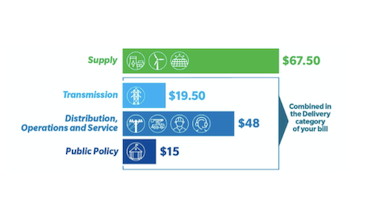
So what makes up the three categories in the delivery side of the bill?
Transmission is the cost of building, maintaining and operating the regional transmission
system that brings electricity from power generators to the local distribution system, officials said.
They described Distribution, Operations and Service charges as those "encompassing how we safely and reliably deliver power from the transmission system to homes and businesses.
They continued, "Beyond delivering the power, this service includes the cost of skilled employees and the technologies they use to operate and maintain the local system of poles and wires and provide customer service. It also includes the cost of improvements to make the electric grid more resilient and reliable."
The public policy portion includes costs mandated by the state and federal government
for financial assistance and energy efficiency programs, purchasing renewable and carbon-free electricity, and funding solar and electric vehicle incentives to help make it easier to take advantage of clean energy options.
The supply and delivery charges are both driven by the amount of energy used each month.
"The more energy a customer uses, the higher both the supply and delivery portions of the bill will be, especially as we approach warmer weather," officials said.
On average, Connecticut customers use 35 percent more electricity during the summer months, primarily to stay cool, officials said.
"We encourage all of our customers to take advantage of the many energy efficiency programs and services we offer that can help them save money and energy at Eversource.com/home- savings," officials said.
Eversource officials also pointed out a variety of payment and bill assistance programs accessible via the eversource.com website.
Get more local news delivered straight to your inbox. Sign up for free Patch newsletters and alerts.