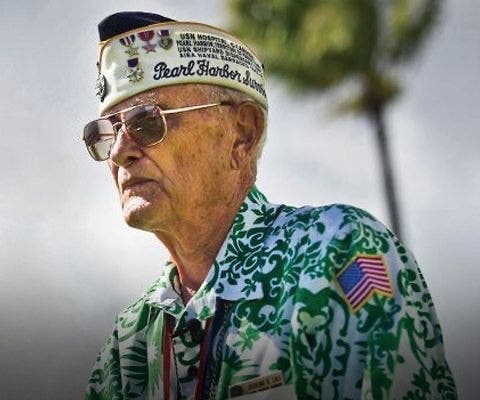
A rising sun was the first sign to Sterling R. Cale that something was off. But rather than the sun, it was Mars, the god of war, that became his uninvited and all-too-frequent companion in a military career that spanned from World War II through the Vietnam War.
On the morning of Dec. 7, 1941, Cale was a 20-year-old Navy hospital pharmacist’s mate stationed at Pearl Harbor. He’d just eaten breakfast and was walking to the receiving station when he noticed something happening on Battleship Row.
“‘How come they’re bombing the battle wagons?’” he thought at the time. “‘We don’t train on Sunday! Must be some sort of National Guard or reserve activity’ .... But then, as I was watching, a plane came by with the Rising Sun on the fuselage, and I said, ‘My God, those are Japanese planes!’”
Find out what's happening in Tollandfor free with the latest updates from Patch.
In that moment Cale’s life, and the world, changed. Though he wasn’t a strong swimmer, Cale walked into shallow harbor waters to retrieve wounded and dead bodies over the next two hours.
“I only picked up 46 people,” he told The American Legion in 2019. “Some of those people were dead already. Some were badly burned, and I would try to pick them up and the skin would come right off their hands. Some of them were just tired because they were blown off the ship or jumped and had to get ashore.”
Find out what's happening in Tollandfor free with the latest updates from Patch.
A life member of John R. Rowe American Legion Post 17 in Honolulu, Cale, 98, has told the story of his Pearl Harbor experience hundreds of times –often with tourists to the Pearl Harbor National Memorial, and the handful of living survivors who visit. “In the last 10 years we talked to 25,000 students from fourth grade up to college. We told them all about it. Japan didn’t like to let anybody in their country know how they attacked our country and our ships.”
Like most people in his generation, Pearl Harbor was Cale’s first exposure to combat. A farm boy from Macomb, Ill., Cale enlisted in the Navy with the intention of serving in the dirigible airship program at Lakehurst, N.J. But the 1937 Hindenburg disaster led to the program’s cancellation and a change in Cale’s plans. After the attack on Pearl Harbor, he was attached to the 1st Marine Division, where he would serve as a corpsman at Guadalcanal.
In the book “Sterling Cale: A True American,” Cale’s son, Sterling V. Cale, writes, “May we take the life of one man and his family to heart, and emulate it to continue our country’s great legacy and remember the sacrifices that were made for our freedom.”
Today, Cale is believed to be the last living military Pearl Harbor survivor still residing in Hawaii. His home is just a few miles from where the attack occurred.
“It has always been on my mind,” he said. “I know what happened, how it happened, (but) I can never understand why it happened.”
Credits: John Raughter is deputy director of media relations for The American Legion.