Business & Tech
UI officials urge customers to 'switch'
Switching suppliers does not financially hurt local electric utility, and can save customers some money.



A difficult job for United Illuminating (UI) officials is to convince its customers that if they switch electric supplies then it will not harm UI financially.
It is equally difficult for some to follow when electric company officials say that switching electric suppliers can save money for customers who live in UI's 17-town service area, including Trumbull.
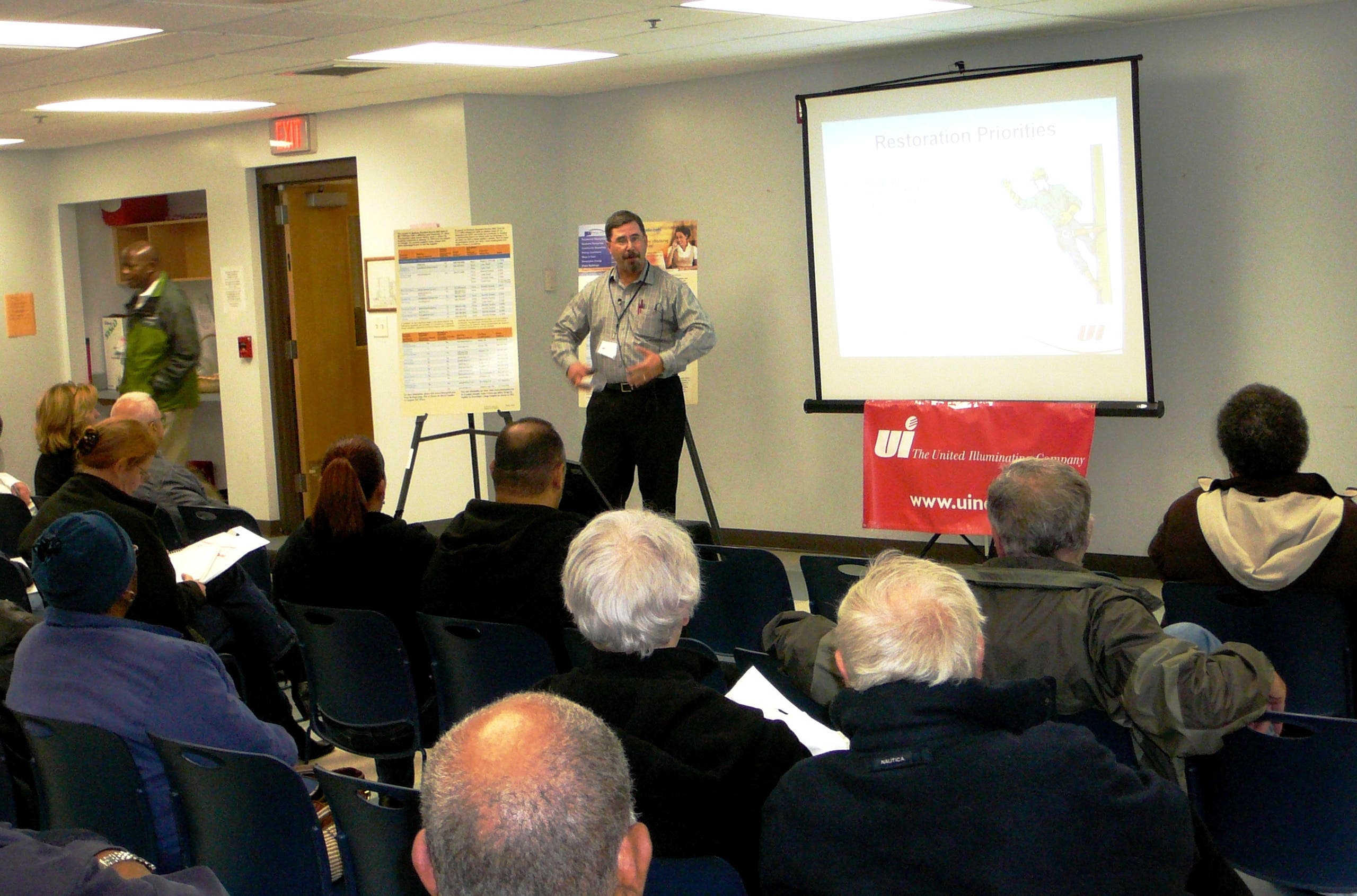
Several of the 40-plus people attending the meeting held Tuesday evening, Nov. 16, at the Birdseye community building in Stratford, commented that they believed UI would lose money if they – the customer – switched to an alternate supplier who offers a cheaper electric rate.
Find out what's happening in Trumbullfor free with the latest updates from Patch.
"Not true," said Jim Michaud, UI's Manager of Supply Relations, who told the audience that customers switching suppliers was basically revenue neutral for UI, which is a state and federally regulated electric utility.
Instead, Michaud said, switching suppliers for customers was akin to "picking up a $10 bill off the street. Who here wouldn't pick up that $10 bill?" he asked.
Find out what's happening in Trumbullfor free with the latest updates from Patch.
"Why switch?" he continued. "You can save up to 20% immediately on the generation portion of your bill.
"There is no cost to switch.
"UI encourages the switch.
"You can change suppliers once a month in case you are not happy with your situation, even switch back to UI.
"And 70% of our load (largest users) and 38% of our customers have switched."
Michaud added, "I personally switched suppliers in 2007," adding that he has changed his electric supplier four times since to take advantage of lower rates. "I have probably saved $1,000 in total."
Michaud was one of three speakers at the hearing held to discuss UI's emergency storm response plans, capital and electric infrastructure needs, deregulation and alternate suppliers.
The meeting was the last of four the utility has held in West Haven, Hamden, Orange and Stratford since mid-October. In its press release, UI said, "The meetings are an opportunity for customers to learn about a variety of topics," and provides an opportunity for customers to "talk directly to company executives.
"Things are changing in the energy markets and we felt it was important to reach out, engage our customers again, particularly those in the residential sector, and be a true resource for them," said Michael J. West, Jr., UI's Director of Corporate Communications.
Speaking first in Stratford was Bill Ostrum, UI's Director of Construction Operations, who outlined UI's storm response priorities and procedures. One facet of UI's pre-storm planning is assessing the forecast. "For instance, tonight there's a wind advisory and we might put out more crews" in anticipation of outages, Ostrum noted.
He also discussed the electrical system's "aging infrastructure" and the need for capital expenditures to modernize and maintain the grid. "We are spending a lot of cash again" to upgrade equipment that was installed decades ago. "Some older equipment dates back to the 1940s and 50s," he said.
Ostrum also described UI's asset management group, which creates near and long-term asset replacement plans and strategies based on certain criteria including industry experience and norms." The company projects a "10-year planning horizon" when analyzing needs.
He also described the two major components of a customer's electric bill: the first for generation, and the second for transmission and distribution.
Generation involves the cost of providing the electric supply, which is state regulated, and a business that UI is not legally allowed to be in. UI customers can learn more about switching suppliers by going to the web site: www.ctenergyinfo.com.
The distribution portion of the electric bill is where UI gleans its business revenues. No matter who a customer may pick to provide its energy supply, UI will always be the company that responds to power outages, maintains the poles and lines and provides customers a bill, Ostrum said.
UI officials fielded a handful of questions from customers. One asked about the company's stockholders and dividend policy. Another wondered if it was cheaper to install electric utilities underground.
Ostrum said the state Department of Public Utilities Control sets the electric rates in Connecticut, which includes incomes for dividend distribution to stockholders. At the close of business on Nov. 16, one share of UI's common stock stood at $29.44, and was paying about 5.74% in annual dividends.
"If we didn't pay a dividend, we wouldn't have any shareholders," Ostrum said.
Regarding underground electric utilities, Ostrum agreed such a system would be cheaper to operate as opposed to the over-ground electric pole and wire distribution system that is prevalent today. "But it would be very expensive to bring the electric distribution underground, prohibitively expensive in my opinion," he added.
On the other hand, "smart" expenditures that allow the utility to read a customer's electric meter from a computer in an office, or monitor the flow or electricity from one region to another to facilitate more efficient distribution of existing supply have risen substantially, Ostrum said.
Get more local news delivered straight to your inbox. Sign up for free Patch newsletters and alerts.