Neighbor News
Roots of Prosperity #America250, #USA250: Who Holds the Pen (or the shovel).
If anyone can be Freeman, how is our 'local history' documented by the people for future generations?

In the Neighborhood, Literally & Figuratively
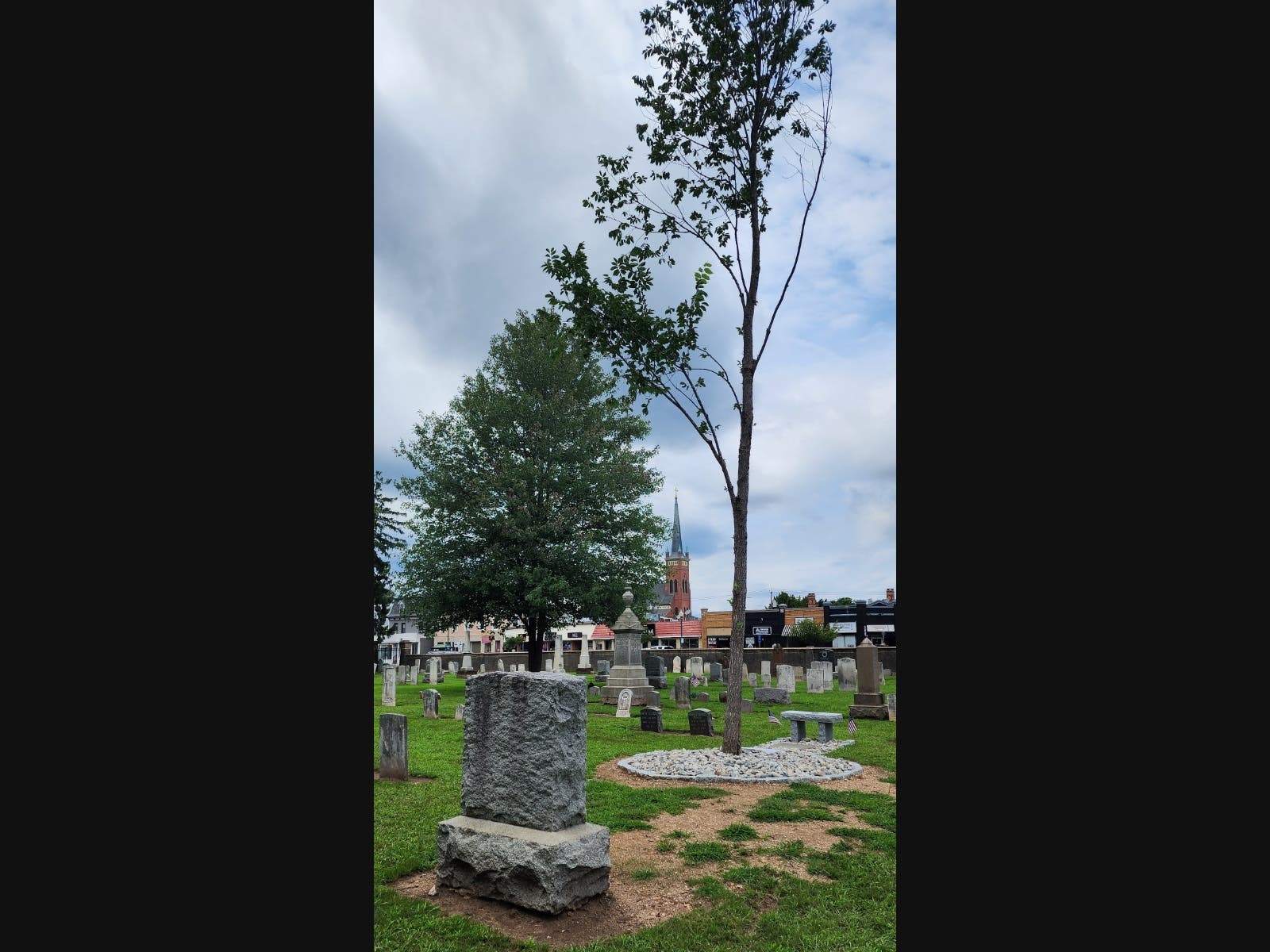
Across the street from the community media center, inside the historic Center Street Cemetery, a Liberty Tree now stands — a sapling already two stories tall, planted in a ceremony on August 14th west of the Lyman Hall monument.
The date wasn't arbitrary: it marks the 261st anniversary of the original Liberty Tree, the Boston elm under which the Sons of Liberty gathered after the first public protest against British rule in 1765.
Our rare, disease-resistant elm has two plaques at its base. One indicates the tree is a donation from the Wallingford Historical Society. A second mentions the town's America 250 Committee. Several members of the committee publicized the dedication event. A serial release of information by the Wallingford Historical Society includes a short video that described the tree as a living symbol of freedom, resilience, and civic pride — and, in the organizer's own words, a rallying point, proof that powerful symbols can still inspire movements.
Find out what's happening in Wallingfordfor free with the latest updates from Patch.
Nothing about this planting was improvised. A deliberate, orchestrated act of commemoration, anchored to a real anniversary and installed with the intent for real permanence. What isn't settled is why that commemoration went where it did. Location. Location. And authorization.
#AnyBodyCanBeFreeman: STORYTELLING
Find out what's happening in Wallingfordfor free with the latest updates from Patch.
Eight years before this year's Liberty Tree commemoration, the same presenter, Mr. Beaumont, told the story of "Wallingford, The Cradle of American History", to the historical society membership. Reading from the town's own meeting records, he shared, "roughly 4,000 residents gathered at the Parade Ground to take the oath of Freeman", in what he called the "first muster of the American Revolution". A Special Meeting. A revolutionary mobilization. He suggested that Wallingford answered a call that would echo across the colonies. Hubris, or fact, unsure, he asserted Wallingfordians were "forerunners of American democracy".
WPAA-TV, the media center across the street, has made ''Freeman" its civic emblem — the name behind its Free Speech Ambassador and its standing claim that anyone can be a Freeman and can tell the stories they believe matter.
Location: A symbol of resilience, rooted among the dead.
History is the stories of the powerful and the less so carried forward in clues carved in stone and inscribed in legend markers. Few will ever know there were questions such as "Why here, and not the Parade Ground? Who decided? What does the plaque leave out?
Here is the irony worth sitting with. The Parade Ground is where the living history actually happened — where residents stood, took an oath, and committed themselves to a cause with real risk attached. The tree meant to claim that same resilience in 2026 wasn't planted there. It was planted in a cemetery, among the dead, less than 100 steps from a similarly challenged monument to Lyman Hall — a cenopath, his remains resting in Georgia, rather than at the muster site.
The Framing — America250 vs. USA250
The shorthand chosen for a national milestone carries weight. #America250 operates as a brand — a sweeping, abstract label that defaults easily to national mythology, grand gestures, and a polished story of continuous progress. It invites the public to admire a finished monument.
#USA250, by contrast, grounds the anniversary in an actual political entity: the United States of America. It points to an ongoing civic, legal, and constitutional experiment — built by flawed people, sustained by imperfect compromises, and governed by documents that demand constant re-examination.
The difference isn't cosmetic. A narrative built on #America250 lets us praise a spectacle. A narrative built on #USA250 requires us to evaluate a living system — and to ask who is included in the story, and who has been left in its margins. That's also the difference between celebrating and reflecting, and it's why the missing word in most local branding is the smallest one: our.
Selective Memory and Local Gatekeeping
When a single "keeper of history" dictates how a town remembers its past, it reveals something important: public memory is curated, not simply preserved. That isn't necessarily an accusation — every institution has to choose what fits on a plaque. But it is a reminder that choice is happening, and that community members have standing to add what's missing.
"Freeman" carries this same tension. Taking the oath in eighteenth-century Connecticut meant being an adult man of a certain property standing, sworn in through a status that, by definition, excluded women, the poor, and the enslaved from the town meetings that decided everything else. The roughly 4,000 people the presenter described as forerunners of American democracy earned that word through eligibility, not universality.
WPAA-TV's own insistence that anyone can be a Freeman is, in effect, a rewrite of the original oath — a claim that the label should finally mean what it was never designed to mean. That's not a contradiction to be embarrassed about. It's the same work the town is doing everywhere else it takes its history seriously: deciding who counts, and saying so out loud.
That same instinct runs through the memorial standing next to the tree.
Lyman Hall's monument sits a short distance away, and the two markers don't tell the same kind of story. One gestures toward universal liberty. The other commemorates a Wallingford-born signer of the Declaration who left Connecticut for Georgia and became a plantation owner there. That detail isn't incidental to the founding document he's remembered for signing: the language in Jefferson's original draft condemning the crown for perpetuating the slave trade was struck from the Declaration after lobbying from Georgia's delegation and other figures embedded in the plantation economy — the same faction Hall belonged to. By Jefferson's own account, the Georgia and South Carolina delegations led the opposition to that clause. Hall's name is on the document that resulted.
None of this erases what Hall risked — the British burned his property and charged him with treason for the cause the memorial honors. But it means the plaque tells only one half of the man. Placing a Liberty Tree within sight of that memorial creates a contradiction that doesn't require a lecture to notice — just a willingness to look. Reclaiming local history isn't about tearing down what's already been placed. It's about adding the pages that were left out, so the record is honest rather than merely tidy.
Reclaiming the Iconography of Resistance
The Historical Society's own framing is worth taking seriously rather than dismissing: a rallying point, proof that powerful symbols can inspire movements. That's true. It's also exactly why the choice of symbol — and the choice of what story gets told about it — carries more weight than a plaque can hold.
A rallying point rallies people toward something. The question worth asking is what, specifically, this one is calling the town toward, and whether the history being invoked supports that call.
Modern memory tends to flatten "the Founders" and "the Sons of Liberty" into a single revolutionary bloc. The historical record is more conflicted than that. When the Sons of Liberty looted and leveled Massachusetts Lieutenant Governor Thomas Hutchinson's home in 1765, John Adams condemned the destruction as a "frenzy of anarchy." Even the Boston Tea Party split opinion among the Founders: Benjamin Franklin was troubled enough by the destruction of East India Company property that he offered to repay it out of his own pocket, to keep the line between protest and lawlessness from disappearing entirely.
That distinction mattered to the people who built the country's institutions. Washington and Adams both understood that a lasting republic couldn't rest on street violence indefinitely. The Constitutional Convention itself was driven partly by a desire to contain populist uprisings like Shays' Rebellion, replacing mob action with a legal framework that channeled grievance through representation.
So when modern movements — anti-statist or otherwise — reach for colonial iconography, from the Gadsden flag to the Liberty Tree itself, and claim a direct line to 1776, the claim is worth scrutinizing rather than accepting at face value. The original resistance was aimed at an external authority; some of what borrows its symbols today is aimed at the very civic institutions that resistance ultimately produced. Those are not the same project, even if they share a flag.
Reclaiming the Narrative for Posterity
The real measure of any anniversary isn't how smoothly it polishes the past — it's what it hands to the future. A constitutional republic isn't a finished monument to be admired from a distance; it's a trust, passed down and renewed by each generation that inherits it. Every plaque installed, every tree planted, every marker dedicated is a record of what a community valued at one particular moment — not the last word on what it should value.
Leaving out the harder truths doesn't protect that inheritance; it shortchanges it. Telling the fuller story — including the discomfort of a liberty symbol standing near a monument to conditional freedom — doesn't weaken civic memory. It's what makes that memory resilient enough to survive contact with its own history. A milestone treated as a living trust, rather than a sanitized myth, is the only kind worth handing to whoever comes next.
WPAA-TV and Community Media Center is a CT250 affiliate adopting the #USA250 branding. Reflective opportunities continue in our space until July 4, 2027. Watch 250 @250 produced by Heather Cox Richardson, and the America at 250 Yale Devane Lectures, in addition to our local Place Yourself In History Stories also on YouTube
This commentary is authored by volunteer WPAA-TV's Executive Director in compliance with board-approved affiliation status as CT250 affiliate and Information Literacy Resolution.