Neighbor News
The Story is not Black and White
Rev. Jesse Jackson Visited Wallingford CT in 2000 - I Affirmed My Reason for Being Here

It forever tinges the town's reputation. It is easily evoked when the symbols of terror reappear — painted on the side of a barn, hung from a tree, or poised in public view: symbols of the Klan, or the confederacy. In Wallingford, a modest and dominantly white suburb in Connecticut, the unfinished business of civil rights has a specific address in time.
Video here:
Excerpt Citizen Media Maven - The Life
Find out what's happening in Wallingfordfor free with the latest updates from Patch.
On April 27th, 2000, a few microphones were strategically placed at the base of the steps on The Parade Ground, a landmark historic gathering place in front of Town Hall. A curious crowd grew into hundreds of expectant onlookers. Journalists poised with paper and pen, overrun by TV news crews. All awaited their appearance.
Before speaking from the steps of Town Hall, Rev. Jackson comforted a smaller crowd inside St. Paul's Episcopal Church on Main Street. He reassured the "real Wallingford" saying, "This is not an issue of black and white; this is an issue about right and wrong."
St. Paul's had annually opened its doors for local prayerful commemoration of Dr. King's legacy — a front line for unity since the early 1970s. What brought Rev. Jackson to Wallingford was audacity. The fact that three self-professed white supremacists, wearing white robes, could parade in front of this church while others participated in a solemn remembrance of Dr. King struck a nerve — locally and nationally.
Find out what's happening in Wallingfordfor free with the latest updates from Patch.
Wallingford was the last Connecticut municipality to implement the Federal Holiday as a paid day for town employees. Every Connecticut newspaper, and a few major national papers, carried some version of the story. The headlines ranged from "Jackson and Klan Face Off in Connecticut" to "KKK Threat...or Merely a Hoax?" It took a state mandate — signed by the Governor the very morning of Rev. Jackson's arrival — to move the needle.
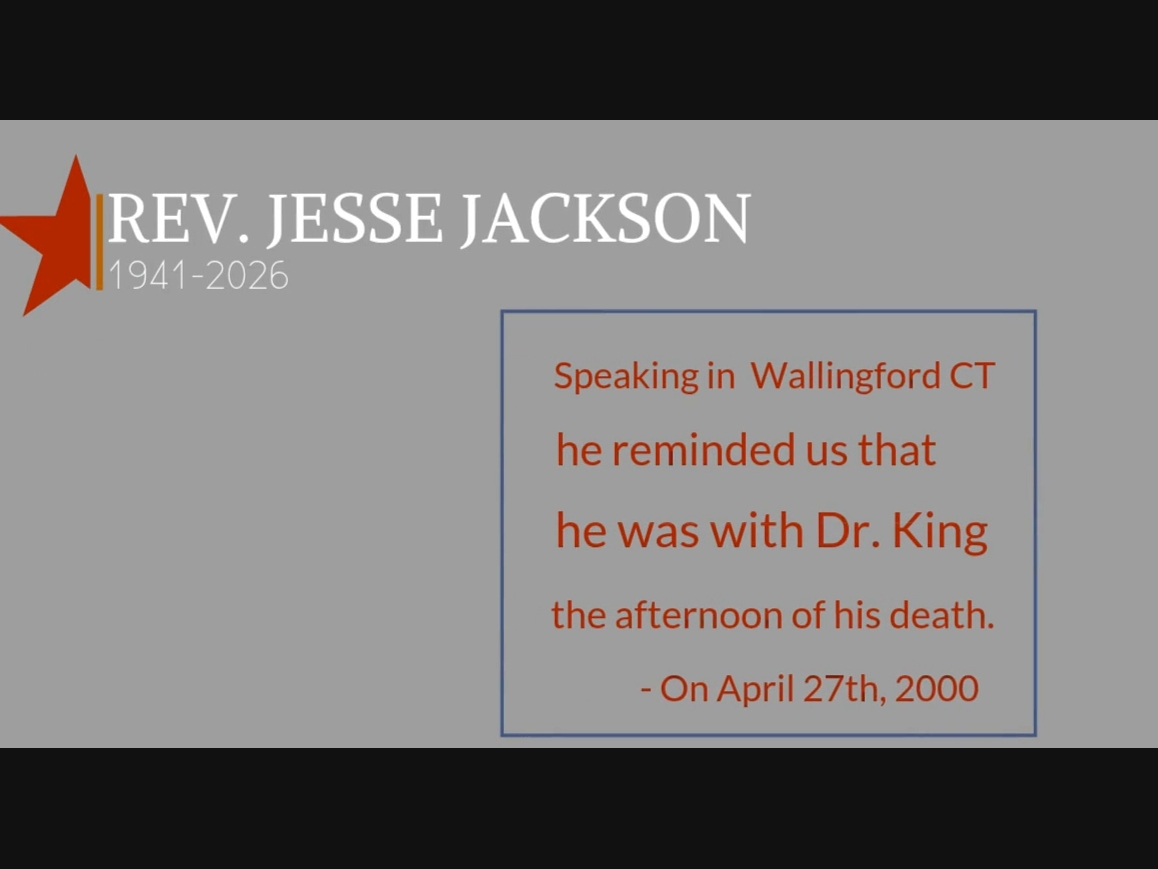
As Rev. Jackson spoke from the steps of Town Hall, he reminded us that he was with Dr. King the afternoon of his death. His proximity to that historic act of violence had changed both his struggle and the struggle. As a witness to martyrdom, he doubled down on his commitment to justice, keenly aware the cause was bigger than any man: "A man must be willing to die for justice. Death is an inescapable reality and men die daily, but good deeds live forever."
He walked past the predominantly welcoming crowd toward the protestors. I followed his movements among the cameras. For someone as short and unskilled as me, the large Panasonic VHS Camcorder on my shoulder — too long ago for a cell phone moment — was challenging to stabilize. What I captured was a blur: shoulders jostled to butts to shoes. My attempt at documenting my divided community, thirty-two years after King's assassination, proved futile. But being there was not.
At the conclusion of his remarks, hundreds of mostly white people — singing "We Shall Overcome" and holding candles — joined hundreds already assembled on The Parade Ground.
"Those who are waving these flags show us there is unfinished business," Jackson said, offering to shake hands and trying to peek under the face mask of one man dressed in Klan garb, who rebuffed him.
He came to Wallingford for a small controversy in a small town because that is what he did. He showed up. His willingness to make Wallingford a stop on the long arc toward justice is itself a piece of his legacy worth naming plainly.
Postscript: I Am Here for a Reason
I was too new to Wallingford to have experienced St. Paul's King Day services firsthand. As I got my footing as a resident, communities that gathered people with similar interests in advocacy, allyship, and justice were of particular interest to me. St. Paul's was one.
Years later, at my community television station, a life-long resident named Beth sat down with her friend KiKi — a person of color — for a conversation about race in relationships. In the first three minutes, Beth wove together many loose ends for me.
She recalled growing up in Wallingford: "At the time the Klan was very predominant. You'd walk down Center Street and you would see, you know, the sheets." She remembered standing outside St. Paul's the day of the march, watching the robed figures with their microphone. "I remember shaking a little bit because they scared me. I knew nothing about them because it wasn't something that we ever talked about."
Beth had been carrying that childhood fear in mothballs for decades. Her friendship with KiKi gave her the courage to say it out loud. I used a clip from their conversation in our 2018 Video Annual Report — a 25-second trailer that ends with the line: "I wasn't aware that the Ku Klux Klan was in Wallingford." Cut.
What Beth did not know when she came to WPAA-TV to record conversations with a friend, is that her story would fill in some blanks for me. Her Community Conversations stories with Keiwanna (KiKi), shed light on her unresoved curiosity. For me, her series affirmed that I was exactly where I needed to be fulfilling a commitment I made on the day of Rev. Jacksons visit. There was a need for advocacy and justice work in Wallingford and communities like it and I could do it as the volunteer Executive Director of WPAA-TV.
When I heard Beth's story, I realized we had been at the same event, differently. She was a life-long resident in her mid-twenties, shaped by years of silent witness. I was a relative newcomer with a fourteen-year-old son, anxious about what he was absorbing in a town that had become national news. He referred to home as New Haven — where he was born — not Wallingford, where his mother bought a house.
Rev. Jackson's visit had already planted something in me. Watching him walk toward the protestors, toward discomfort, toward the unfinished business — that did not leave me. It solidified what that voice had been telling me: you are in Wallingford for a reason. Beth's story, recorded in a modest studio at a community television station, was part of that reason made visible.
Communities that do this work — the slow, unglamorous work of naming what happened and building something better — are why I stayed. Rev. Jackson answered that call every day in many places and he came to Wallingford.
In my own modest way, I answered the call to do the unglamorous work to build something better.
Susan Adele Huizenga, Volunteer Executive Director WPAA-TV and Community Media Ctr -May 2012
#LeadingTheWay hashtag#WallingfordCT hashtag#wpaatv @revjjackson #NowMoreThanEver