Neighbor News
We Asked Youth to Speak. Then We Listen (Or Do We?).
An Open Letter to Our Community Because They Didn't Reject the Message. They Translated It.

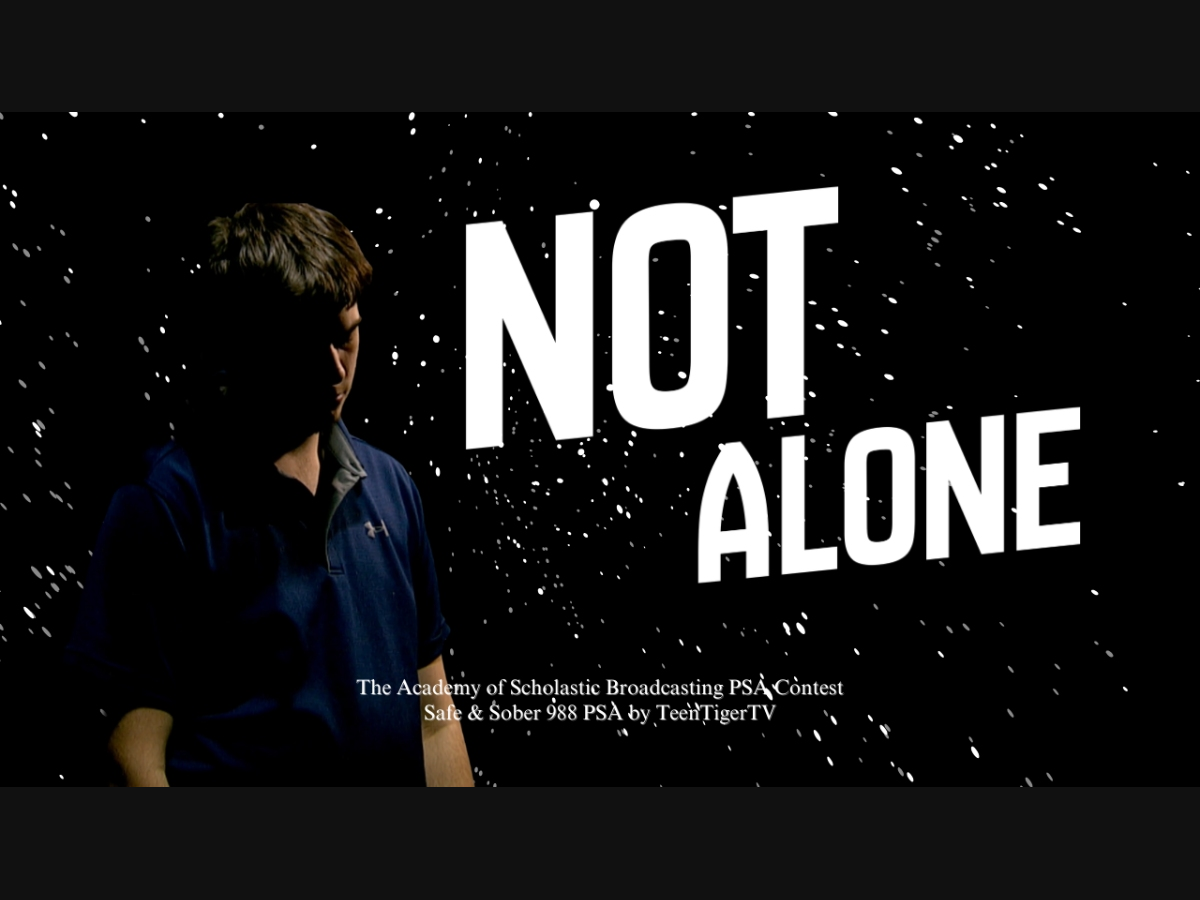
Contests as Experience
A few weeks ago, TeenTigerTV youth submitted a video to a nationwide PSA contest on youth mental health. After the contest, they reviewed how other teams interpreted the assignment, what they would do differently (outside of the rules/with more time), and what submissions connected for them from 100s of entries.
Conclusion: The team appreciated the personal storytelling by Collin & Ian, and the illustration & animations in Onion. The personal stories connected. There were some clever props, some effective, others not so much. Because the 988 topic was not new to the team, they did not feel the experience changed their mental health resources knowledge. It did change there appreciation for a diversity of ideas and approaches that can provide an opportunity to talk more openly about real concerns.
The submissions will be viewable for a short time here:
Find out what's happening in Wallingfordfor free with the latest updates from Patch.
The contest came with lots of guidelines
The contest rules included a pre-written script—approved by experts, aligned with national guidelines, saying all the "right" things. The guidance was along the lines of Do No Harm | Show No Harm: a 16-item list followed by 5 technical requirements.
Our students read it. They agreed with the message.
Find out what's happening in Wallingfordfor free with the latest updates from Patch.
And then one of them asked: "Who can actually read this in 60 seconds?" (The PSA time limit.)
No one could.
What happened next is why I'm writing this letter.
They Didn't Reject the Message. They Translated It.
The contest allowed shortening the script "so long as it does not change the meaning." So our students did something remarkable: they kept every core idea—but rewrote it in their language, from their perspective. Here is an example of what changed.
Here's one small example of what changed. Do you see what they did?:
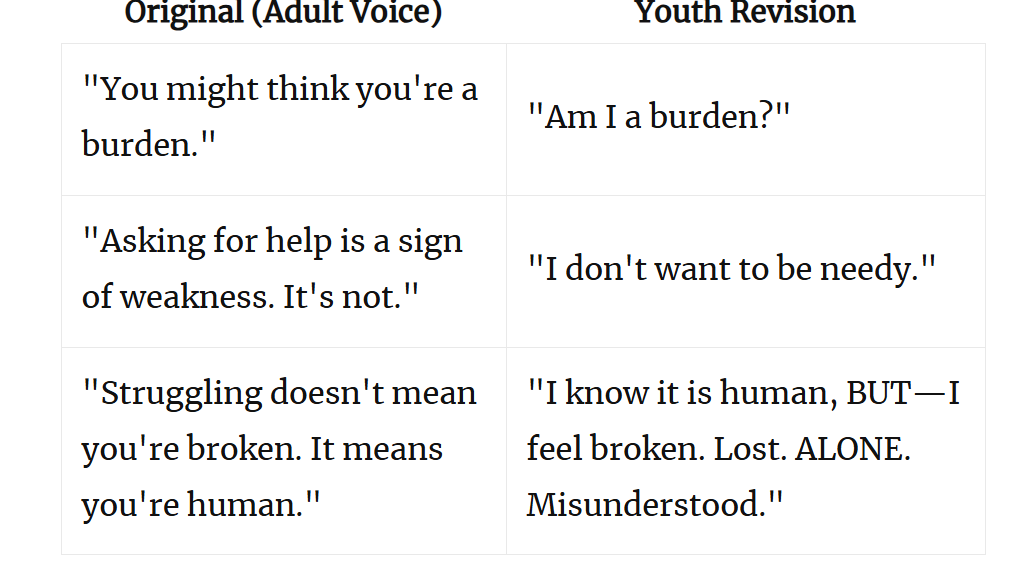
The original script talks about young people. Theirs speaks as one.
The original reassures quickly. Their script sits in the feeling first—because that's what real connection requires.
The original lists who to turn to: "Friends. Teachers. Counselors. Family." Theirs says: "someone you trust." Because they know not every young person has safe access to that whole list—and that the relationship matters more than the role.
The Line That Stopped Me
"I know it is human, BUT—I feel broken. Lost. ALONE. Misunderstood."
Read that again.
They're saying: We've heard the advice. We understand the logic. And it still doesn't reach us.
That word—"BUT"—is the gap between what adults tell young people and what young people experience. Our students kept the message. They also, quietly, honestly, flagged where mental health messaging often loses its audience.
That's not rebellion. That's insight.
What This Taught Me
We say we want youth voice. We put it in our mission statements and judging criteria. But when young people actually use their voice—when they change "you" to "I," when they add the word "BUT," when they refuse to rush past the pain—do we recognize it?
Our students followed every rule. They stayed on message. They made something that could actually reach their peers.
And they did it in two hours.
Not because they're exceptional (though they are). Because they're close to it. They didn't need a focus group to know that "I don't want to be needy" lands harder than "asking for help isn't weakness." They live it.
The Invitation
I'm not writing this just to praise our youth—though they've earned it.
I'm writing because this matters beyond one contest. The video is also here on YouTube. The summer 2021 team self-selected this topic. Their award-winning video '988 It's Never Too Late' is here. We encourage you to share both AND tell someone you know between the ages of 14 and 25 about TeenTigerTV.
If we want mental health messaging to reach young people, we need to let young people shape it. Not as a checkbox. Not as a last-pass edit. From the beginning.
WPAA-TV Story Coach
Our students proved they can honor the guidelines, carry the message, and make it land. That's not a tension. That's a skill.
Remember this the next time you're writing for young people — Ask yourself: Am I speaking about them—or as them? Am I reassuring too fast? Am I using their language or mine?
Final Thought
The original script ends: "You matter. Help is real. And you are not alone."
Our students kept that line. Word for word.
But they earned it differently. They didn't just say it—they showed what it sounds like when someone's actually in it, and someone else reaches back.
That's the whole PSA, really. That's the whole point.
Thank you for listening. And thanks to the contest host ASB The Academy of Scholastic Broadcasting and Safe & Sober.
This nationwide project was supported by Missouri Foundation for Health by grant funding. CPO is funded 39% at $4,132,356 with federal funds received from the U.S. Department of Health and Human Services provided by the Missouri Department of Social Services, Missouri Department of Mental Health and Substance Abuse and Mental Health Services Administration, 5% at $508,571 by other federal funding, and 56% at $5,960,206 by other non-federal sources.