Community Corner
Waterford Officer's Voiceless Son Needs Your Help
A Waterford police officer's son has a disorder that makes talking an extreme challenge. Here's how you can help.


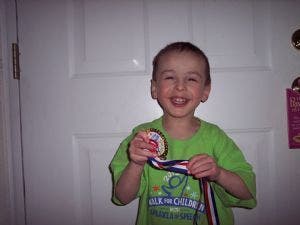
Imagine having all kinds of thoughts inside your head but being unable to express them. Think of how often your children, nieces or nephews ask you “Why?” Now think of how it would be if they were unable to verbalize the questions and get the answers they want and need.
This is what it’s like for Waterford Police Officer Gil Maffeo’s son, Charlie. He was diagnosed with apraxia, a motor speech disorder that results in a disconnect between the brain and muscles.
“The frustration he feels when he cannot say what he is thinking is painfully obvious, but his smile can light up the whole town,” mother Lisa wrote. “He is a smart, eager and social little boy who has a voice craving to be heard.”
Find out what's happening in Waterfordfor free with the latest updates from Patch.
To help support Charlie and other children with apraxia, Lisa organized a walk for Sunday, Sept. 7. The Waterford Police Department officers are asking the community to help out by donating to the cause via this link. The walk is a community event and the public is welcome to attend.
“From the Maffeos and us here at the WPD, ‘thank you for helping to unlock the voices of our children’,” the Police Department said via Facebook.
Find out what's happening in Waterfordfor free with the latest updates from Patch.
Activities or offerings include face painters, a clown, a magician, a Home Depot workshop, archery with Stay and Play, child ID kits, a fire truck, The Rolling Tomato of Groton, an ice cream truck and live music.
What is Apraxia?
According to the American Speech-Language-Hearing Association, children with apraxia have difficulty saying sounds, syllables and words.
“The child knows what he or she wants to say, but his/her brain has difficulty coordinating the muscle movements necessary to say those words,” the ASLHA said.
The cause of the motor speech disorder is unknown and improving on speech skills involves practicing talking using a number of different techniques.
“There is something in the child’s brain that is not allowing messages to get to the mouth muscles to produce speech correctly,” the ASLHA explained. “In most cases, the cause is unknown.”
There is no cure but progress can be made. Check out the below video to see what a therapy session is like for children with apraxia.
How You Can Help
The Walk for Apraxia will take place at Camp Oakdale, 140 Meeting House Lane in Oakdale, on Sunday, Sept. 7. Registration begins at 10 a.m. and the opening ceremony will start at 11 a.m.
Anyone with questions may email Lisa at unlocktheirvoices@gmail.com.
The Importance of Early Intervention
“My son Charlie wasn’t talking according to guidelines I had seen but everyone kept saying ‘he’s a boy, they talk late’,” Lisa wrote. “Thanks to the astute recommendation of his pediatrician, we began services early and he started receiving speech therapy at 20 months old.”
The road has not been easy. Charlie spends hours undergoing tests and appointments to help him with his speech. Lisa hopes that by organizing the walk, the road can be smoother for children with apraxia.
“We are walking to spread awareness about what it means to have apraxia and that early intervention is essential,” she wrote. “Just because children are non-verbal, it doesn’t mean they have nothing to say!”
Get more local news delivered straight to your inbox. Sign up for free Patch newsletters and alerts.