Schools
Easton School Board Discusses Plans for Curriculum Improvement
The Easton Board of Education held their final meeting of the year Tuesday evening.
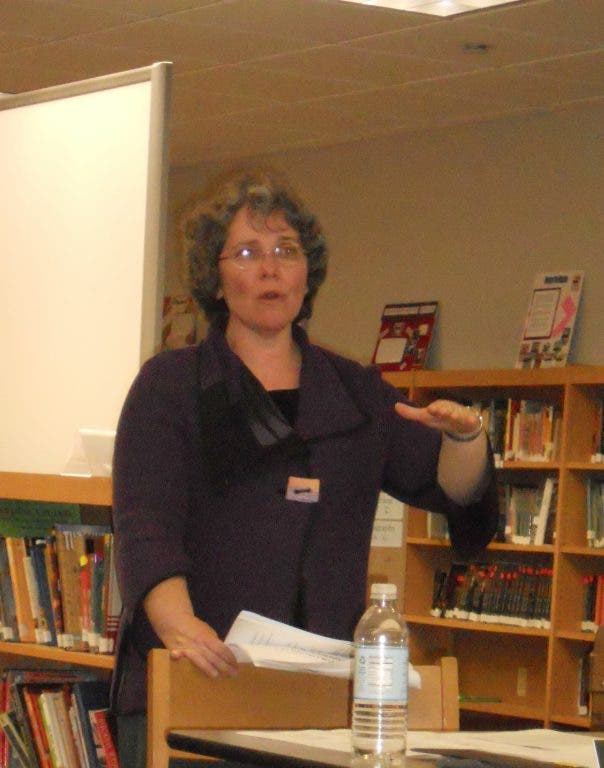


Continuous district improvement.
That's what the Board of Education is eying for Easton's schools. The school board held its last regularly scheduled meeting for the 2010-2011 school year on Tuesday night.
The board presented an action plan for continuous district improvement.
Find out what's happening in Weston-Redding-Eastonfor free with the latest updates from Patch.
“Every grade will have a curriculum map,” said Marie McPadden, assistant superintendent.
The board came up with five critical factors that would make the curriculum map an integral part of continuous improvement. Curriculum alignment was the first factor that the board considered.
Find out what's happening in Weston-Redding-Eastonfor free with the latest updates from Patch.
“Curriculum alignment has to do with the alignment between the school curriculum and the state standards,” McPadden explained.
The next factor on the list was instruction, which Language Arts specialist Sarah Broas feels can determine a child’s success in school. Broas assists children at and sees the effects of proper classroom instruction.
“You can have the best curriculum on paper, but if the instruction isn’t strong, the curriculum will not [help students],” McPadden said.
Assessment of the students’ understanding of the curriculum was third on the list. The board appreciates the feedback gained from testing children with standardized tests like the CMTs and the CAPT. Professional development and monitoring and evaluation made up the last portion of the five critical factors.
“We are really doing what’s right for the students,” Broas stated.
The ER9 curriculum steering committee plans to oversee the curriculum alignment within Easton’s schools by conducting curriculum audits, identifying any gaps or overabundances in the curriculum, and revising the core curriculum in order to meet state standards. An audit in the social studies department has already taken place, and Emily Marchetti, a fourth grade teacher at is pleased with the results.
“We did a social studies audit and at the last meeting that the curriculum committee had, we took a look at those results,” Marchetti said. “Once we were successful with the social studies, we started on the science and music audits.”
K-12 Discipline Questions
Another major part of improving curriculum and learning in Easton’s schools will depend on newly implemented discipline questions.
“Easton is ahead of the game in terms of unpacking the standards,” McPadden stated. “However, we have never had K-12 discipline questions.”
“Discipline questions are on a larger scope,” Broas said. “There will be questions like ‘how do people learn to adapt to new cultures.'"
They are both excited about the plan which will guide the expectations of students’ knowledge.
“Our next step is to see what we expect our students to know by the end of 12th grade,” McPadden explained.
The committee plans to train teachers in new technology and then implement the discipline questions. Programs and materials will be reviewed during the audit process in order to come to a decision regarding students’ needs.
“There may be some painful discussions, but [the committee] is looking to get what’s best for the kids,” said Superintendent Michael Cicchetti.
The committee plans to maintain the same curriculum with Redding schools so when it is time for the students to enter into , they will have a shared understanding of the curriculum.
“We look at Redding and make sure when they get to the high school, the students are doing the same types of things,” Marchetti stated.
High school, middle school audits online
“All the teachers are excited about it, and everyone is on board,” Broas said of the audit plans.
The committee hopes to post the audit maps online in order to provide better communication between Redding and Easton Schools.
“I think posting of audit maps will be very helpful,” Cicchetti stated. “From my perspective, it wasn’t the time that it took to create a curriculum map, but what questions we need to incorporate. The curriculum really should drive the programs we teach.”
He feels that sharing the information between schools will benefit students in the long run, and getting teachers on board is the first step in implementing the audits.
“We need to accelerate now and get these units developed,” Cicchetti said. “This will mean nothing unless we give the teachers the support they need.”
Some parents in the audience do not feel that computerizing the audits and curriculum is the best idea.
“I think being able to share and get that access is phenomenal,” stated Sharon Stemme of Tersana Drive. “The thing is, some people love computers and some people don’t. I hope we find a way for all teachers to utilize it.”
Kimberly Fox-Santora, Principal of , tried to ease Stemme’s concerns by explaining the plan for teacher training.
“We have explored using minimum daytime, after-school time, we’ve explored a lot of different options,” Fox-Santora stated.
“This is going to just be a different way we update our documents,” Broas chimed in.
She along with her fellow teachers have been using the process of binder audits for quite a while, and sees the online access as a positive change.
“Two thoughts are going through my mind,” said Beverly Dacey of Redding Road. “Our teachers are overloaded. What I think we’ve all learned and recognized is that classroom dynamics play a huge role—there’s a lot of stuff that people have to focus on. When I hear about this 21st century learner, it brings me back to the baby-boomers. We had such basic skill sets, that whatever was thrown at us in the working world, we were able to adapt to. I hope we don’t get so distracted by the glitz and glamour that we forget about [teaching and learning]. Please don’t overburden our teachers."
Jennifer Rose, a social studies teacher at HKMS, doesn’t feel that the online curriculum audits will be a hindrance or a burden.
“It’ll be really user friendly in the long-term,” Rose stated.
“Education is constantly changing, and we can’t keep up with education by keeping pieced of paper in a binder,” Broas explained. “[Principal of Joel Barlow High School] Tom McMorran said it best when he said, ‘education is a conversation, not a document,’ and this will allow us to have that conversation. It is important that we go through this process slowly [for proper understanding of the system].”
ER9 Five-Year Timeline for Curriculum Review and Revision
2010-2011:
- Curriculum audits in core subject areas began
- Social studies teacher training in the design of discipline questions began.
- Social studies teachers had begun to develop discipline questions.
2011-2012:
- Committee members will be trained in Rubicon’s Atlas Curriculum Mapping software, as well as monitor and assess all work done.
- Social studies teachers have begun to develop unit questions/objectives (critical and creative thinking skill), as well as in design software for editing.
- Math, science, art, and music teachers train in and create discipline and course questions.
2012-2013:
- Math, science, art, and music teachers continue to create unit questions and objectives (critical/creative thinking), as well as train in editing and creating design software.
- Training in K-12 discipline questioning, as well as the implementation of the questions will be provided for health, language arts, physical education, world language teachers, and guidance counselors.
- Assessment and monitoring by committee members will take place.
2013-2014:
- Training of curriculum design software (editing/creating) provided to language arts, health, world language, physical education teachers, and guidance personnel.
- Grades 3-12 teachers will be trained in designing/developing Problem Solving Tasks (PST), and they will be expected to write one PST question each.
- Analysis and monitoring of PST in classrooms.
- Assessment by committee members.
2014-2015:
- PST will be revised across all grade levels.
- One PST written by each K-2 teachers in the following subjects: elementary art, music and physical education.
- Assessment of student knowledge of PST through analytical rubrics will be created.
- Assessment by committee members.
The committee feels that it is an ambitious task, but they don’t want to see five years go by without any progress in student learning.
“We have the right people together to work on this, and I don’t think they will let this fail,” Cicchetti stated.
Plans for the Joan Parker Memorial
Regina Bobroske presented the Joan Parker Memorial Committee’s plan to honor the late principal, who passed away last year. Parker who was beloved by her students placed great care into the students’ learning experience, as well as their experience as children. The committee as well as the students were excited to honor her memory with an outdoor classroom.
“We’ve reviewed many, many generous ideas from the community,” Bobroske said. “We all know and witnessed Joan’s dedication to Helen Keller Middle School.”
The committee thought of ways they could incorporate the ideas from the community as well as the students themselves. An idea that an eighth grader came up with was to incorporate handprints into the benches in the outdoor classroom. A shadow box with memorabilia and photos of Parker and her family will be incorporated into the classroom. On top of the memorial, the committee will be presenting one boy and one girl with the Joan C. Parker award each year at the eighth-grade move-up ceremony. Lastly, a plaque will be built into the school in memory of the dedicated principal. On May 24, there will be a student-only ceremony to commemorate Parker.
Other Noted Items
- The board has approved school lunches to increase by 25 cents. With management changes, they have seen a decrease in lunch purchases.
- A cooler at SSES has once again sprung a leak, and was temporarily patched up for a second time. A second leak was discovered during repair.
- Six Samuel Staples Students were awarded with $100 savings bonds for their participation in a Connecticut invention convention.
- HKMS received a letter from Washington, D.C. letting them know they met the accreditation standards in order to become a Blue Ribbon School—one of Joan C. Parker’s dreams.
The Easton, Redding and Region 9 Boards of Education will meet on June 7.