Business & Tech
Terex CEO Ron DeFeo: Infrastructure Investment = Prosperity
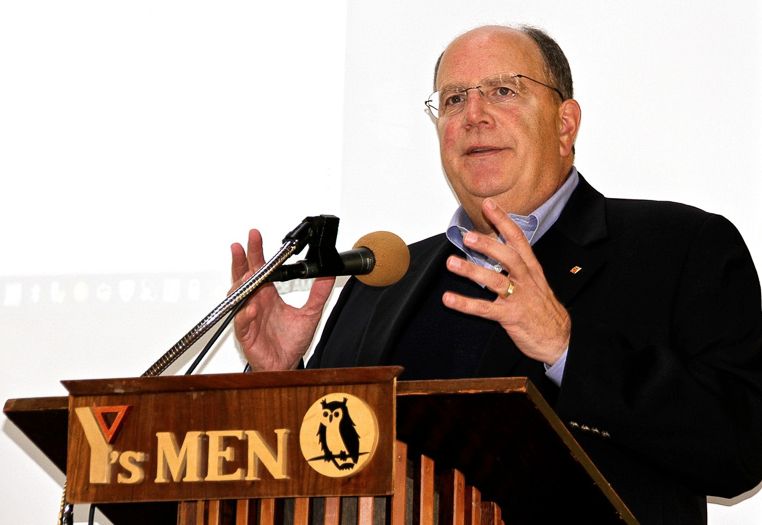
DeFeo, chairman and CEO of Westport-based Terex Corp., told the Westport/Weston Y's Men that infrastructure investment builds future growth.


By Roy Fuchs
For the Westport/Weston Y’s Men
Ron DeFeo, Chairman and CEO of Westport-based Terex Corporation, underscored the need to invest to revitalize our nation’s infrastructure in his recent talk to Y’s Men.
Find out what's happening in Weston-Redding-Eastonfor free with the latest updates from Patch.
Terex is a $7.3 billion NYSE-traded global manufacturer of cranes, aerial platforms, mining equipment and small earth movers. Today’s company was created by investing over $40 billion in more than 40 strategic acquisitions between 1997 and 2011.
The company markets globally, with operations in over 80 countries. 70 percent of its products are produced outside the US, and 65 percent of its revenues are generated offshore.
Find out what's happening in Weston-Redding-Eastonfor free with the latest updates from Patch.
Infrastructure investment drives its revenues, revenues that can fluctuate as much as “30 to 40 percent year over year,” as government funding for infrastructure projects changes with changes in the economy.
DeFeo began his career at Procter & Gamble, entered the equipment business with J. I. Case, then joined TEX in 1992. He was named CEO in 1995 and Chairman in 1998.
“Infrastructure investments have been historically transformative” he told the group. He pointed to the Erie Canal, that opened up what was then the west and reduced shipping costs; to the Panama Canal, that shortened coast to coast shipping times; and to the Interstate Highway System, that enabled high speed coast to coast travel, and was seen as a military necessity during the Cold War.
DeFeo’s theme was that “We cannot create enough wealth in this country on our aging infrastructure.”
“My generation has been a user generation, living on the vision of our predecessors, not delivering a new vision for our children and grandchildren.”
Building a better vision requires “defining a future state, developing plans to achieve it, marshaling a multi-pronged funding strategy and the political will, then streamlining the approval process.”
He called planning both insufficient and “highly politicized,” and pointed to overcrowded and deteriorating I95. Only time will tell whether these remain issues for our rail bridges, such as the 118 year old Walk Bridge in Norwalk that ties up MetroNorth too frequently.
Politics and lack of planning have resulted in a failure to replace the rail bridge that crossed the Hudson River near Poughkeepsie since it was destroyed in 1974. With its demise routes 95 and 84 have become increasingly overcrowded with truck traffic hauling freight elsewhere in New England, which “clogs our roads and beats them up unnecessarily.”
Likewise the deteriorating Tappan Zee Bridge, which was built in the 1950s and is only now - and belatedly - in the early stages of being replaced.
He called the American Reinvestment and Recovery Act of 2009 “not successful” because its $100 billion of federal money largely replaced state funding for already planned projects. “Shovel ready projects weren’t shovel ready.”
Continuing reinvestment has become difficult. Historically the federal gas tax funded road construction. Unfortunately, this tax remains where it was set in 1993, at 18.4 cents per gallon - so today yields only half its original purchasing power.
To compensate, many states have stepped up their taxes (the total Connecticut tax on a gallon of gas in is now about 45 cents). But if Connecticut is a model, they use at least some of that money to satisfy other state spending needs.
Meanwhile, collections are trending down as vehicles become more efficient.
DeFeo said “I’m a proponent of increasing and indexing the gas tax. I know it’s unpopular… off the record both Democrats and Republicans say we need to do it… but not so publicly.”
He was pessimistic about Connecticut. “If we do nothing Connecticut will continue to erode. We will turn into a pure service economy.”
He said Terex does not manufacture here because the state’s infrastructure is too congested and too outdated to meet the company’s needs. “Any industry requiring a modern infrastructure will invest elsewhere.”
DeFeo may not have told the group anything it didn’t know. But he brought home his points by offering detail the layman lacks.
In the end, he seemed frustrated at two levels. Broadly, because he believes we, as a nation, need to raise the level and consistency of infrastructure reinvestment to enhance our economic prosperity.
And as the CEO of a major producer of heavy construction equipment, frustrated because the market — and his company’s revenues — are volatile, due to an absence of vision, planning, commitment and funding.
Get more local news delivered straight to your inbox. Sign up for free Patch newsletters and alerts.