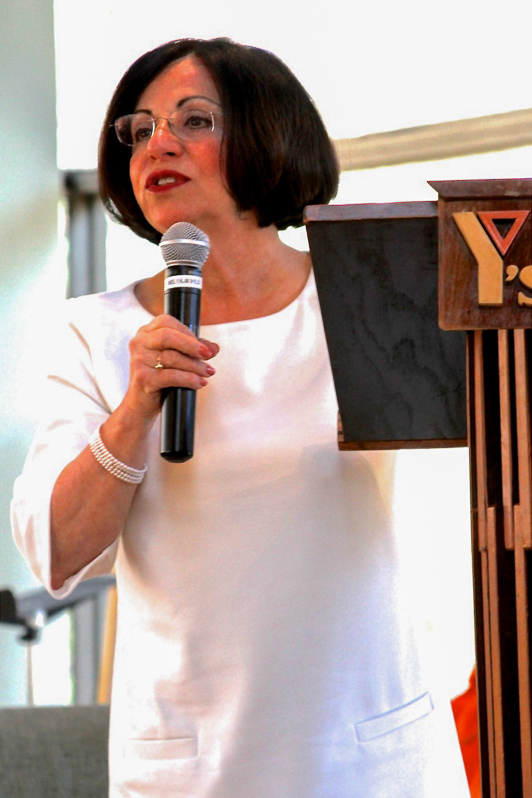
State Senator Toni Boucher (R-26), speaking to Y’s Men of Westport/Weston on November 21, outlined an austerity program designed to return Connecticut to its former greatness. She recently announced an exploratory committee for governor in 2014, so it may be that she was testing messages, should she run.
Ms. Boucher is the American dream. Born in Italy, the daughter of a farmer with a fifth grade education and a mother who never attended school, her family came to Naugatuck when she was five and her brother seven. She went from not knowing a word of English to earning an undergraduate degree from American University and an MBA from UConn. Today, in addition to her government duties, she job shares at Wilton-based investment manager Commonfund.
She recalled the halcyon days when Connecticut was “the envy of the country, when we had little or no tax at all.” Then she ticked off a list of “temporary taxes” that have become permanent and have made the state less competitive and less attractive. Nevertheless, she said, it remains a “great place to live and work,” and would be even better if our government spent and taxed less.
Find out what's happening in Westportfor free with the latest updates from Patch.
Her primary culprit is state employees. The government’s 50,000 workers make it Connecticut’s largest employer. The bureaucracy is “bloated... with very rich fringe benefits,” state employees can retire at 52. How about raising the age to 62, she asked, and asking them to contribute more to their health insurance and pensions, and raising co-pays? She also stated that Connecticut “should be right to work state.” “Simple changes can add up to billions of dollars.”
She added that “we have funded less than 50 percent of our employee pensions. We don’t want to become Detroit on the sound.”
Find out what's happening in Westportfor free with the latest updates from Patch.
We can eliminate “fraud and duplication,” but to get control of spending “we have to bring unions back to the table.”
The budget itself is not in control. “Even with an historic tax increase in 2011 and another historic gas tax increase in 2013 Connecticut is still slated for deficits in the out years... we need restructuring.” In addition, we have a billion dollar deficit, the result of spending too much, as tax revenues came in below forecast. Meanwhile, to meet the requirement that the budget be balanced, the Malloy administration moved $6 billion off budget.
During Q&A Senator Boucher was asked about Common Core State Standards (CCSS), a new approach to K-12 education consisting of a new curriculum, a new testing protocol and a more rigorous teacher evaluation process that is being implemented in 46 states.
CCSS was developed by educators and business leaders as a way to compare students across the country and to those in other countries, and to raise the bar and make our schools and students more competitive in our global economy.
Boucher said CCSS “started off in a great way. Everyone wanted school reform and accountability, and a better outcome for our kids.” But as Connecticut school districts began to implement CCSS, some started getting second thoughts: Where “Norwalk and Stamford love it because it strengthens their curriculum, districts like Westport are already at a high level, so it’s less than what they like.”
CCSS’s student testing protocol was developed by the Smarter Balanced Assessment Consortium to replace the current Connecticut Mastery Tests and Connecticut Academic Performance Tests, upgrading today’s multiple choice heavy testing with ones requiring more critical thinking and writing.
Boucher also addressed regionalization, a topic that is being increasingly discussed as communities seek to improve service delivery and reduce costs. Connecticut eliminated county government some 50 years ago, leading municipalities to form agencies to collaborate on issues impacting multiple communities – traffic on Route 95 and the Merritt Parkway, for example. As communities seek new ways to improve service delivery and reduce costs, regionalization is coming more to the fore. Boucher supports merging functions such as police and fire dispatch and multi-community health districts. But she opposes regionalizing larger functions – out of concern that it may expand from roads and transportation planning to housing issues, then education. She also questions whether final authority will be local or regional, and whether regionalization might create a new level of taxation.
She also noted that the medical marijuana issue is “concluded,” that Metro North “cannot explain the composition of our costs,” that “I’m a huge advocate for higher education,” but the system “is making it too expensive,” and closed by saying she believes in term limits, that “public service is not supposed to be a life time career.”