Business & Tech
Some Shop in Wilton for a Reason
A new series looking at how local businesses are navigating the rougher economy. This week: Krik-it
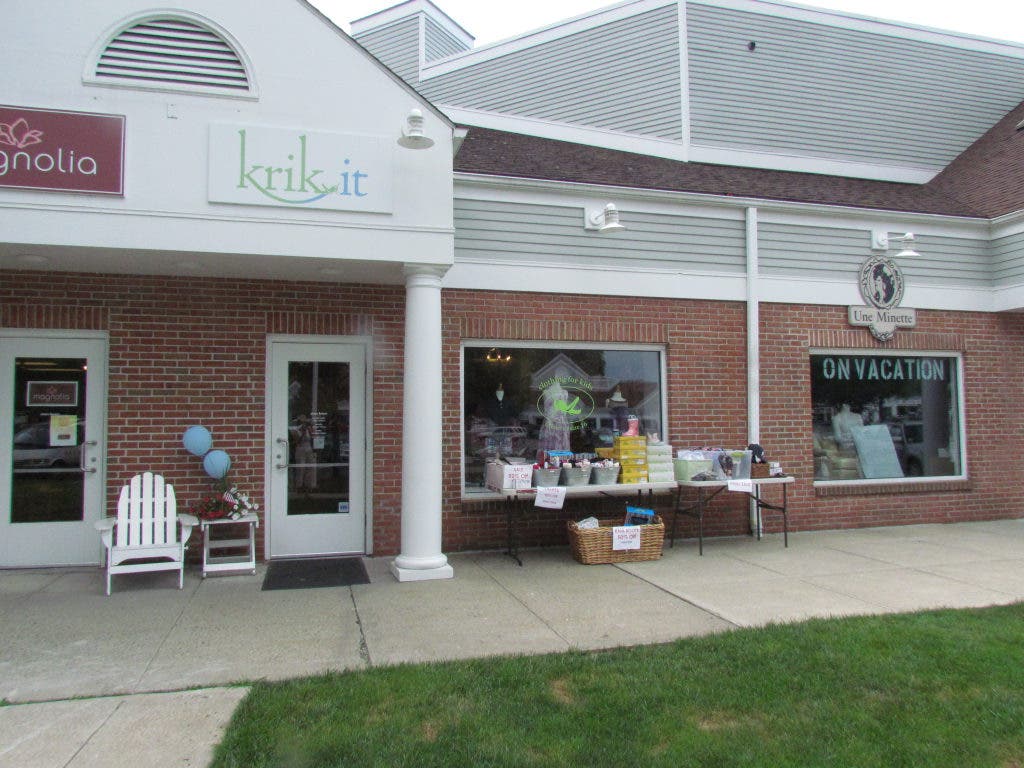


With the country’s economy still in need of ongoing CPR, the media overflows with stories of poor job reports, volatile stock markets, debt ceiling debates and major corporations in Chapter 11. But abstract bigger-picture stories don’t always capture what’s happening locally. Rather than talk about economic struggles “out there,” what about taking a look at what’s happening for the local shopkeeper?
In a new series, Patch wants to focus on the trials and tribulations of local retailers and business owners to explore what they’re facing and how they’re faring. Some are holding their own by trying ‘out-of-the-box’ efforts to attract new customers and clients; others are struggling to survive and want the community to know how important it is to support the local economic base.
For this first piece, Patch spoke with Rosanna Coughlin, who owns the children’s clothing store Krik-it with her business partner, Melissa Thompson. Krik-it has been open in the Stop & Shop plaza at 5 River Road for almost four years as of September.
Find out what's happening in Wiltonfor free with the latest updates from Patch.
Coughlin, a Wilton resident as well as a member of the town’s commercial base, said she always keeps the ‘local’ economy top of mind, whether she’s thinking as a store owner or as a local shopper.
“I try to frequent local businesses, and I think about if I’m going to the Gap, and it’s costing me a certain amount of money, it’s not going to Wilton, it’s not going to my kids’ education, to a Wilton neighbor or what have you. So I definitely think about that now,” said Coughlin.
Find out what's happening in Wiltonfor free with the latest updates from Patch.
Where the dollars are spent has become a focus for Krik-it’s owners. They’ve joined a nationwide campaign called The 3/50 Project, which is an effort to remind shoppers that spending in independently-owned, neighborhood stores benefits the local community more directly than purchases made online or in chain and big box stores.
According to the 3/50 Project’s website, for every $100 spent locally, $68 returns to the local community in the form of wages, taxes and other communal fare; when that same $100 is spent with a national chain, only $43 finds its way back into the local revenue stream. Spend it online and nothing at all comes home.
So what does 3/50 stand for? Coughlin explained:
“If you chose three of your favorite local stores that you’d hate to lose, and you shop at one of those stores and spent just $50 in one month—not even $50 per store, per month, but just one store—then that money goes into the local economy. Think of it this way—it’s just $50 in one of those stores that you would hate to see go out of business,” she said.
The website puts it in these terms, citing statistics from the 2009 Department of Labor: “If half the employed population spent $50 each month in locally owned independent businesses, it would generate more than $42.6 billion in revenue.”
Perhaps Coughlin’s main plea is that people stay conscious about the potential benefit of keeping their dollars local.
“We just want people to care. We want people to realize and think about what they’re spending and how they’re spending it. I want people to be aware and not turn a blind eye to it,” she said.
Krik-it’s owners said they are also trying more concrete things to attract new customers and to keep them happy: They cross-promote with other locally-owned businesses, like photographers and music teachers, in order to bring special events in-store.
“It’s win-win for ourselves and a local business partner: They get exposure for their local business, it’s exposure for our store to new customers and it’s something extra we can offer to our customers,” Coughlin said.
Her business has also been affected by the recession.
“When we first opened it was great and then the recession hit and it dipped. But we’re noticing in the past six-months to a year, things have been sort of turning around, at least energy-wise. People have been a little more positive.”
Customers have changed their purchasing habits, she said.
“They question things more and they’re not impulse-buying as much as they did when we first opened. We do get some customers that don’t really shop our store all that much and they’ll come in for sale time and they’ll comment on how we compare to the Gap; they’ll say, ‘I can get this for such and such price at the Gap,’” said Coughlin.
Yet differentiating themselves from national, cookie-cutter chains is something Coughlin feels is what will help them stay afloat in the long run. She said one way to do that is to make the shopping experience feel personal for the customer.
“Yes, we do have higher-end items, but we’ve brought in more lower-priced items too. It’s a necessity; kids do need to be clothed. We’re the only boutique clothing store in Wilton other than the Gap, but I feel we set ourselves apart. We appreciate any customer that walks into our store, even if it’s to buy a five-dollar barrette,” she said.
To Coughlin, steering the store through rougher economic waters means making changes when needed and thinking strategically to adapt to ups and downs in the children’s market. The key to that? Keeping closely in touch with what the customer wants, according to Coughlin.
“Shopping local is personal: We definitely get to know our customers, we know their kids’ names, their birthdays; it’s a nice personal level, you get that customer service that you don’t get in a big box store. We do all kinds of things for our customers—special orders, we call them when new things come in, we do complimentary gift wrapping. There’s just a wealth of things that we do uniquely that a big box store just doesn’t offer,” said Coughlin.
Coughlin said she is keeping a wary eye on recent discussions at the town government level about how to expand the commercial base in Wilton. She wonders, will attracting more well-known retailers in turn attract shoppers from farther away, or will it change the nature of Wilton?
“I understand where they’re coming from. A well-known store like J. Crew, for instance, because people know the brand and like it, it makes sense in a way [for that type of business to come to Wilton]. But what’s going to happen to the charm of the town? To local families that try to open up businesses? I wouldn’t want Wilton to turn into a Westport where pretty much everything is a big box store and you can’t expect to find anything unique and different.”
All Wilton business owners are welcome to contact Patch to discuss their problems and successes brought upon by these hard times—just shoot us an email.