Business & Tech
The Serious Business of Local Farming
Ambler Farm hosts a talk on the budding trend of CSAs led by three local farmers that are putting them to good use.



There is such a thing as accounting for taste and an English teacher from the Bronx, a scientist, and a woman who is terrorized by vegetables can explain how.
You see, these three people are all now local organic farmers in Western Connecticut. What they do for a living these days, in between plowing, sowing and hoeing, is precisely that: account for taste.
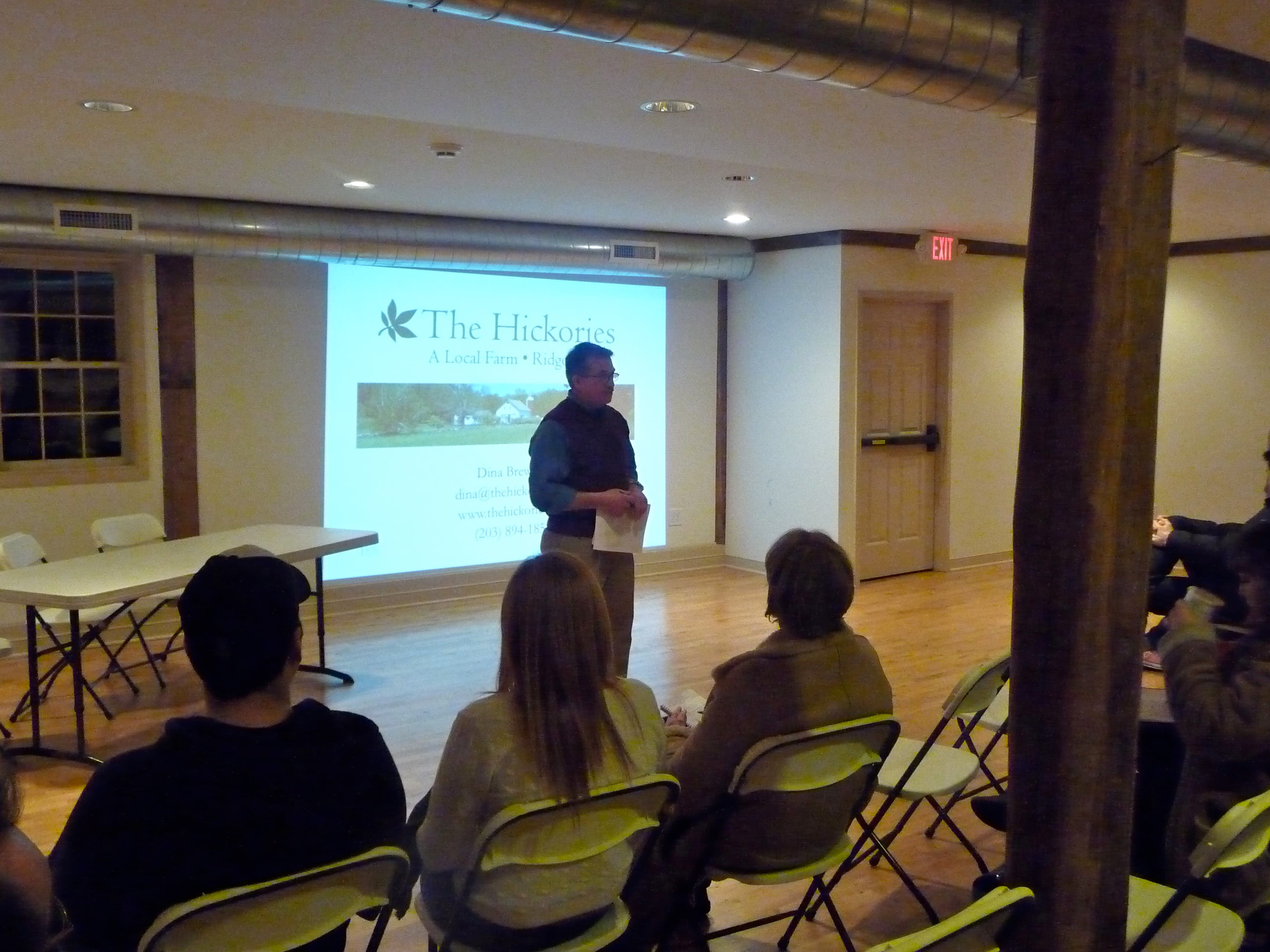
That taste is conjured by and in the produce they grow and they are trying and succeeding, in varying degrees, in monetarily supporting their efforts through Community Supported Agriculture ventures (CSAs). On Monday evening, Ambler Farm played host to the three and their discussion of the method.
Find out what's happening in Wiltonfor free with the latest updates from Patch.
Neil Gluckin, a friend of Ambler Farm and the night's moderator, led off by painting a sad picture of farming in the state. Early in its history, most of Connecticut's families supported themselves entirely through agricultural revenue. Today, according to Gluckin, only about one percent do so. Add to that the fact that between 1997 and 2002, Connecticut lost more farmland to subdevelopment than any other state in the country, and that it loses between 7000 to 9000 acres of farmland to non-agricultural uses every year, and you have a bleak outlook.
"I don't mean to provide a depressing backdrop," Gluckin said, "but I wanted to give you a sense of what it might be like to be a 21st century farmer in the state today...but looking at the future, there appears to be the potential for a turnaround underway."
Find out what's happening in Wiltonfor free with the latest updates from Patch.
Enter the former teacher, scientist and legume-o-phobe.
Dina Brewster, the owner of The Hickories, an organic farm in Ridgefield, began by narrating her own budding fear.
"I wanted to tell you about the new paranoia I have in my life, which is grocery store paranoia," she said. "It is the fear of people in my town seeing me buying groceries...part of my paranoia is based in feeling like I have to be some sort of poster child for farming."
Brewster's self-proclaimed fear may arise from the fact that she's pretty green in all this farming business. Before coming to Ridgefield to run the Hickories five years ago, she was an English teacher in a school in the Bronx, teaching Thoreau and Emerson. At the tender age of 29, however, she had what she hesitatingly called her "mid-life crisis" and decided to heed the call of her family's agricultural roots (they had bought the Hickories in 1936, though she's the first in her family to run it).
Despite the region's rich agricultural history, Brewster said that she is "pretty much the last working farm" in Ridgefield, somewhat ironic considering she's in a part of town known as "Farmingville."
"You have this sort of woolly mammoth on an iceberg feeling," she said of being the lone working farm in town.
But she is making something of her family's farm ownership (to this day, she drives her grandmother's tractor) and the growing demand and appreciation for locally-grown produce. And she is doing it, in part, by instituting a CSA, which she sees a viable way to "combat that isolationism."
CSAs are something like timeshares, where a certain number of families buy into a farm collective and, in turn, receive both bushels of fresh produce and the chance to socialize with other like-minded people while they gather and, on occasion, help harvest at the farm. Shares run somewhere around $500-$600 per season and usually extend through the summer, when many of the vegetables are picked and distributed.
And they are growing in popularity. At the Hickories, for instance, Brewster started her first with 20 shares. The next year they sold 50, 150 this year, and plan to sell around 200 next year, and the demand to buy in is so high that they, and many other farms that run CSAs, have extensive waiting lists.
The CSAs have a range of benefits, helping tie locals to the land they live on and understand and appreciate it more deeply, bringing them together and fostering a stronger sense of community, helping farmers ease the pain of labor-intesive harvests and, maybe most importantly for agricultural longevity, subsidizing the farmers' hard work.
Paul Bucciaglia is the former scientist, a Penn State grad who used to work in laboratories on plant molecular biology. Today, he runs Fort Hill Farm in New Milford and could well be considered a success story for CSAs.
Bucciaglia rents his land from the Sunny Valley Preserve, a local land trust that is a project of the Nature Valley Conservancy, and has about 20 acres of land that he has cultivated. From that 20 acres, he provides between 500 and 600 families with CSA shares, with the profits accounting for about 85 percent of his business.
"Beyond the normal demands, I feel like it is a sustainable business," he said. "I am able to support myself and my fiancee fairly well."
Bucciaglia signed his first lease in 2002 and has a rolling five-year lease, which essentially allows him to renew the whole term every year, an arrangement he called "a solid platform for us to build our business on." His farm began production in 2003 and now both he and Fort Hill have a solid reputation in the area, so much so that many (including the third presenter, Patti Popp) turn to him for advice on how to set up their own farms and CSAs.
While admitting his love for his work and his appreciation for his CSA's success, Bucciaglia also talked about the detriments of the arrangement and farming in Connecticut, in general.
"CSAs have gotten ahead of what the farm can produce," he admitted.
According to him, arable land in Connecticut is running out and and is constantly threatened by non-agricultural developments looking to capitalize on certain properties' commercial value. As an example, he told the audience to look around as they drive up I-91 around Hartford. Much of that land, he said, is some of the best and most fertile farmland in the country. But, it is increasingly covered by golf courses, McMansions, large box stores, and even high schools.
"As a farmer, it pains me to see that high quality land used in that way," he said.
Bucciaglia's farm has reached its own space capacity and he is lucky to have as much land as he does. Around the rest of the state, quality land (flat, stone-free fields with rich, high quality soil) is hard to obtain, if there is much left at all.
And this is not the only problem. With the state in dire financial straits, there is even more of an impetus to sell otherwise good farmland to the highest commercial bidder to earn revenue that might help mitigate one of the largest budget deficits in Connecticut's history. Even this year, Bucciaglia said he had heard that Governor Rell wanted to pull money out of the Purchase Development Rights plan (a state funding plan that helps support farms) and put it into the general fund, though the move has not yet come to fruition.
"The limiting factor is not interested people," he concluded. "It's not people who farm...it's quality, available farmland."
That's why people like Patti Popp, the owner of Sport Hill Farm in Easton, are increasingly important. Popp moved to Easton in 1997 and bought her house, admittedly, because of its historical value.
It wasn't until she and her husband bought some adjoining property and cleared some of the forested area that she conceived of starting her own farm.
"Everybody asks me what started [the farming]," she said. "And I just say 'I don't know.'"
Popp had a tough first few years, with struggling crops and slow public demand. But, partially with Buccaglia's help, she started a CSA with 20 families, many of whom she immediately ostracized because of the sporadic production of her vegetables.
"I never thought vegetables would terrorize me," she said. "But they did. I woke up in a cold sweat many nights wondering if I had enough vegetables to fill the families' baskets."
Those 20 families, however, grew to 44 the following year, 75 last year, and she plans to have up to 150 families this year, supported by almost four acres that she now farms.
Popp is the only one of the three farmers' CSAs that does not have a waiting list, proof that people are becoming evermore interested in eating locally grown, organic produce. But even with strong demand, the rigors of working a farm and turning crops into proverbial bread on the table (that's the accounting for taste part-making a livelihood off what the land produces) constantly challenge the farmers.
But it is their love of the land and their love of their work that keeps them invested in it. They encouraged the audience, as well, to turn to their own backyards for food, much as Popp did with the land she and her husband cleared.
And what of the fear of being caught buying groceries in the grocery store, when, as farmers, they are "supposed" to be living off the fruits of their labors?
"I do like my Fritos here and there, too," Popp said.
For a list of CSAs and farms near you, you can visit localharvest.org. and each of the farms mentioned above have sites that are hyperlinked and provide a bounty of information on their efforts and CSAs, as well.
Get more local news delivered straight to your inbox. Sign up for free Patch newsletters and alerts.