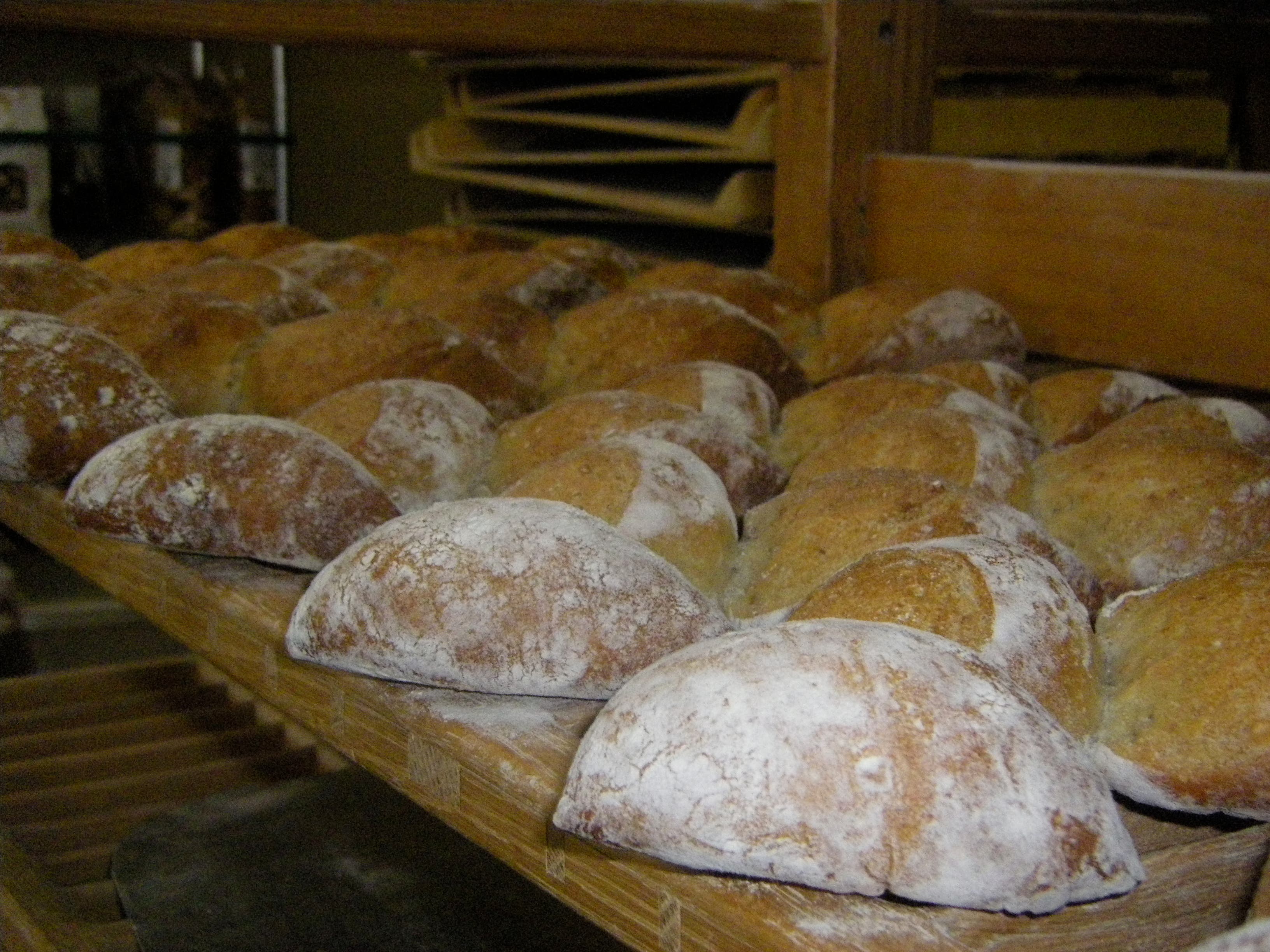


Flour dusts the floor like the first frost. A starchy smell permeates the air.
Four years ago, Margaret Sapir and her husband Mitch Rapoport fired up the oven and opened Wave Hill Breads in Wilton. Today the bakery delights taste buds across Connecticut. It supplies 18 farmers markets and 35 stores across Connecticut.
“We were looking for different kinds of things to do,” Sapir said, seated at a small round table beside a picture window. A newly sliced loaf rests on a cutting board.
Find out what's happening in Wiltonfor free with the latest updates from Patch.
Sapir, a French major, ran Berlitz’ language program for children. Her husband, who speaks Mandarin, developed home banking for Chase. But after two decades living the corporate life, the couple decided it was time for a change.
One summer while in Stowe, Vermont the couple happened to taste the bread of Gerard Rubaud.
Find out what's happening in Wiltonfor free with the latest updates from Patch.
“We thought his bread was just delicious,” Sapir said.
And so they asked Rubaud if they could become his apprentices. Rubaud, who once skied with Jean-Claude Killy on the French National Team, agreed.
The Frenchman proved to be an exacting taskmaster. Soon Sapir and Rapoport found themselves baking at home in the evenings and traveling to Stowe for long weekends devoted to perfecting the art of the bread.
Baking bread is a science, Sapir said. Heat and humidity must be carefully measured in order to turn out loaf after loaf of perfectly crusty de campagne, or country bread.
At first, perfect crusts eluded the couple.
“In the beginning the dough just all squished out and looked like it was going to flow off the board,” Sapir said. “We were here overnight and had to deliver ourselves.”
Now three drivers and two full-time bakers work at the bakery.
Sharon Nisch, one of the bakers, lifted the bucket’s lid and revealed a frothy mousse, like the kind that floats atop a Kronenberg. But it wasn’t beer. It was poolish; the basis for Wave Hill bread. Poolish smells yeasty and rich and sits for six hours before Nisch adds it to bread dough.
One secret to Wave Hill bread is that it contains less than four teaspoons of yeast for every 75 loaves, Nisch said. The average home baker uses far more yeast.
And the longer the dough sits, the longer the bread keeps. Wave Hill bread remains fresh for up to two days, said Sapir.
“A baguette is like a baseball bat after a day,” Sapir said.
Making the bread required bushels of patience. They adapted Rubaud’s recipe, mixing in spelt and rye until it evoked Europe.
The pair first baked loaves in their kitchen and then took them to stores. Bakery managers wanted to sell the bread immediately, Sapir said. However the couple had to find a location. Once they found the Danbury Road spot, they had to have a chimney built in the former office space.
Sapir didn’t grow up thinking she was going to working a 3,000-pound oven or supervise farm stands across the state.
“I like to cook. My father would make pies and I make challah,” Sapir said. “But I’m not as precise as I should be. I’m more of an artistic temperament.”
Slowly, regular hours replaced the all-nighters.
“Now we see them, but we never socialized with them in the beginning,” Louise Sullivan said scooping cubes of bread into bags. The cubes, twice-baked, will serve for stuffing throughout the holidays.
These days, Wave Hill Bread fills baskets in stores like Peter’s Market in Weston and the Village Market in Wilton. Farmers markets as far away as Simsbury and as close as Georgetown eagerly anticipate its arrival. And most recently, food writers Jane and Michael Stern listed the bakery in their new book “500 Things to Eat before it’s Too Late.”
“Has it exceeded my expectations?” said Sapir. “Maybe not my husband's, but certainly mine.”