Health & Fitness
Aqueduct Bridge Over the Potomac: Yesterday and Today
The Aqueduct Bridge played a central role in the history of Washington during the Civil War. Today, little remains of this once magnificent bridge.


My wife and I decided to take a walk along the in Georgetown earlier this summer. Our little attempt at exercise gave me the perfect opportunity to check out the remains of the Aqueduct Bridge, which are located next to the canal path in the vicinity of present-day Key Bridge. This bridge was one of three river crossings into Virginia from the D.C. side of the Potomac at the time of the Civil War.
The Aqueduct Bridge dates to the antebellum period, when Alexandria comprised part of the federal District of Columbia. Alexandria, a port city, desired to benefit from the trade that was moving along the C&O Canal to rival Georgetown. In 1830, a group of Virginia merchants formed the Alexandria Canal Company. They sought to extend the C&O Canal to the Virginia side of the Potomac River, and from there, to Alexandria.
The Aqueduct Bridge, known as the Alexandria Aqueduct or Potomac Aqueduct, was designed to carry the canal across the river. Construction on the bridge and the Alexandria Canal began in the early 1830s and was completed in 1843. The bridge, an engineering marvel of the 19th century, cost a staggering sum of around one million dollars. With the extension of the C&O Canal to Cumberland, Maryland in 1850, the Aqueduct Bridge played a key role in bringing coal from western Maryland to the the port at Alexandria.
The Aqueduct Bridge featured prominently at the start of the Civil War. Virginia voters officially approved secession on May 23, 1861, and in the early morning hours of May 24, Union soldiers moved to occupy Alexandria and Arlington Heights. A Federal column including the 5th, 28th, and 69th New York crossed the Aqueduct Bridge into Virginia. Not long afterward, the Union Army constructed Forts Corcoran, Bennet, and Haggerty to guard the approaches to Aqueduct Bridge from the Virginia side of the river. These forts comprised part of what would become the ring of defenses built to protect Washington during the war.
In his A Report on the Defenses of Washington to the Chief of Engineers, U.S. Army (1871), Brevet Major General John Gross Barnard noted that the Union military decided that a "permanent and secure bridge connecting Washington with the Virginia shore" was preferable to the use of the Aqueduct Bridge to transport military supplies to Alexandria by way of the canal. Some officers, as well as the canal company, initially objected to the suspension of canal operations across the Aqueduct Bridge. A "boat bridge" was contemplated for military purposes, but proved an unrealistic alternative given concerns about water depth, flooding, ice, and currents. Barnard described the subsequent transformation of the Aqueduct Bridge:
Find out what's happening in Georgetownfor free with the latest updates from Patch.
The tow-path of the aqueduct did indeed furnish a narrow passageway to horsemen and footmen; but this was far from adequate to the military exigencies. Accordingly, early in the winter of 1861-'62, the water was shut off from the aqueduct and its trough converted into a double-track wagonroad, the floor being overlaid with 4-inch planks and long inclines, on trestles, forming connections with the roads on either side.
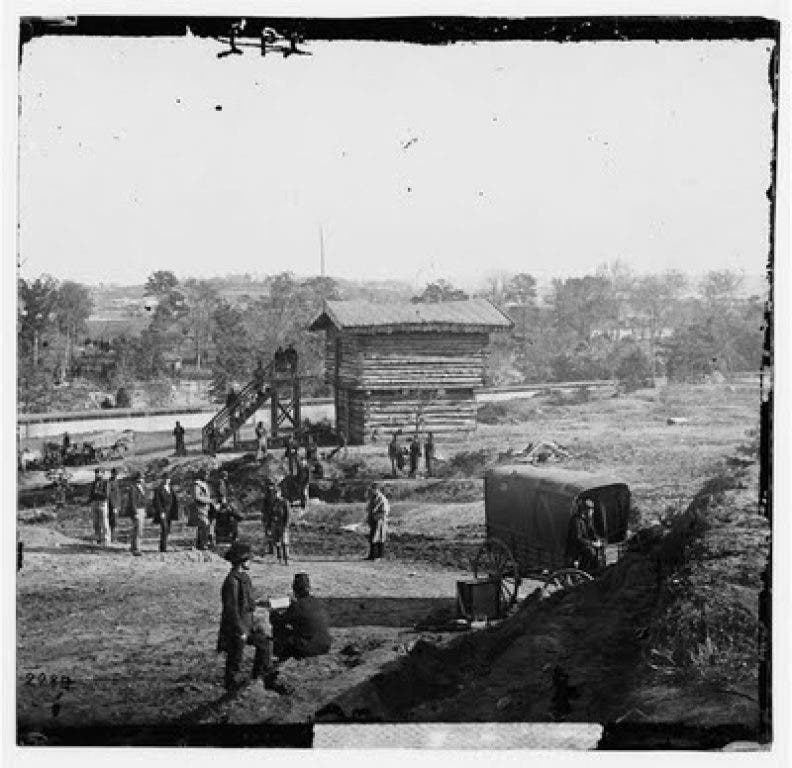
Eventually three blockhouses and a rifle trench were placed at the Virginia end of the Aqueduct Bridge. The head of the bridge was also enclosed with a stockade to protect more effectively against cavalry raids. The Union Army contemplated placing a shore battery in Georgetown to command the length of the bridge, but decided against this defensive measure. A guard of one officer and thirty men usually covered each end of the Aqueduct Bridge.
Barnard, who oversaw the construction of the the defensive works around the nation's capital, concluded in his report that "the aqueduct served perfectly, throughout the entire period of the war, its new destination, and was recognized as an important and essential adjunct to the 'Defenses of Washington' and to the great military operations in Virginia."
The bridge was returned to canal usage after the Civil War. In 1923, the Aqueduct Bridge was closed when the Key Bridge was built next door, and in 1933, the old bridge was largely dismantled. Today the remaining Washington abutment is a visible reminder of the existence of the Aqueduct Bridge and the place it occupied in the capital's Civil War history.
Find out what's happening in Georgetownfor free with the latest updates from Patch.
Ron Baumgarten writes the blog "All Not So Quiet Along the Potomac: A DC Lawyer On The Civil War." He says: "As a member of the DC Bar, I am a passionate Civil War enthusiast in my spare time! I look forward to introducing readers to Civil War history and sites in the DC metro area, with a particular focus on Northern Virginia. I also would like to share interesting Civil War finds, whether books, films, websites, collectibles, or museum exhibits." To read more of his work, click here