Community Corner
National Zoo Reveals Sex of Surviving Panda Cub
....and we also find out which of two pandas is the father. We also learn what caused death this week of smaller panda cub.

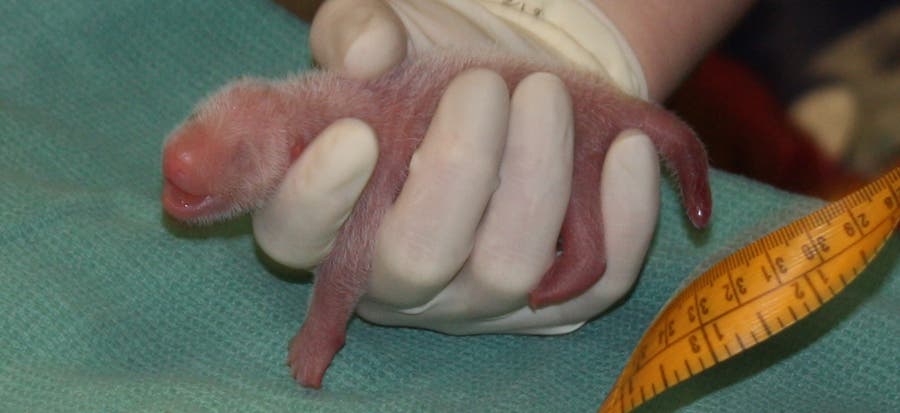
The National Zoo has revealed the sex of the surviving twin Giant Panda cub this morning: It’s a boy!
Scientists at the Smithsonian Conservation Biology Institute’s Center for Conservation and Evolutionary Genetics confirmed that the giant panda cub born Saturday at the National Zoo is male.
The zoo also announced which of two pandas is the dad; two male pandas participated in artificial insemination--one panda from China and another from the National Zoo.
Find out what's happening in Georgetownfor free with the latest updates from Patch.
A paternity test shows that the National Zoo’s Tian Tian (t-YEN t-YEN) is the cub’s father. Scientists also confirmed the deceased cub Mei Xiang (may-SHONG) delivered was a male, also sired by Tian Tian. The cubs were fraternal twins.
Scientists compared the DNA of the cubs’ cheek cells to the adult pandas’ DNA samples for the tests. Veterinarians collected the cheek-cell samples with a small swab during a preliminary health check Monday.
Find out what's happening in Georgetownfor free with the latest updates from Patch.
“What we have learned will greatly add to our body of knowledge about artificial inseminations in pandas,” said Rob Fleischer, head of the Center for Conservation and Evolutionary Genetics. “Determining the pedigree relationships of a cub is a key aspect of helping to maintain a genetically diverse population. Our ability to assess the cub’s lineage will help our colleagues ensure that he finds a suitable mate.”
Juggling twins
Developed from the experience and success of Chinese partners and other zoos, the hand-rearing protocol provided the panda team with several strategies to manage twin cubs. Swapping the cubs between mother and hand-rearing is a proven method that enables zoo staff to best care for twins in the event that the mother cannot manage two cubs, which was the case with Mei Xiang.
When swapping the cubs became difficult, the panda team had in their possession the smaller cub, which was losing weight, needed calories and energy, and was at risk if he remained away from Mei Xiang for a prolonged period of time. The cub’s best option for survival was to receive supplemental feedings via bottle and tube, but both techniques present risks. The team witnessed some regurgitation of food during one feeding, so the cub was started on antibiotics as a preventative measure.
Smaller cub’s death
The smaller cub was with Mei Xiang from about 2 p.m., Tuesday, until the morning of Wednesday, Aug. 26. When the panda team swapped the cubs, they assessed the cub and had concerns because he had not increased in weight, appeared weaker and exhibited possible respiratory issues. He died shortly after 2 p.m. Based on the necropsy’s gross findings, Zoo pathologists and veterinarians determined the most likely cause of death to be complications associated with aspiration of food material into the cub’s respiratory system resulting in the development of pneumonia.
Artificial insemination
Mei Xiang was artificially inseminated April 26 and 27. The first procedure used a combination of sperm cells from Hui Hui and Tian Tian. The second procedure also used thawed sperm from Hui Hui and sperm refrigerated overnight from Tian Tian. The Zoo live-streamed portions of the first procedure on Twitter using Periscope and live-posted to Instagram using #PandaStory.
The David M. Rubenstein Family Giant Panda Habitat has been closed to the public since Aug. 20, and will remain closed until further notice to provide quiet for Mei Xiang and her cub. Both will be visible on the panda cams. Visitors can see Mei Xiang’s Tian Tian and Bao Bao in the outdoor habitat.
Get more local news delivered straight to your inbox. Sign up for free Patch newsletters and alerts.