Politics & Government
Zoning Commission Continues Hearings on Campus Plan as Neighbors Testify
Thursday, the Zoning Commission heard its fourth night of testimony on the Georgetown Campus Plan.


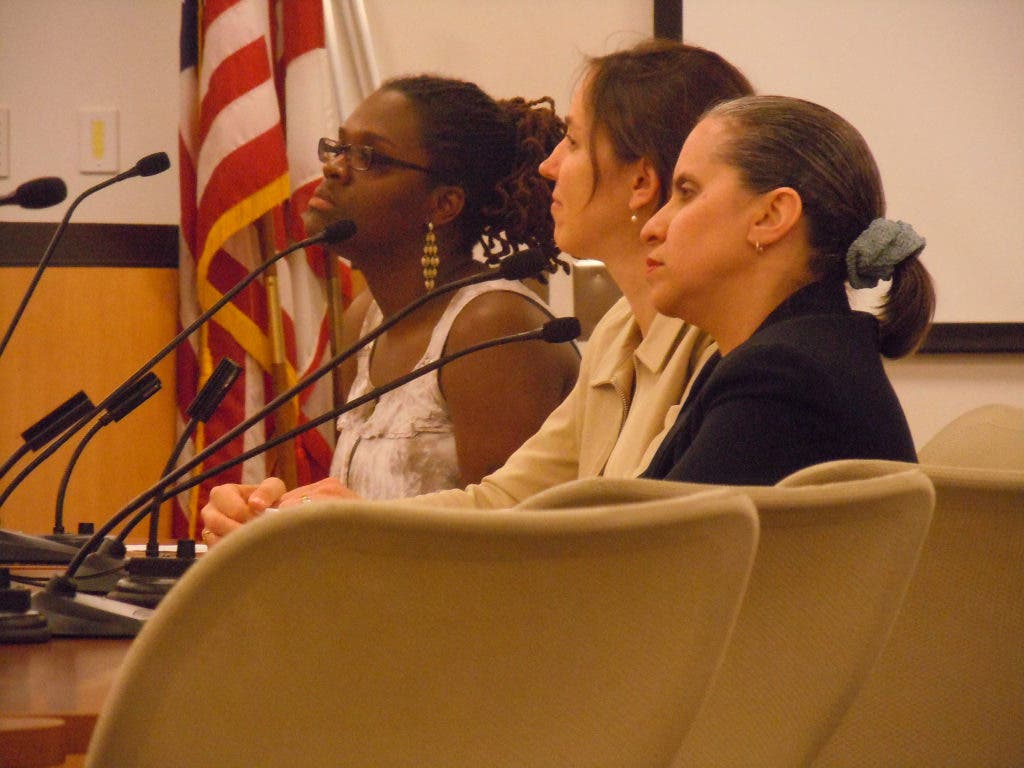


The Zoning Commission held its fourth night of hearings on the Georgetown University Campus Plan with groups in opposition providing testimony and individuals both in support and opposition speaking to the commission, Thursday. The next meeting is Monday, June 6 and the record for written testimony will remain open until at least June 20.
Parties in Opposition
The Citizens Association of Georgetown (CAG), the Burleith Citizens Association (BCA) and the Foxhall Community Citizens' Association testified against the proposed campus plan, laying out a case for the continued objectionable impacts the plan would have on the three communities.
Find out what's happening in Georgetownfor free with the latest updates from Patch.
CAG's President, Jennifer Altemus, walked the commissioner through a PowerPoint presentation that included videos that she said depicted the very behavior that is destroying the quiet Georgetown community. The videos, shot at night, featured young people who appeared to be drunk, fighting on street corners, meandering down streets, yelling and entering parties.
Commission Chair Anthony Hood commented on the videos, saying he would not have believed the behavior depicted was happening had he not seen it with his own eyes.
Find out what's happening in Georgetownfor free with the latest updates from Patch.
Altemus testified that "one party can keep an entire block awake most of the night." She said her organization pays $200,000 a year for a security patrol that in part deals with partiers.
Even if neighbors do have an agreeable situation with the current group of students living next door, Altemus said they never know who will live there next year.
"There is always going to be a 'next' house," she said.
Commissioner Michael Turnbull asked Altemus how much noise she considered acceptable and how would she define the "tipping point."
She said of course moving to a community with a university, residents "expect some noise." But it becomes "overwhelming" when "you can’t sleep at night and your kids are being woken up" every night because of late night noise.
Lenore Rubino of the BCA said the dramatic deterioration of Burleith is a direct result of Georgetown University policies. Part of her presentation focused on the number of group houses and the role they play in the real estate of the neighborhood.
Rubino said the environment created by undergraduates living off campus incentivizes investors to purchase homes in the neighborhood. They then often convert a two- or three-bedroom home into a group house that sleeps as many as eight, legally or not, she testified. Such homes push an already dense neighborhood to its limits, explained Rubino.
Commissioner Konrad Schlater later asked Rubino if "the very presence of a rental is objectionable" even if there were not problems with noise or trash. She maintained that it is the extreme number of students in the community that is the problem.
Individuals in Support
The list of individuals in support included both people with affiliation with the University and those without. The Commissioners focused much of their questions on those members of the community who supported the plan and did not have an affiliation with GU.
Tim Moran lives in Burleith with his family and said he finds "GU to be a very good neighbor...the student who live on [my] street are very respectful, very pleasant people."
The campus plan "seems reasonable to me," added Moran.
Tom Strike also lives in Georgetown with his young family and said contrary to his neighbors' testimony, the area has not been overrun by students, rather it has been overrun by families with children. On his block alone, he explained there are now eight young children.
Though he did have an issue with a medical student living next door who drove to quickly in a public alley, the Dean of the School responded to Strike's complaint promptly.
When asked by the counsel for the parties in opposition if he worried about the turnover in the student homes near him, Strike said he of course thought about it. But, he added, the recent changes to the that allow for arrests based on police observation would, in his opinion, go a long way toward reducing noisy parties.
Seeing a party organizer leaving in handcuffs is "Going to put the fear of God in them," Strike said.
Jacques Arsenault lives near the Duke Ellington School of the Arts and said his block is densely populated with students. In the four years he has lived in his current home, some 100 people have lived in the various student houses.
Of course there are the occasional loud parties or late night noises, he said, but they are "nothing like the number or intensity described" by neighborhood groups. His is "certainly not neighborhood swamped" by objectionable impacts from the students.
Later in answer commissioners questions, Arsenault said that part of the problem is that "people get tired" of the constant turnover in group houses. Being a neighbor to students requires "constant effort, constant vigilance," he said, but that is something he is willing to give.
Individuals in Opposition
Sandrelle Larijouw lives across from Georgetown dorm Magis Row, which is outside the main gates of the University campus. She said the behavior of students there is affecting the "harmony" of her home and family. She said she has tried to call the University's SNAP team but, "SNAP doesn’t work for me," she said.
Candith Pallandre lives in Burleith and has taught at Georgetown. She said she has enjoyed her current neighbors who are nursing students. But she just learned that their lease had been prematurely terminated by the landlord who wants to rent the space to a larger group of undergraduates instead.
"Anyone in my neighborhood could experience this in such short notice," she said. The landlords only care about "maximizing rent and minimizing maintenance."
Pallandre was positive that the community and GU could find a compromise, "there are solutions out there, you just have to want to do it."
Ken Archer a ten-year Georgetown resident lives five blocks from the University with his wife and toddler. He said he appreciates the role of the University in the community that he wants to live in a vibrant city. To that end, "I don’t mind being awakened occasionally," by late night parties said Archer.
However, the growing frequency these student parties is "making me and others feel that GU does not value our presence as their neighbors nearly as much as we value theirs," said Archer.
He continued that the University argues that opponents just a bunch of easily angered NIMBY's who dislike density. Archer said he has testified previously in favor of density and other smart growth initiatives.
"What's happening at GU is different, it's not smart growth, it's just growth," said Archer.
Throughout the evening Commissioners looked to the people testifying for solutions, for compromises for an answer to just how the body should seek to meet both the University's needs and those of the neighborhood.
They will continue asking these questions next week as the remaining individuals in opposition testify Monday, June 6 at 6:30 p.m.
Get more local news delivered straight to your inbox. Sign up for free Patch newsletters and alerts.