Neighbor News
Big Lick Animal Cruelty: Oliver Potts & USDA's Regulatory Debacle
This fourth piece in a multi-part series on the soring of show horses tells how we 'burned the midnight' oil trying to finalize USDA rules

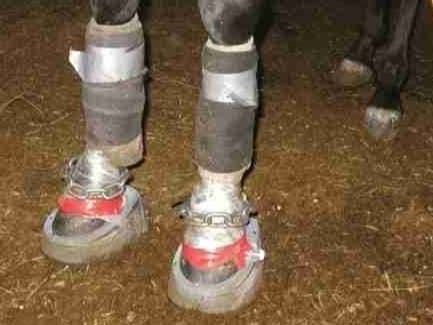
Last week I shared the story of the Prevent All Soring Tactics (PAST) Act’s failure in 2014, and the ultimate passage of the renamed U.S. Senator Joseph D. Tydings Memorial PAST Act in 2019, H.R. 693. And while I briefly touched on the U.S. Dept. of Agriculture’s failed anti-soring regulations, you may have wondered what occurred in the five-year span leading up to the Tydings’ PAST Act’s passage in the House.
On July 31, 2014, when I learned House Speaker John Boehner, R-Ohio had caved-in to political pressure from the pro-soring coalition and refused to advance the PAST Act to a vote, I knew we must find a different path forward to end soring. Still working in Congress, I consulted with my now-colleague, Wayne Pacelle, and we devised a strategy to advance USDA regulations to ban the use of the large-stacked shoes and ankle chains placed on horses’ feet in the show ring to exacerbate pain caused from soring and eliminate the industry’s failed self-policing program. Two of the three main components the proposed PAST Act would have mandated by statute.
I had long known that the U.S. Secretary of Agriculture had published a statement in the Federal Register in April of 1979 – just a few months before I was born – that if soring persisted USDA would consider removing the stacked-shoes and ankle chains. Horse advocates had made attempts to achieve that end in 1988 with a judicial mandate that ultimately led to the reduction of the size of the shoes and chains instead of elimination, and again in 2012 when USDA listening sessions were held in Texas, Tennessee, Kentucky, California, and Maryland on the proposed regulations. Ultimately, both attempts failed, and not much changed in the way of soring practices.
Find out what's happening in Washington DCfor free with the latest updates from Patch.
But in the wake of Boehner’s decision, I saw a window of opportunity to achieve regulatory reform and convinced U.S. Reps. Ed Whitfield, R-Ky., and Steve Cohen, D-Tenn. to lead a Congressional sign-on letter that garnered 166 bipartisan Members of the House to Secretary of Agriculture Tom Vilsack urging him to enact regulations to end soring. Whitfield and I pressed Vilsack for weeks and ultimately secured a direct discussion with the Secretary in August of 2014. We were both quite surprised to learn of Vilsack’s knowledge on the subject of soring, and willingness to work with us. In the meantime, Wayne directed litigation specialists at his disposal to press the White House and Administration for federal rule-making on the issue, and we were off and running.
We spent the better part of the next two-years working to achieve those regulations and faced many setbacks along the way. Initially, attorneys at USDA who drafted the regulations failed miserably in their first attempt by applying the language to “other related breeds” which set off a firestorm of fury within the American Saddlebred world and American Horse Council. Veterinarian Reps. Ted Yoho, R-Fla., a large animal equine vet, and Kurt Schrader, D-Oregon, were then joined by more than 150 Members of the House in asking Vilsack to clarify the language and ensure it only applied to Tennessee Walking, Racking, and Spotted Saddle Horses – the three breeds who had proven histories of soring abuse. The language clarifications cost us precious time and the clock was ticking fast as Vilsack’s term in office and the Obama Administration was quickly coming to a close.
Find out what's happening in Washington DCfor free with the latest updates from Patch.
In the final months of 2016, the U.S. Senators from Tennessee and Kentucky pressed Vilsack for further extension of a comment period on the regulations in an effort to stall our work, and Vilsack granted their wish. I spoke directly with Secretary Vilsack following that action and he conveyed to me that he granted the extension to keep “the boys on the Hill happy,” but that he promised to get the anti-soring regulations done before he left office – and he kept his word. On the very last afternoon President Obama’s longest-serving cabinet member held office, Tom Vilsack announced the finalization of the USDA regulations to ban large-stacked shoes and ankle chains in the show ring and eliminate the industry’s corrupt inspection scheme. A monumental day in the history of soring – or so we thought.
A few days later – ironically enough I happened to be at lunch with former U.S. Senator Joseph D. Tydings the moment some tragic news came – we learned the Director of the Federal Register, Oliver Potts, sternly refused to publish Vilsack’s regulations in the Federal Register, preventing them from becoming official. Tydings and I were together that day as we prepared to honor him with an award at the National Press Club for his half a century of work on the issue of soring.
And while colleagues who weren’t well-versed in the processes of the Federal Register were celebrating the regulations with cake and champagne in Gaithersburg, MD, U.S. Rep. Steve Cohen, myself, Wayne, Whitfield, and Priscilla Presley all “burned the midnight oil” pressing Potts to reconsider. We went as far as reaching the Directors of the Whitehouse Office of Management and Budget (OMB), and Office of Personnel Management (OPM), along with the head of the Government Printing Office (GPO), and attempted to get the Federal Register published on Inauguration Day for the first time in American history. We even reached Vice-President Joe Biden’s office, but with only hours left in the Obama Administration, our efforts failed and President Trump’s Administration rolled-back the unpublished anti-soring regulations in a one-two punch.
Once again, in keeping with the six-decade-long trend, our effort was obliterated, and the pro-soring coalition dodged a speeding bullet that would have led to the death of the “big lick” animal cruelty. It was an unfortunate series of events and to this day, I am convinced there is something we don’t know about Oliver Potts and soring, and he remains the Director of the Federal Register today.
I’ll be back in touch next week with more insight on where we are in 2021 on the issue of soring, and how the landscape for both regulations; corporate reform that could be achieved by the Tennessee Walking Horse Breeders’ & Exhibitors’ Association, and Tennessee Walking Horse National Celebration; and a potential revised PAST Act looks ahead. In the meantime click here to take action and tell USDA’s APHIS Administrator Kevin Shea to crack down on soring at the upcoming “Heart of Dixie Showcase” in Philadelphia, MS this Saturday.
Marty Irby is a former 8-time world champion equestrian who currently serves as executive director at Animal Wellness Action in Washington, D.C., and was recently honored by Her Majesty, Queen Elizabeth, II for his work to protect horses. Follow him on Twitter, Instagram, and Facebook @MartyIrby