Community Corner
Military Hero Challenges Authority
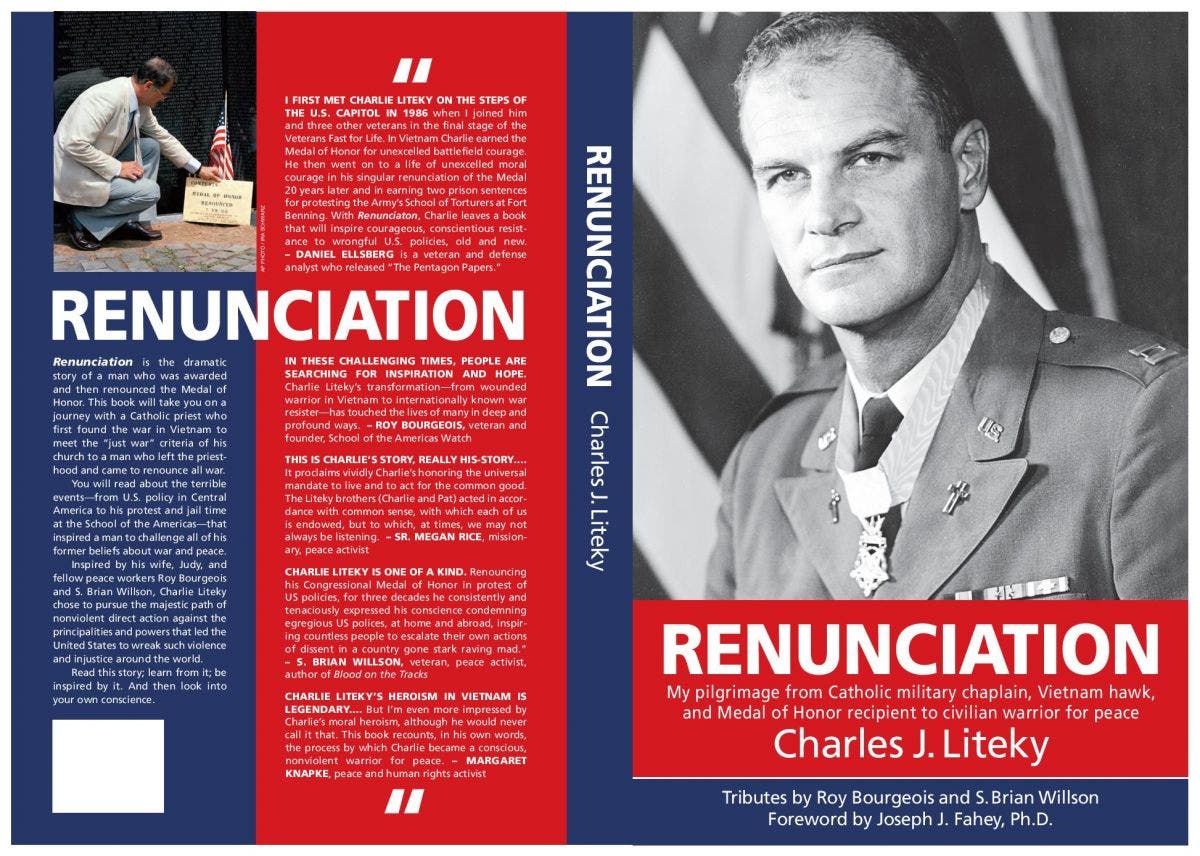
"Renunciation" is Charles Liteky's memoir tracing his journey to peace.

On July 29, 1986, Charles J. Liteky returned to the city of his birth. He placed the Congressional Medal of Honor that he had received for his service in Vietnam at the base of the Vietnam Veterans Memorial in Washington, D.C. Liteky had been a Roman Catholic priest, a military chaplain in the U.S. Army, a Vietnam hawk. Now, he was a civilian warrior for peace.
In his posthumously published autobiography, Renunciation, Liteky explains his pilgrimage in life that brought him to the decision to return his medal. Renunciation is available on Amazon.com in paperback and ebook. The book also can be ordered directly from the new Charles Liteky website. Learn more about the Charles Liteky story on the website and follow on Facebook.
Charlie Liteky was born on February 14, 1931. His father, also Charlie, was a Seaman 2nd Class in the U.S. Navy stationed in the nation’s capital. Soon after the junior Charlie arrived, the family moved to Hawaii when the senior Charlie was transferred to Pearl Harbor.
Find out what's happening in Washington DCfor free with the latest updates from Patch.
Catholic Upbringing
After five years in Hawaii, Charlie returned with the family to Washington. He was educated at a small Catholic school administered by the sisters of St. Joseph.
Find out what's happening in Washington DCfor free with the latest updates from Patch.
“They taught me my numbers,” Liteky wrote in his memoir, “letters, prayers, gradation of sins, the existence of angels, devils and saints and introduced me to basic Roman Catholic theology, a religious construct that answers all the big questions about life from beginning to end and beyond. It never occurred to me to question Catholic theology until the early evening of my life.”
Saving Lives
Until that time arrived, Liteky had been ordained a Catholic priest, served as a chaplain during the Vietnam War and earned his medal for heroic actions on the battlefield on December 6, 1967. Neglecting shrapnel wounds and, without a weapon, helmet or flak jacket, exposed himself to mortars, land mines and machine guns to rescue 23 wounded colleagues who had been ambushed by a Vietcong battalion. He evacuated injured soldiers and administered last rites to the dying.
After the war, Liteky worked with courageous women and men to oppose U.S. military strategies around the world, including American foreign policy in Central America. He was horrified when four missionary women were murdered in El Salvador during 1980 by that country’s national guard. He joined protests that opposed the training of Latin American officers at the School of the Americas (now the Western Hemisphere Institute for Security Cooperation) at Fort Benning near Columbus, Georgia. Liteky was arrested twice and served prison sentences for civil disobedience.
Many years later, Liteky summed up the reasons for his heroic actions during the war and the heroic actions to defy authority after the war. Simply, he said, he was just there “to save lives.”
“Throughout this book, Charlie’s voice speaks loud and clear for the silent and those who have been silenced,” said Joseph J. Fahey, a retired professor of religious studies at New York’s Manhattan College and a friend of Liteky. “It is a challenging story for anyone in the military, for religious and for all of us. We hope that Charlie’s pilgrimage will inspire others to act when necessary and have the personal courage to change.”