Community Corner
NASA Rocket May Be Visible Over NoVA, DC Monday Night
NASA will launch a suborbital sounding rocket Monday from Wallops Flight Facility in VA. Residents in seven states may be able to see it.


MARYLAND — A NASA rocket may be visible from DC and parts of Virginia on Monday night, after it's launched. Viewing should be good with mostly clear skies and a low around 46 degrees, according to the National Weather Service.
NASA will launch a suborbital sounding rocket Monday from Wallops Flight Facility in Virginia. Residents in seven states, including Maryland, may be able to see it, NASA said.
The rocket will carry scientific equipment into space for an experiment, and then return to Earth.
Find out what's happening in Washington DCfor free with the latest updates from Patch.
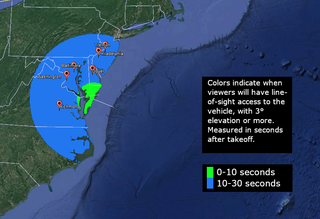
The rocket launch is scheduled between 7 and 10 p.m. Eastern on Monday, March 21. Live coverage will begin on the Wallops Facebook and YouTube pages.
People in the Chesapeake Bay region may be able to see the rocket for 10-30 seconds, NASA said.
Find out what's happening in Washington DCfor free with the latest updates from Patch.
Backup launch dates are set between March 22 and April 1, according to NASA.
The official name for this project is BOLT: Boundary Layer Transition and Turbulence. This flight is BOLT II.

The BOLT flight experiment is designed so scientists can better design hypersonic vehicles to withstand heat, NASA said.
This particular rocket is a Terrier-Improved Malemute rocket, which can carry up to 400 pounds.
As NASA explains, the mission's purpose "to increase the understanding of boundary layer transition, turbulent heating, and drag on vehicles flying at hypersonic conditions. Boundary layer transition to turbulence is the process where smooth, laminar flow becomes unstable after which turbulence dominates and significantly increases heating and drag on high-speed vehicles."
Patch Editor Michelle Rotuno-Johnson contributed to this story.
Get more local news delivered straight to your inbox. Sign up for free Patch newsletters and alerts.