Arts & Entertainment
The Upside Down World of Georg Baselitz
A deep look at the work of the expressionist artist Georg Baselitz's artwork in the comprehensive exhibit at the Hirshhorn museum in D.C.


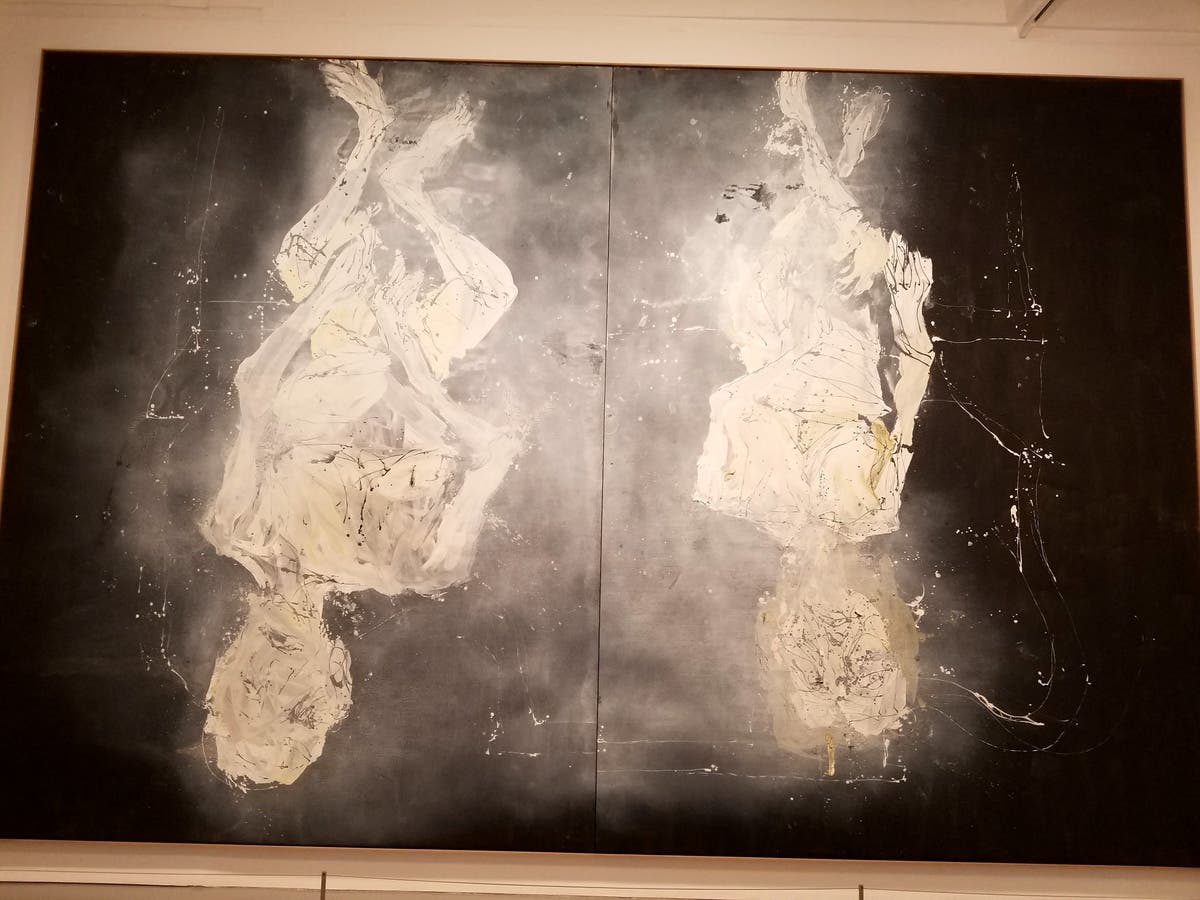
“When I hear the laughter of critics, I am compelled to pay attention” English writer John Ruskin said upon hearing harsh criticism by an art critic belittling the works of the Pre-Raphaelites' brotherhood painters. Hence, I stand with Ruskin, when I hear an art critic mocking an artist's work as unworthy, I am impelled to pay attention, and curious to see what the fuss is all about! Recently, I saw a review putting Baselitz's work not in the best of lights – this made me run to the Hirshhorn museum to see for myself and in my own eyes the latest retrospective exhibit titled “Baselitz Six Decades”. The exhibit is a comprehensive collection of around 100 works of art by acclaimed German figurative expressionist artist, Georg Baselitz (born 1938). The exhibition covers the artist's work over the last sixty years.
The retrospective is a great choice by the curators of the Hirshhorn museum. It is such a strong and powerful plus interesting show on view at the museum. So, if you love this different style of expressive art, do make it a point to visit this exhibit.
I will start on a light note since this subject matter is super heavy.
Find out what's happening in Washington DCfor free with the latest updates from Patch.
Um.. it is rather unfair that some art critics have put DOWN the works of Baselitz – the way I see it, it is completely UPSIDE DOWN! All joking aside and on a serious note, the criticism is that Baselitz can not make a clear decision between going this way or that way - that he blurs the lines between abstraction and realism and how dare he does that! So, due to this unorthodox artistic behaviour, he is deemed unmerited! Seriously, if an artist cannot have an artistic license to play around and produce his work according to his aesthetic and liking then what is he/she then... I ask thee? For what is the role of an artist if it is not to express oneself and awaken the senses though beauty, through shock, through awe. Surely, anyone can see that Baselitz with no hesitation is an expressionist. What ever happened to encouragement to ideas such as “think outside the box”?
So, if a master painter such as Georg Baselitz says I will now present my work upside down or right side up or my personal favorite to the side, then let it be! He is obviously different. I feel this was the struggle of Baselitz all long and even to our days to fit in. One can see that Baselitz's work is truthfully original and not in any way shape or form dull!
Find out what's happening in Washington DCfor free with the latest updates from Patch.
Upon viewing the exhibit which begins with his early rebellious work right side up one sees that the journey of an artist consists of so many ups and downs, and clearly we see that literally in Baselitz's work. The growth is very evident. Yes, a budding artist might go through the confusing states of finding his voice and vision in his art, but the consecutive work of over 60 years will deliver one in the end to a clearer vision. This we do see crystal clear in Baselitz's work. His latest work in my eyes is his ultimate best. This is a natural occurrence. The growth does not only happen to Baselitz but to many artists as well. It is with practice and perseverance that art escalates from one style to another merging and shaping up becoming more refined with every attempt to create. The last room of the exhibit embodies all that and more. The paintings in the last room are a clear departure from his early in your face rebellious strokes albeit very strong. Yet, the latest work done in his old age have an ethereal, spiritual, unworldly almost supernatural quality to them. In these transcendental works such as “We're Off” and “Dierske” one feels that the artist has finally arrived to a place he has been longing to be at for a long time. The artist has become at peace with himself and his art, and that's what ultimately matters at the end. There are so many strong pieces in this exhibit, but by far the best piece I believe is in the form of a self portrait of a painting titled “We're Off” (Wir fahren aus) oil on canvas done in 2016. In this monochromatic palette of black, white and grey painting (not upside down mind you but to the side), we see a ghostly skeletal male figure almost taking off from the ground. Feet floating in air flying in a cosmic universal background, taking off with his visible body, yet his head chopped and cropped at the frame of the picture. A headless creature like many of his works. Yet, in this painting the ambiance of the piece feels different. It is not as painful looking as the rest. It is almost a pleasant composition mystical unhindered by life's banalities. Flying in happiness to a different universe, and almost out of body and out of this world experience. In a way, I see this painting done in his old age almost a preparation to the the after life saying: “I am ready, I am ready for departure form this world into another world, I am ready to take off into the unknown”. In a documentary Baselitz explains that in his earlier days all of the arguments, fights, and effort he put in standing by his work and defending it – making people understand his art – he now finds himself a changed man. He is not that person any-more, he doesn't need to make them understand. He is fulfilled and content with the artist and the person that he became to be. To me the change and shift is obvious in looking at this exhibit of 60 years worth of work. The work does shift - that in your face attitude, I am flipping it to the world by flipping around the artwork no longer seems to be evident in his later work. On the contrary, a more content, even happy Baselitz seems to prevail. For me seeing this amazing collection from early to mid to late work clearly shows the struggles Baselitz had not only in his society, but the struggles and hardships that he had within himself and all that he had endured growing up in post war torn Germany (World War II) broken into two halves the communist East on one side and the capitalist West on the other. The strong opposites of two different worlds of the same country had also reflected immensely on the art scene at that time. In a era that belonged to two artistic visions and divisions of artists those who painted in pure abstraction and the others who favoured representational art. In a world of either belonging to this or that, Baselitz found himself lost in those adhered restrictions of the art world. His struggle is obvious because he was different – different because he didn't conform to the rest of the leanings of the art world. He stood alone, a lone fighter fighting the establishments of what is considered the appropriate art. And through his fight and struggles he himself got confused, and this is a natural reaction when the world is fighting you and not accepting you nor understanding what you offer. After all, art is a very personal matter and anyone can see that Baselitz's art came right form every ounce of his existing soul. So, when the world hammers you down with its rules and regulations, how can you make sense of it all. Well, you cannot. Baselitz reacted by making the right decisions and he did what anyone would do in his position. Change your point of view from where you stand. Baselitz did just that. He flipped the work of art. This change not only by twisting the position of the painting but as a whole the entire composition changes as to him and to us the viewers as well. This very simple change of exhibiting the artwork upside down brought in a new fresh perspective to the modern art world. Why look at a work of art in a specific traditional way? Why not look at it by flipping our heads and our bodies and our eyes? Why not be different for a change? Surely, Baselitz wanted to do exactly that – be different from all the rest of the cookies cutters. It is by being different he truly did stand out. In a way, one feels sympathy for Baselitz and his struggles in his journey. One can almost say that his upside down paintings were a cry for attention from those who deemed his work unworthy to the eyes. But, I see this action to also be a form of understating himself and even more the work that comes from him. As an art educator, if I find a beginner student struggling at drawing the simplest of shapes then I turn around the subject matter or piece of paper they're working from and say “draw it upside down!”. By looking at things in a way we don't usually do (upside down) we make the natural shift form the left analytical and verbal side of the brain to the right side brain which is the more creative one. The side that you want to be on, and should be on when creating artwork. So, by Baselitz painting upside down it could be a calculated step form his part to accomplish a better drawing and painting to achieve that needed shift in brain activities which is essential in becoming more creative. To add, by presenting the works to the public upside down naturally the brain of all the viewers has to work extra hard in deciphering the matter at hand and of course at sight. So, we end up using more of our right brain in viewing his work. Thus, this little alteration of position shifts us all artist and viewers to a view and position we have not been in before. Therefore, the upside down movement and shift triggers brain activities in places where cells have been dormant for way too long. This simple twist gets them dusted off, refreshed and voilà the magical success of Georg Baselitz! Calculated, perhaps. Work of a genius, you bet!
Another nod one has to give Baselitz is his obvious utter love to his wife Elke whom modelled for him from his early paintings and onward throughout his career. Baselitz had based most of his female figurative work be it paintings or sculptures on his wife such as in the case of the colossal wood sculpture titled “Mrs. Ultramarine” (Frau Ultramarin) made in 2004 with cedar-wood and oil paint. The figurative sculptures at the exhibit have a humorous and almost satiric take on the subject matter and mainly on society as a whole. “Mrs. Ultramarine” a huge wooden statue could almost belong in a theme park or a “Mickey Mouse club” due to its cute animation quality depicting perhaps the absurdity of the material world. The sculpture stands tall almost saying “here I stand tall, taller than you all, stylishly dressed to the nines with my platform heels, my fancy wrist watch, my hip ultramarine bathing suit, my stylish up-do hair. Here I am a tourist showing off my goods”. Reading on this piece says in this statue Baselitz depicted his wife Elke as a Mediterranean tourist alluding to iconography portraying the Virgin Mary in blue robes. I don't personally see this that the piece is some sort of a Virgin Mary depiction. And just because the statue is wearing blue doesn't in any way make thoughts nor images of the Virgin Mary jump into my brain. However, what I clearly see in this piece and in all the pieces depicting Elke is the love Baselitz has for his wife - such a love to deem her holy and to depict her as the Virgin Mary. A love that tests the times and endures the struggles, the ups and downs of life, marriage and all in between. So, besides all the strong brush strokes of rotated 180 degrees paintings, the message resonates. It is a message of love not only to his life long partner but to the art itself. The message of staying strong standing the test of time and making it all the way to the end together and stronger than ever. The latest paintings done in his old age exhibit and present us with a sense of peace through its colours, ghost like composition and subject matter. All in all it comes through stronger at the end. One extensive exhibit – a diary of the soul trapped within the figure, entrapped, distressed, clinging, loosening up, twisted, spiralled, pushed around, pushed up, pushed down – pushed outside, outside of the boundaries, pushed again and again till the end – almost there, almost flying – finally, almost at the end, finally getting it right, and finally “We're Off”!
I end with the words of John Lennon that I feel perfectly fit the case of Baseltiz, a rebel with a cause. Similar to Baselitz, Lennon who was much loved but also misunderstood during his time which signifies the situation that many real artists find themselves in during their living years, Lennon said this: "I always was a rebel...but on the other hand, I wanted to be loved”.
“Baselitz: Six Decades” is at the Hirshhorn Museum, Washington D.C. till Sept. 16.
For more about artist and art educator Vian Borchert visit: www.vianborchert.com