Schools
School Board Hears Update On Core Curriculum Program
Development and implementation of the Manatee Core Curriculum program is in its fifth and final year.
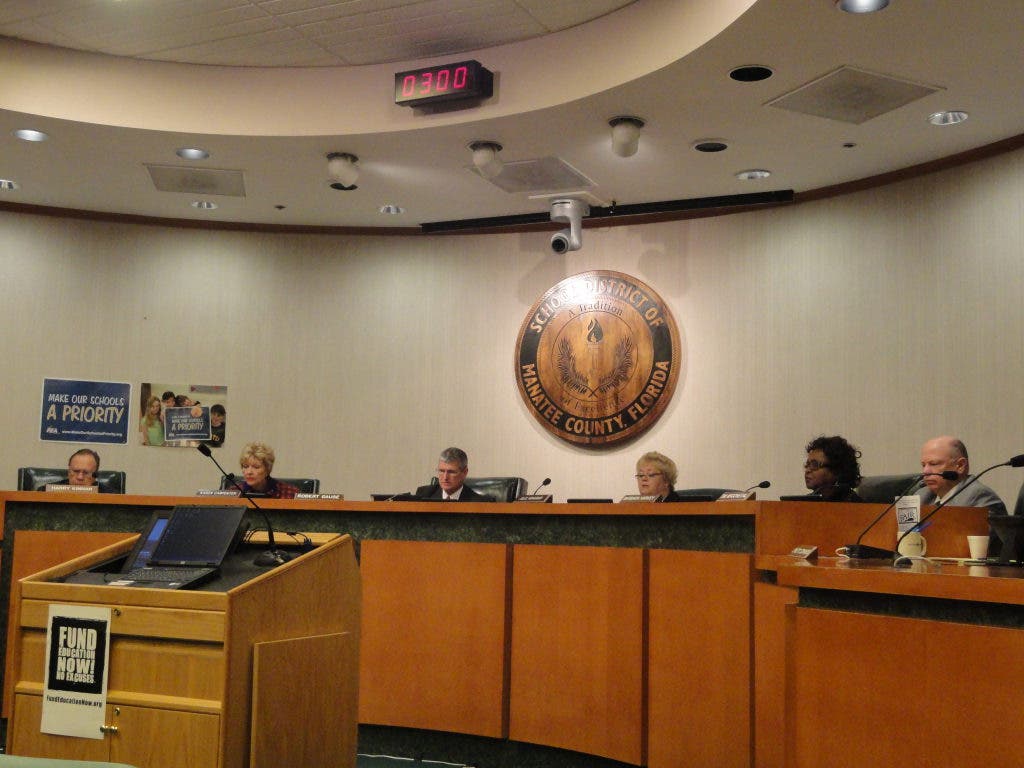
With next year’s budget discussions and teacher contract negotiations working their way through the process, the Manatee County School Board dealt with less weightier issues Monday at its regular meeting.
One agenda item was an update on the Manatee Core Curriculum project, a five-year examination and rewriting of the school district’s curriculum that started in 2006 for four subject areas: English language arts, mathematics, science and social studies.
Linda Guilfoyle, leader of the Core Curriculum Team, told the board members with the aid of an animated slide show that last year the elementary and secondary school teacher design teams finalized the class unit overviews for reading, writing, mathematics, science, social studies and music in the elementary schools.
Find out what's happening in Bradentonfor free with the latest updates from Patch.
Most of the core curriculum program has been implemented in the middle and high schools.
The design teams were finishing up the science portion of the program for the secondary schools.
Find out what's happening in Bradentonfor free with the latest updates from Patch.
They aligned the course study units to the new science textbooks that will be introduced in the next school year, Guilfoyle said.
The new core curriculum will connect directly to EdVantage, the district’s strategic plan for improving education.
The design teams also developed model lessons and teaching material to support the teachers’ in-classroom work, Guilfoyle said.
A system of teacher instruction and evaluation has been included in the core curriculum program.
Board member Harry Kinnan detailed the history of how the Manatee Core Curriculum project started.
Before this program students would switch schools within the district and were at a disadvantage because they were expected to know about a subject matter that was not taught in their previous school, Kinnan said.
He said more than 30 percent of the students change schools during the school year.
This project requires all grades in all schools to teach a specific core curriculum so a student moving to a different school will be on the same footing as the other students in any specific class.
Board member Barbara Harvey wanted to know if the new science textbooks would be on electronic readers.
Guilfoyle said the state and the district were moving in that direction and it is expected that all textbooks to be on electronic readers by 2015.
The new science textbooks for this upcoming year will be hard back, but there are web-based components available for the student and teachers.
Chairman Robert Gause asked if there was any flexibility in the program for the teacher to address the needs of the advanced and less-advanced students.
Guilfoyle said there was flexibility, because with a core curriculum the teachers have a set of standards to meet with the ability to add to the study units.
The school board also heard from Christy Holt, project director for the district’s Teaching American History grant programs.
The two grants, Freedom and Democracy and Foundations of Freedom Liberty Fellowship, have provided opportunities for professional development workshops for teachers, Holt said.
They also have helped students learn the importance of participation in the democratic process and to carry those lessons throughout their adult lives, she said.
An important point, Holt said, was that no district monies were used for these programs; they were both funded through the U.S. Department of Education.
Several people spoke during the public comment portion of the meeting, including Sondra Sharff-George, who asked the board to reconsider the modified Wednesdays policy, where students go to school for a half-day so that teachers can have in-service time.
Sharff-George said this is a hardship for many working parents and that she personally loses $8,000 a year to pick up her two children from school.
Kinnan said the school board has scheduled a workshop at 6:30 p.m. Wednesday on the subject.
Tom Garland questioned the wisdom of the school district getting into the business of medical clinics when its expertise is education and funding is so tight.
Gause said the board will discuss that issue at a workshop at 5:45 p.m. April 4 because the administration brought the idea forward as a cost-saving possibility.
He said the reason for the workshop was to hear about the program, but it did not mean the board would implement it.