Home & Garden
Slow Hurricane Seasons Spell Trouble for Florida, History Shows
The state leads in the number of 'below-average season' impacts.


While forecasters seem to agree the 2015 Atlantic Hurricane Season will be a slow one, that doesn’t mean Floridians are off the hook from keeping an eye on the sky.
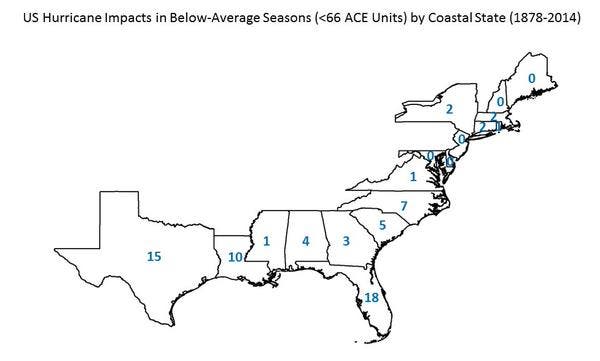
Dr. Philip Klotzbach of Colorado State University has crunched the numbers to see which Gulf Coast and Atlantic states have had the most brushes with storm impacts during “slow seasons” in the past. His look at historical data related to below average seasons turned up some eye-opening results for the Sunshine State.
Florida, Klotzbach says, leads the country in the number of hurricane-related impacts during below average seasons with 18. The next closest states for slow-season impacts are Texas with 15 and Louisiana with 10.
Find out what's happening in Clearwaterfor free with the latest updates from Patch.
To arrive at that conclusion, Klotzbach looked at below average season data between the years of 1878 and 2014.
“The reason that I posted this figure was to emphasize the fact that even though the season is predicted to be below-average, it does not guarantee that the U.S. will not be impacted by hurricanes,” Klotzbach was quoted by the Palm Beach Post as saying.
Find out what's happening in Clearwaterfor free with the latest updates from Patch.
Klotzbach also tweeted a graphic of his analysis to show followers that danger is present even in slow seasons. Data for the analysis came from NOAA’s Atlantic Oceanographic & Meteorological Laboratory’s Hurricane Research Division. An “impact” doesn’t necessarily mean landfall, only the presence of hurricane-force winds along a state’s coast.
See Also:
- Hurricane Seasons 2015: Time to Prepare is Now
- 2015 Atlantic Hurricane Season: What You Need to Know
- Tampa Bay ‘Ripe for Disaster,’ Hurricane Experts Say
The National Oceanic and Atmospheric Administration anticipates the 2015 season, which runs through Nov. 30, will witness the formation of six to 11 named storms. They’ve set the likelihood for that many storms at 70 percent.
Storms are named when they have winds of 39 mph or higher. Of those six to 11 storms, forecasters anticipate three to six could become full-blown hurricanes with winds of 74 mph or higher. Up to two major hurricanes – with winds of 111 mph or higher – could form.
“A below-normal season doesn’t mean we’re off the hook,” NOAA administrator Kathryn Sullivan was quoted in a media release as saying. “As we’ve seen before, below-normal seasons can still produce catastrophic impacts to communities.”
Sullivan was referencing the 1992 season that only saw seven named storms in total. The first storm that year was Andrew, the monster Category 5 storm that wreaked havoc on South Florida. And, as Klotzbach’s research shows, below-average seasons have signaled trouble for Florida many times in the past.
Klotzbach’s team anticipates there is a 15 percent chance a major hurricane could strike the American coastline this season, the Post noted.
Graphic courtesy of Dr. Philip Klotzbach
Get more local news delivered straight to your inbox. Sign up for free Patch newsletters and alerts.