When I was an adjunct instructor at Daemen College in Buffalo, New York, a student once asked me, “What do I need to do to get an “A” in your course?” In reply I said, “Well, if you just come to class and meet the college’s attendance requirements, I’ll give you an A.” With a bewildered look, he responded, “I don’t get it. Why would you do that?”
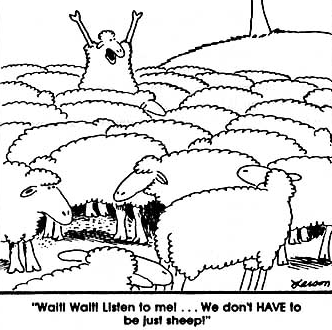
What the young man didn’t understand about education is that college students are sometimes like sheep. They register for the classes they want, to earn the grade and the degree they think they need, to get them the job that may eventually burn them out, because their life goals were focused too much on achievement and not enough on learning, experience, and integrating textbook knowledge with practical, real-life situations.
A similar phenomenon can happen in the work environment. “What do I need to do to get a job with your company and earn a living?” Unfortunately, the answer is often something like, “You need to show up every day, do your job, don’t ask questions, and everything will be fine.”
Find out what's happening in East Lakefor free with the latest updates from Patch.
When new hires and rank and file employees become nothing more than sheep in the company fold, organizations place themselves at great risk. The outcome is that change takes a back seat to “the way we’ve always done it around here,” while growth and innovation are suffocated by “Pyramid Paralysis.” In other words, the corporate shepherds are comfortable at the top of the organizational pyramid with the current direction of the company; the last thing they want is a new idea that might upset the status quo.
Researchers at the University of Michigan’s Business School assert that deviance in the workplace can actually be a good thing. Traditionally, deviance can be understood as intentionally negative behaviors that depart from organizational norms in destructive ways; for example, stealing, incivility, public humiliation, and manipulating an employee’s good will for dishonest outcomes are common examples of deviant, harmful behavior.
Find out what's happening in East Lakefor free with the latest updates from Patch.
However, in an article in the American Behavioral Scientist, Gretchen Spreitzer, clinical professor of management and organizations, and Ph.D. student Scott Sonenshein define positive deviance as “intentional behaviors that significantly depart from the norms of a (company) in honorable ways.” What does that mean?
The positive organizational deviant will engage in one or more of the following workplace behaviors:
1. Challenges a departmental process with an alternative idea and supports their recommendation with sound reason and logic
2. Suggests a new policy or procedure that will improve personal or organizational effectiveness
3. Speaks up in staff meetings and plays a devil’s advocate role while questioning the wisdom of a particular course of action
4. Challenges leadership to embrace new and innovative ideas
5. Calls into question people, processes, or policies that deviate from the company’s mission and core values
“Positive deviance focuses on those extreme cases of excellence when organizations and their members break free from the constraints of norms to conduct honorable behaviors,” Spreitzer says. “It has profound effects on the individuals and organizations that partake and benefit from such activities.”
In the process of recruiting, selecting, hiring and training new employees, HR professionals customarily seek out those who are a “fit” for their corporate culture. Unfortunately, that method results in the acquisition of a staff member that is little more than a mechanical robot, simply going along to get along.
To achieve a sustainable competitive advantage in today’s marketplace, what companies need are more positive deviants, corporate “change-makers” who inject their passion, creativity, and innovative ideas into the veins of the organization.