Crime & Safety
Florida Sheriffs Refute Research Behind Prison Reform Bills
A Florida Sheriffs Association report says crime has been reduced 67 percent with the Truth in Sentencing law.



Editor's note: The original version of this story quoted from the report including past comments from a sheriff who is now deceased, and should have noted that those comments were made in 1975. That information has been removed and the story updated to reflect the views of contemporary experts on the issue.
TALLAHASSEE, FL — A report just released by the nonprofit Florida Sheriff's Association indicates that Florida's law mandating that all state inmates serve at least 85 percent of their court-imposed sentence in state prison has reduced Florida's crime rate by 67 percent.
Refuting the research behind prison reform bills under consideration by the 2020 Florida Legislature, on Tuesday more than 30 Florida sheriffs gathered in Tallahassee to formally release their Truth in Sentencing report, the first product of the newly launched Florida Sheriffs Research Institute.
Find out what's happening in Largofor free with the latest updates from Patch.
The sheriffs association founded the Florida Sheriffs Research Institute to conduct independent research on public safety issues, in the process, provide some balance to research conducted by nonprofit social justice institutes.
According to the first report released by the Florida Sheriffs Research Institute, Florida's Truth in Sentencing law coupled with the state's incarceration model has resulted in a lower crime rate and lower incarceration rate than many other states.
Find out what's happening in Largofor free with the latest updates from Patch.
Despite being the third largest state by population in the U.S. and accommodating 125 million tourists each year, the report claims that Florida's crime and incarceration rates are significantly lower than many smaller states.
The report also aimded to debunk claims that Florida's prisons are overcrowded with first-time, nonviolent offenders.
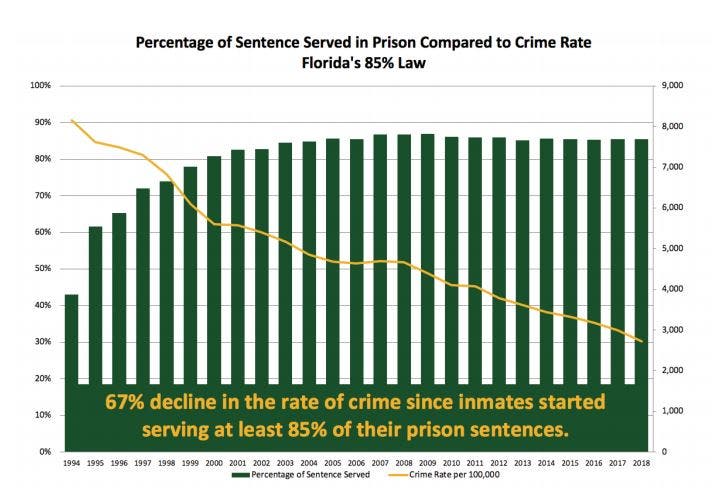
Graphic provided by Florida Sheriffs Association
The report includes anecdotal statements from Florida sheriffs including Flagler County Sheriff Rick Staly who was shot three times on July 31, 1978, while he was an Orange County deputy. The shooter was found guilty two years later and sentenced to 20 years in state prison. However, he was released after serving just 8 1/2 years or 40 percent of his sentence. Since his release for attempting to kill Staly, he has been a revolving door inmate, committing crime after crime. Staly said that would not have happened if he'd served at least 85 percent of his sentence.
"Florida’s 85 percent law (Truth in Sentencing) was passed because of cases like mine," he said. "Florida has a 50-year low in crime partly because more criminals are having to serve the full amount of their court-ordered sentence. As a victim of crime, a 45-year Florida law enforcement officer and current sheriff, lessening the terms of incarceration for offenders will be disingenuous to the duty we all share for public safety. It will make Florida more dangerous for our citizens, our visitors and for law enforcement officers protecting our cities and counties."
Eighteen states and the District of Columbia now require prisoners to serve 85 percent of their sentences. An additional 22 states require prisoners to serve a mandatory sentence of more or less than 85 percent. Just 12 states have no Truth in Sentencing law.
However, there's a move in the Florida Legislature to relax the 85 percent rule.
St. Petersburg Republican Sen. Jeff Brandes, chairman of the Senate Criminal Justice Committee, is sponsoring a packet of criminal justice reform bills including SB 572, which would reduce the 85 percent law to 65 percent for non-violent offenders. Violent offenders would still have to serve 85 percent of their sentences.
The bill is aimed at lowering the state's prison population. Estimates show the bill could release more than 9,000 people from prison by the year 2023-24 and save the state $860 million over a five-year period.
"Many of our institutions are understaffed and overstuffed with idle inmates," said Brandes noting that the savings could be used to put more police on the streets. "We're trying to give judges more discretion to determine the appropriate sentences for individuals. Mandatory sentences just don't work, and we're spending more money than needed on housing individuals that don't need to be in jail."
Florida Rep. Dianne Hart, a Democrat from Tampa, supports a House version of the bill. She said the money saved could be used to educate and train those incarcerated for non-violent crimes, so they can become productive citizens when they're released.
Until now, the bulk of the social justice research has been conducted by organizations like the nonprofit Brennan Center for Justice, an outspoken proponent of prison reform and clemency.
"State laws contributed to mass incarceration, and those laws must change to end it," said Brennan Center director of justice Lauren-Brooke Eisen in a Jan. 2 article titled, "Criminal Justice Reform at the State Level." "Given the toll that mass incarceration takes at the state and county level, it’s essential that we focus reform efforts there to ensure that states roll back punitive laws that send too many people to prison for far too long."
The Florida Sheriffs Research Institute, led by Steven Hougland, a retired law enforcement officer and former associate professor of criminal justice, said the statistics he's uncovered don't support the Brennan Center's claims.
"The FSA Research Institute is significant for our state, so we can finally have analysis done that makes certain the full impact of our current laws is properly assessed," said FSA President and Pinellas County Sheriff Bob Gualtieri. "What our first report finds is that the current research tells us that the 85 percent time-served law has been associated with significant reductions in the likelihood of recidivism. Truth in Sentencing works, and it is making our communities safer with less crime and fewer victims."
"This report demonstrates Truth in Sentencing is effective and proven," said FSA's legislative chairman and Manatee County Sheriff Charles Wells."Due to term limits, legislators need to know why these laws were put in place and why Florida's current incarceration model sets the standard. We have witnessed a 67 percent decline in the rate of crime since inmates started serving at least 85 percent of their prison sentences."
Get more local news delivered straight to your inbox. Sign up for free Patch newsletters and alerts.