Politics & Government
'Big' Changes May Be Coming to US-Cuba Relations: Miami Experts
President-elect Trump does not appear to view Cuba as a critical issue.


MIAMI — With little more than a month to go before the Trump administration officially begins to “drain the swamp,” experts on Cuban-American relations here are warning that “something big” is likely in the works.
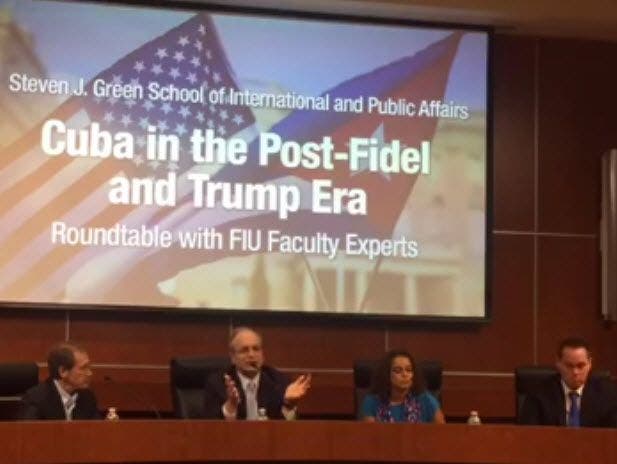
“If anything, the transition has raised expectations that something big is coming,” asserted Frank Mora, former U.S. deputy assistant Secretary of Defense for the Western Hemisphere, speaking at a Florida International University roundtable discussion on Tuesday that examined the future of U.S.-Cuba relations following the death of former President Fidel Castro.
“Now what that looks like, I grant you we don’t know. And, I don’t think that on Jan. 21 president Trump will break relations with Cuba, but he has to start moving in the direction because he feels — at least feels, or perceives — that he has a political debt.”
Find out what's happening in Miamifor free with the latest updates from Patch.
Mora, who now serves as director of FIU’s Kimberly Green Latin American and Caribbean Center, doesn’t believe that President-elect Trump necessarily views U.S.-Cuba relations as a high priority for his coming administration.
“He changed his mind three different occasions in the last six months,” insisted Mora on Tuesday. “Now he has the position of reversing everything that president Obama has done. So, the way I see this is that he will delegate Cuba policy to others and he will delegate Cuba policy to largely — but not solely — to Cuban-American legislators in this town, and to Sen. Marco Rubio and to Sen. (Robert) Menendez.”
Find out what's happening in Miamifor free with the latest updates from Patch.
The FIU discussion was the second in a series of roundtables following the Nov. 25 death of the 90-year-old Castro, sparking celebrations throughout the Cuban-American community in Miami and other parts of Florida, where there is a large population of Cuban immigrants. Singer Gloria Estefan took to social media on Nov. 26 to defend the celebrations.
FIU will host the third roundtable on Dec. 8 at 10 a.m. It will be broadcast live through Facebook by visiting the following link and selecting “videos”: https://www.facebook.com/fiusipa.
Rubio has said that the U.S. should do everything possible to encourage the post-Castro Cuba to move toward democratic reforms, including a free press and changes to Cuba’s domestic and foreign policy.
Brian Fonseca, director of FIU’s Jack D. Gordon Institute for Public Policy agreed with Mora and the other panelists that Trump does not necessarily view Cuban-American relations as critical but the expert doesn’t necessarily think that this will result in closing embassies between the two countries or rolling back recent changes that have allowed commercial flights between the two countries and other firsts.
“Those that have been sort of lining up to make substantive investments in Cuba are probably going to put pressure on Trump to keep economic space open,” Fonseca explained. “There may be a balance now between sort of the politics of closing that space and the economics of opening that space that Donald Trump is going to have to work through, I think, in the short term of his presidency.”
Professor Danielle Clealand, who has studied racial politics in Cuba, Latin America and the U.S., added that she doesn’t anticipate much of a departure in the policies of President Raul Castro following the death of his brother, but that the U.S. response is much more uncertain.
“Certainly our president-elect is quite unpredictable so we really can only speculate,” she said. “But, as far as policies led by President Castro, I don’t think we’ll see much change.”
Mora reminded the audience that there are many political considerations that will go into President-elect Trump’s decision-making regarding how he will handle Cuba.
While Trump won the state of Florida in the Nov. 8 election, Miami-Dade and Broward Counties voted solidly for Hillary Clinton. And with the exception U.S. Representative Mario Díaz-Balart, local Republican leaders did not support President-elect Trump.
Mora predicted that President-elect Trump could return back to a Cold-War era approach to dealing with Cuba.
“On an issue that he does not care about, in a sense he will hand over this political chit to people who did not support him, and say ‘here you take this, run with it, but remember in the future I’m going to cash in that chit on another issue, maybe in 2020 when I run again,’” according to Mora. “So, this is all a political calculation that has nothing to do with desired effects or policy effectiveness. It has all to do with politics.”
Photo from Florida International University Facebook broadcast.
Get more local news delivered straight to your inbox. Sign up for free Patch newsletters and alerts.