Neighbor News
The Fire That Illuminates: An Interview with William May
Exploring Creativity, Identity, and the Poetic Journey in Blaze Without Burning

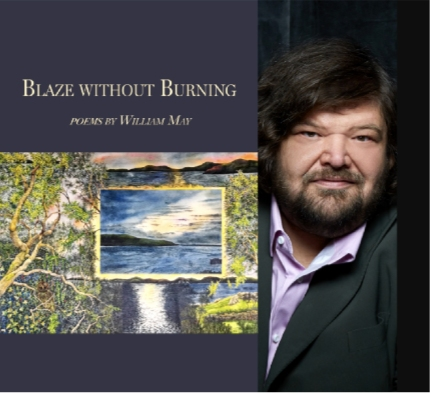
Author William May's journey to poetry was anything but conventional. Diagnosed as neurodiverse at a young age, he initially struggled with reading and writing, believing that language might never be his strong suit. However, literature became not only a refuge but a force of self-discovery, leading him to craft a body of work that explores transformation, resilience, and identity. His poetry embraces duality—light and shadow, past and present, destruction and renewal—offering a layered reading experience that rewards careful attention.
May’s debut chapbook, Blaze Without Burning, is a testament to this, offering readers a collection that is both deeply personal and structurally bold. Releasing on May 30, 2025, through Finishing Line Press, the book is already generating conversation for its inventive approach and emotional resonance.
Beyond his work as a poet, May has made a name for himself in the literary world through his podcast, Argh! Not Another Book Publishing Podcast, where he discusses the ever-changing landscape of publishing and creativity. His unique perspective and ability to dissect complex themes make him a compelling voice in contemporary poetry.
Find out what's happening in Miamifor free with the latest updates from Patch.
In this interview, we dive into May’s creative process, his inspirations, and how Blaze Without Burning came to life. He shares insights on the challenges of crafting poetry that is both experimental and deeply human, as well as what he hopes readers take away from the collection. Join us as we explore the mind behind the words and the fire that fuels them.
Pre-Order the book here:
https://www.finishinglinepress.com/product/blaze-without-burning-by-william-may/
Find out what's happening in Miamifor free with the latest updates from Patch.
What initially drew you to poetry as a form of expression, and how has your relationship with it evolved over time?
I think that a large part of what drove me towards writing in general, and poetry in particular, is my early experiences learning to read. As a child with dyslexia, I had a great deal of difficulty with attaining the skills of basic literacy, and it was only after I was diagnosed and received the right kind of instruction that I was able to unlock the capacity to understand the written word. I had a great deal of shame about my failures up to that point, even believing myself to be mentally incapable of ever learning to read or write, so it may be understandable that, once I overcame those obstacles, these skills became something I treasured immensely. Poetry became an extension of that core relationship, allowing me to maintain an intimacy with and a deeper understanding of how language works, of just what words can be encouraged to do.
The title Blaze Without Burning is striking—what does it mean to you, and how does it reflect the themes of the collection?
The title comes from one of the poems in the book, “What Is Released,” and it is an image about wanting to reach out towards something beautiful and warm, with an awareness of the inherent danger of touching that source. Blaze without Burning is a collection built on dualities, on the multiplicity of meaning inherent to an experience and how it can shift through time and perspective, but also about how the same moment can be more than one thing, can be both the flame that warms and the fire that singes.
Your poetry explores resilience and transformation in deeply personal ways. Were there particular moments in your life that shaped the emotional core of this book?
The poems in Blaze without Burning were largely written when I was still dealing with my father’s passing, and that certainly colors the book. Many of the poems in the book are reflections on loss and loneliness, and I think that, though not all of this is directly occasioned by grief, the general tenor of the work is a reflection of the shadow mourning a loved one can cast on life, even when we are not conscious of that influence.
You’ve spoken about struggling with reading as a child before discovering your love for books. How did that journey influence your path as a writer?
Well, I do think that a lot of my passion for language and literature is a direct result of having struggled to read. For me, literacy is hard-won and precious, and this has manifested in a love of words and the structures that we can make from them. This is true both in the direct sense, in terms of my drive to write, but also, and I think as importantly, in the way it inspired me as a reader when I was young. Once I was a proficient reader, I was almost always engrossed in some book or another, and I was fortunate to be exposed to a great deal of wonderful writing from an early age. Certainly, that experience has provided a strong foundation to build upon as a poet and a writer.
You describe yourself as a “Neurodiverse Language Wizard.” How does your neurodiversity shape the way you approach poetry and storytelling?
It can be difficult to explain just what impact neurological differences have. I’ve lived my entire life with a dyslexic mind and brain, and I cannot say just how that experience differs from a neurotypical one. I know, however, that there are differences, and I am certainly informed by that awareness. I think that a great deal of what comes through in my work is a certain awareness of reading as an experience, as a part of work, not just the vessel for its communication. This is not always directly acknowledged or expressed, but there is always, at least for me, an awareness of reading as a process which informs my decisions.
The cover art by Richard Frank plays an important role in setting the tone of your book. What drew you to this piece, and how do you see it connecting with your work?
I feel very lucky to have Richard Frank’s untitled painting on the cover for Blaze without Burning. Beyond the fact that it is just a beautiful and intricate piece, it is a painting that captures something magical and mysterious which I can’t quite explain, with a central duality of its own. The connections that I find between the painting and book are not entirely concrete, but I believe that perhaps the book and the painting share a kind of resonance. In truth, I had been looking through various options for the cover and the moment that Frank’s painting appeared, it was obvious to me that it was the right image. I have to thank Museum of Art Deland for their support and for access to the image.
You recently hosted a podcast episode about independent publishing. What has been the most rewarding and the most challenging part of bringing Blaze without Burning into the world?
I think that there are two different answers that I can offer here. First, in terms of creating the book itself, I think the most challenging, and the most rewarding aspect was in weaving the poems into a cohesive whole. I didn’t write the poems that became Blaze without Burning with any intention towards a larger work. At the time I was working closely with the poet Freesia McKee, who was helping me to review work in preparation for sending it out on submission. She selected a group of poems that she felt would make a good chapbook manuscript, and it was in revising and organizing that work that the book took shape, including the pairing of the poems into twins. Bringing the individual poems together in order to create a larger whole feels very significant for me as an artist.
There is also, though, an answer that I think is a bit more relevant to publishing and that entire process. The fact is, Blaze without Burning is not something that came together last week or even last year. I have been submitting this manuscript for years up to this point, and until recently, none of the publishers had seen fit to accept the work for publication. Rejection is a difficult thing to endure for anyone, and I know that I am somewhat sensitive to it myself. It took a long while to get here, and it is easy to think back on that now, as I am preparing for the book to launch, and think of it in a very different way, but staying on course can be the most difficult part of any journey, and I think it is important to honor and remember that when things begin to change.
Poetry often acts as a bridge between writer and reader. What do you hope people take away from Blaze without Burning?
I think bridge is a very good word to use for what a poem is and does. A bridge is not simply a pathway but carries us across some span that might otherwise be impassable. As well, I tend to think of a bridge as elevated, as providing a perspective impossible from most any other locale. In the same way, I think that poems serve to connect a reader with a certain experience, that they allow us to be transported across a space we might not otherwise access, observing what is around us from a different vantage than we could before. In the same way, as you say, the poem connects us to the poet, and, therefore, to a particular way of knowing the world. In many ways, Blaze without Burning is a book about loneliness and grief, and I think that one of the most important things we can have, when we experience those emotions, is the sense of connection with another person and the awareness that what we are feeling is not unknown outside of our own hearts. If a reader connects with the book in a way that makes them feel less isolated and alone in the world, that feels like a deep service for my poetry to perform.
Who are some of the poets or writers who have influenced you the most, and how have they shaped your own writing?
It is interesting to think about the poets who have influenced my work. In some ways, I think that Blaze without Burning, in particular, has a great debt to the Romantics, in particular to William Blake. Even the title, if I consider it, feels like an echo of Blake. That was not an intention, but when I look through the book, I recognize it right off, and that is kind of the thing about influences, really, with how deep they can get within you. I know that I have many poets I can name who have touched me, and there is a degree to which I almost feel shameful offering any specific answer because it is so lacking, because I know I will feel guilty about not having mentioned some poet or another whose work I love.
With your debut chapbook soon to be released, what’s next for you? Are there new projects on the horizon?
I am always writing, of course, and I have been for a long while now, so I can certainly imagine a full-length collection of poems in the future; I will also admit to writing some fiction and other forms of prose, but the truth is that I feel quite lucky to be where I am at this moment. I’m not a young poet, even if this is my first book, and while I might have wished to find opportunities earlier in my journey, I do feel that there is a certain fortune in being old enough to appreciate things as they are happening. While I am hopeful about the future, I am glad to take a moment to keep my focus on launching Blaze without Burning.
Thank you for your questions and for this opportunity to reflect and share a bit about myself and my writing.