Community Corner
Benjamin Baisden and Pasco’s Pioneer Black Community: Freedtown
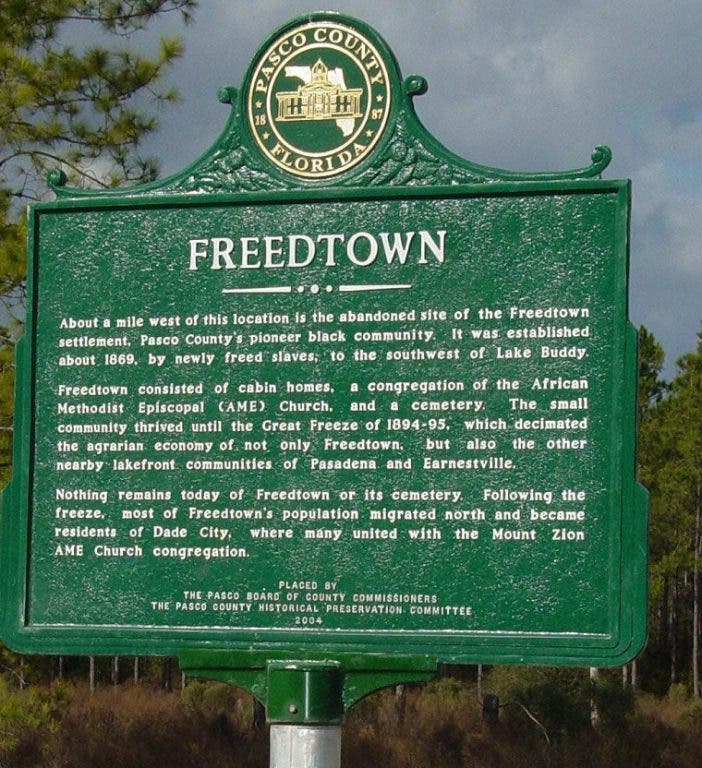
Proposed for future development, today nothing remains of the former Freedtown settlement, not even its cemetery.
Since 1976, February has been officially designated Black History Month — an annual celebration to recognize the achievements and central role of African- Americans in our history.
So, in recognition of this national celebration I'm kicking off a month-long, four-part series that explores some of the lesser known African-American history of Pasco County.
This week, we begin by delving into the life of pioneer resident Benjamin B. Baisden, whose work was instrumental in the advancement of one of Pasco County’s pioneer black communities — Freedtown.
Find out what's happening in New Port Richeyfor free with the latest updates from Patch.
Born in August 1835, like most African-Americans, Benjamin Baisden reportedly spent his early years in slavery and working the low country plantations in South Carolina.
However, according to “The History of Zephyrhills, 1821-1921”,
Find out what's happening in New Port Richeyfor free with the latest updates from Patch.
"Before the North had made slavery its emotional issue against the South, Wright Williamson had assisted Ben Baisden to win his freedom, and the white community had assisted him in settling land. One by one, a considerable colony of freedmen settled near."
And, it’s here where the story of Pasco’s pioneer black community begins.
According to records from the National Archives, by December 1866, Baisden and his family had made their way to eastern Pasco, where they settled about two miles south of Dade City, just south of the great Lake Buddy.
Here, Benjamin acquired the homestead claim to 80 acres, which already contained six small log cabins ready for occupancy.
And, while the Baisdens took residency in one cabin, it’s believed, based on census records, the other five dwellings were likely rented or occupied by other freedmen families, who found suitable work as farm laborers in the community.
By 1885, Benjamin Baisden had amassed 245 acres of property, which he utilized to engage in the citrus and livestock trade — a venture that was extremely profitable.
According to land records, affidavits, and tax records, we catch a glimpse into the size of Baisden's husbandry, with at least 20 acres in cultivation, another 60-plus acres planted with orange groves, and at least $500 worth of livestock that roamed a 20 acre pasture.
And, with the antecedents of this agrarian community in place, Baisden began the lay work of bringing religion and education to the other black families who lived and worked in the neighborhood.
The Baisdens were held in high regards among the white residents. According to the Dade City Banner, as early as 1872, with no African-American churches in the area, the family reportedly attended the nearby Prospect Methodist Church.
There, sitting on that back pew among the white people, Uncle Ben and Aunt Jane, as they were commonly called, not only fulfilled their spiritual needs, but they also received inspiration to become spiritually independent from their white counterparts.
According to “African-Americans on the Tampa Bay Frontier”,
"The African Methodist Episcopal Church's 'Tampa Bay Mission' sent ministers throughout the region for the purpose of setting up congregations.
By 1884, there had been a preaching circuit established for Hernando County, which included present day . This provided itinerant ministers for Hernando County on a regular basis."
And, with the numerous missions that followed, by 1892 growth necessitated the formation of the A.M.E. South Florida Conference.
According to the Jacksonville Evening Telegram and A.M.E. South Florida Conference minutes, in March 1892, the Dade City A.M.E. Mission was organized with Reverend John Tillman serving its congregation.
Four months later, on July 18, 1892, Benjamin Baisden was joined by his wife, Virginia Jane, in deeding one acre of their more than 200 to the church.
Situated at the heart of the community, this maneuver not only turned the itinerant stop and mission into a full fledged church, but it provided the first house of worship for the neighborhood’s black residents.
But, the one acre lot accommodated much more then a church — it also held a small cemetery, since black residents were not permitted burial in the white cemeteries.
And, this racial segregation was no different when it came to education.
Unlike the opportunities afforded to the Baisdens in attending the Prospect Church with white residents, the African American children of the community weren’t so fortunate in receiving a formal education.
By 1890, Freedtown’s need for an institution of learning commanded the formation of one Pasco County’s first African American schools — the Buddy Lake Colored School.
According to school board minutes, on September 1, 1890, church trustee and Freedtown resident Alec Brandon appeared before the Pasco County School Board to make a simple request — establish a school on the south side of Lake Buddy for colored children.
This petition truly displayed the merit of these pioneers in becoming equal. On motion a special school was granted with an allowance of $20 per month for teacher’s salary and Brandon was appointed to serve as the school’s first supervisor.
But, three years later, on October 9, 1893, Benjamin Baisden was appointed by the school board to serve the vacancy created by Brandon’s death.
However, like many communities throughout Florida, Freedtown quickly turned from a prosperous agrarian community to one that was wrought with despair as the decimated the community’s livelihood.
According to the history of the Mount Zion A.M.E. Church in Dade City,
"The settlement was abandoned after the Great Freeze of 1894-95, when most of the residents moved into Dade City. The members of the A.M.E Church at Freedtown later reorganized as the Mount Zion A.M.E. Church after their relocation to Dade City.”
While most residents migrated north to Dade City and others to Tampa, Benjamin and Virginia Baisden remained committed to their homestead. For more than 40-years the Baisdens called Pasco County home.
But, following the death of his wife of nearly 50 years, by 1907, the 72-year-old Benjamin moved to Tampa, perhaps to be closer to his son, Samuel Baisden, who had a small farm at the corners of Laurel and Roosevelt Streets.
There, he married to Grace Timmons Williams Patton — her fourth marriage.
By 1920, Charles Himmelwright and his son, Fred, had redeveloped Baisden's former property into one of the finest groves in the county and since that time these lands have been abundantly covered with groves.
Here, lost beneath the numerous planted trees, still lies Freedtown’s former cemetery — apparently planted over in the early 1940s.
In 1941, San Antonio resdient B.V. Lyons testified in an affidavit that he knew the location of the former African M.E. Church and that the site of the church was still easily discernible and ascertainable by reason of a cemetery which was located in the church yard.
Today’s owners, Evans Properties Inc., are looking to convert the land into the Pasadena Hills Subdivision.
As part of development, between December 2009 and February 2010, Panamerican Consultant Incorporated conducted an archeological and historical assessment of the site.
According to a 2010 letter to the Florida Division of Historic Resources, P.C.I. was unable to archeologically identify the historic cemetery beneath the agriculturally disturbed layers of soil.
While P.C.I. archeologist were unable to locate the cemetery, recommendation handed down by the company included preservation of the entire one acre A.M.E. church site and a 25-foot buffer to sufficiently ensure that human remains will not be impacted by future development.
An opinion given by Laura Kammerer of the Division of Historic Resources stated,
“In order to ensure that human remains will not be impacted by proposed development, ground penetrating radar should be employed to locate the cemetery prior to ground disturbance. The results of the investigation should be forwarded to our office for review and comment.”
When preserved, the former church lot and cemetery will be set aside as part of the new community’s “green and open space” as required by Pasco County as part of development.
Other recommendations included the placement of a historic marker on the former church lot and cemetery site-- perhaps a proper and fitting tribute to Baisdens laywork.
Although, we may never know who lies at rest in the historic Freedtown Cemetery.
Writers note: The name Freedtown is believed to be a modern term given to the community of freedmen who settled south of Lake Buddy. To date, the Freedtown name has not been found in historic records.